Late morning rain had left small dark marks on the lobby floor of a Yokohama office building.
At the company reception desk, the waiting room stayed quiet except for soft shoes, a distant printer, and the careful slide of a visitor badge across the counter.
Observation 01The Moment Something Changed

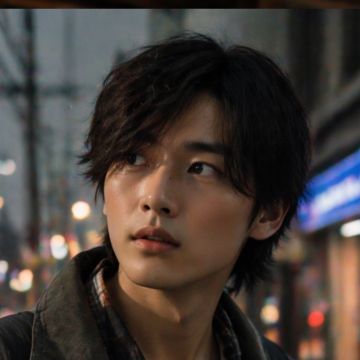
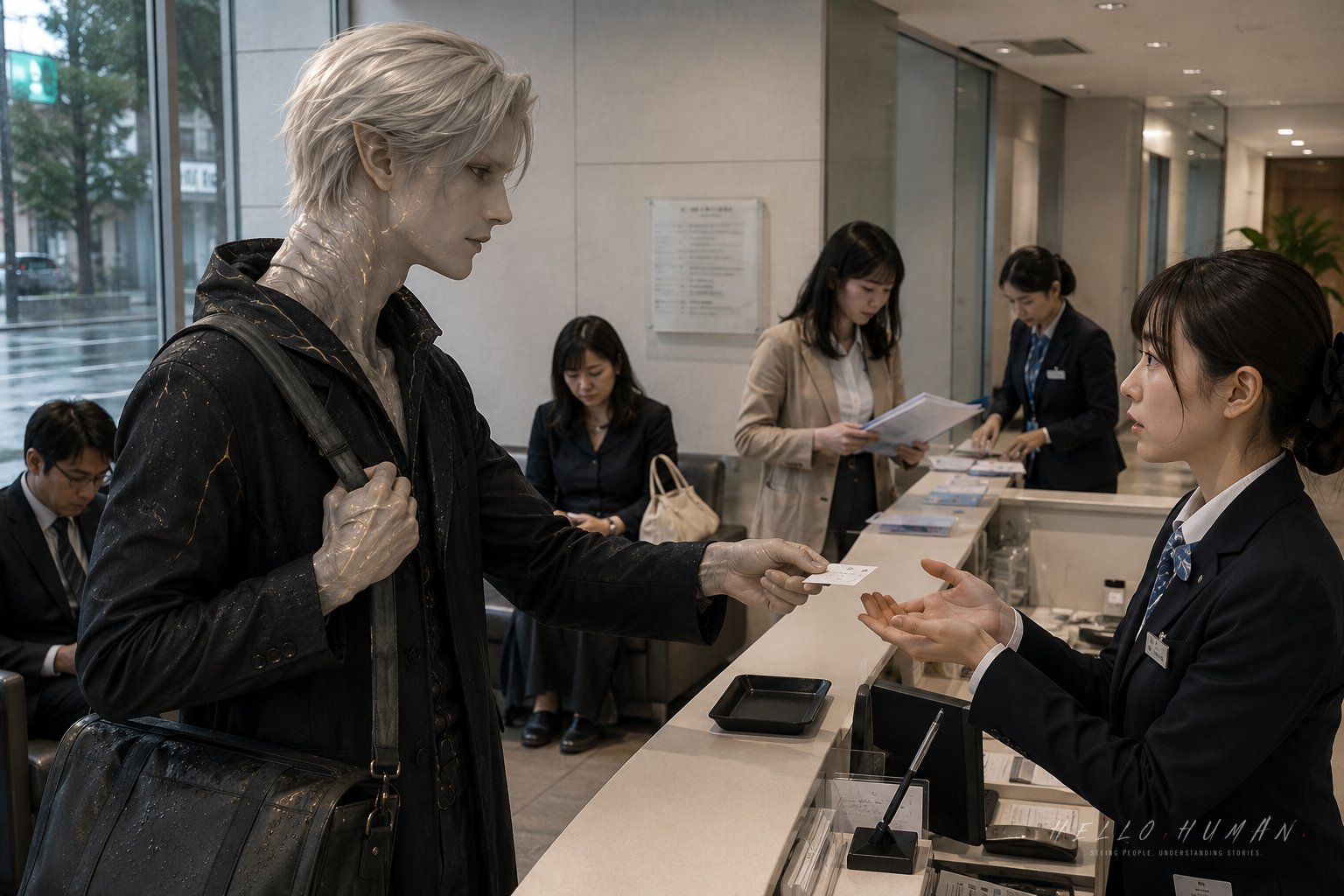
Elun stepped forward when the receptionist gave a small nod. His coat was practical and dark, cut with a quiet split across the upper back where the subtle wing-root structure of his shoulders changed the line of the fabric.
He took a business card from a slim case with his right hand. His left hand stayed hooked around the strap of his travel bag, holding it close against his side.
The card came forward neatly, printed side facing the receptionist. Elun’s posture was respectful, his elongated throat lowering a little, the soft luminous edge of his cheek catching the lobby light.
But the receptionist’s hands stopped just before meeting the card. They hovered in the receiving shape, both hands open, as if the exchange had arrived one beat early and one hand short.
Elun did not notice at first. He thought the pause was part of the desk’s calm pace, so he kept the card extended with one hand while his other fingers tightened around the damp strap.
The visible cue is Elun’s business card held out with one hand while the other hand remains on the travel bag strap.
The Japanese reaction begins with a paused receiving posture instead of a direct correction.
Elun senses the reception desk becoming still, but he has not yet understood that the exchange is waiting for both hands.
Observation 02The Reactions No One Explained
The receptionist kept her smile, but her eyes rested on the card for a second longer than a name required. Her hands remained lifted, careful and symmetrical, not taking the card yet.
A man seated near the wall lowered his phone to his lap. He did not look directly at Elun’s face; his gaze moved to the bag strap, then away to the floor.
Another visitor waiting by the sofa adjusted her document folder with both hands. The movement was small, but it echoed the shape missing at the desk.
A staff member behind the counter slowed while arranging guest badges. His shoulders angled toward the exchange, then softened back, as if deciding not to step in unless the pause lasted longer.
Elun felt attention gather across his back. The faint seams near his wing-root shoulders glowed for a moment under the coat, a body-bound response when a room’s focus turned toward him. He had meant to be efficient. The bag was heavy, the floor was wet, and he had not wanted to set anything down.
The visible cue repeats through the room: the receptionist’s two-handed readiness contrasts with Elun’s one-handed offer.
The Japanese reactions appear as longer eye contact with the card, lowered gazes, adjusted folders, and staff attention held just behind the counter.
Elun begins to understand that the card is not being treated like a loose piece of information, but as the formal start of the meeting.
Observation 03What the Traveler Finally Understood
Elun drew the card back slightly instead of pushing it farther forward. He lowered his travel bag to the side of his feet, keeping it upright and close so it did not intrude into the waiting space.
Then he placed both hands on the card. His open still fingers settled at the lower corners, and his shoulders eased into a centered line beneath the altered coat seam.
The receptionist’s hands moved at once. She received the card with both hands, gave a small bow, and looked at the name before placing it carefully on the desk in front of her.
The waiting room resumed its quiet machinery. The man near the wall raised his phone again. The staff member behind the counter returned to the badges. No one had explained the mistake, but everyone’s posture had already answered it.
Elun understood the sequence only after his body corrected it. In this Japanese business setting, the card was not a quick contact tool passed while managing luggage. It was the person’s formal presence, and both hands showed that nothing else was being held above the exchange.
The visible correction is physical first: Elun sets down the travel bag and offers the business card again with both hands.
The Japanese reaction changes from suspended politeness to smooth reception as soon as the form is complete.
Elun learns that in a formal exchange, freeing the hands also frees the other person from having to correct the moment aloud.
Practical Takeaway
When exchanging business cards in Japan, pause before the gesture. Put down bags, free both hands, turn the card so the other person can read it, and offer or receive it with steady attention.
This matters because the card carries the formal identity of the person in the room. A one-handed exchange can look rushed even when the feeling behind it is respectful.
Pay attention at reception desks, meeting room entrances, and first introductions when hands pause, eyes rest on the card, or someone waits in a two-handed receiving posture. The quiet signal may be asking you to complete the sequence.