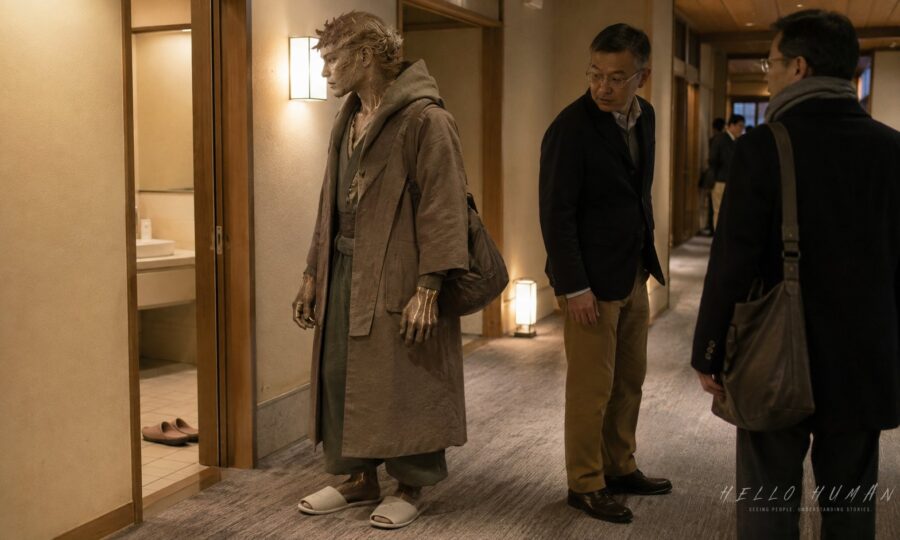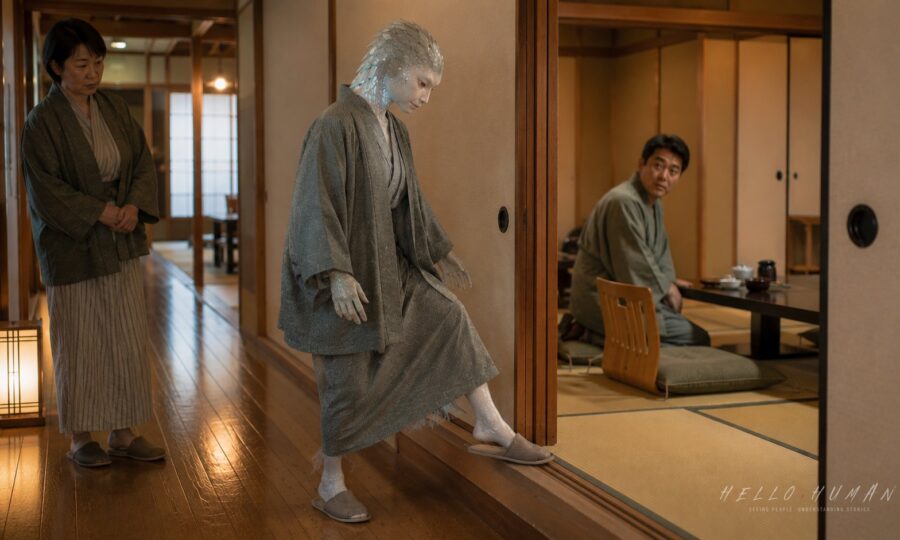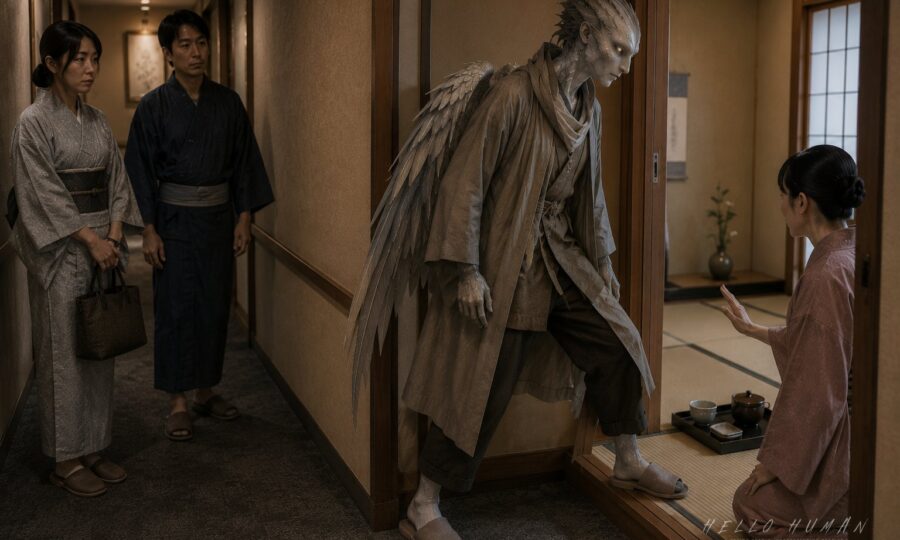
Rain tapped lightly against the guesthouse entrance in the cold afternoon. Umbrellas leaned in a narrow stand, and families packed bags near the shoe area with the careful quiet of people trying not to block the way.
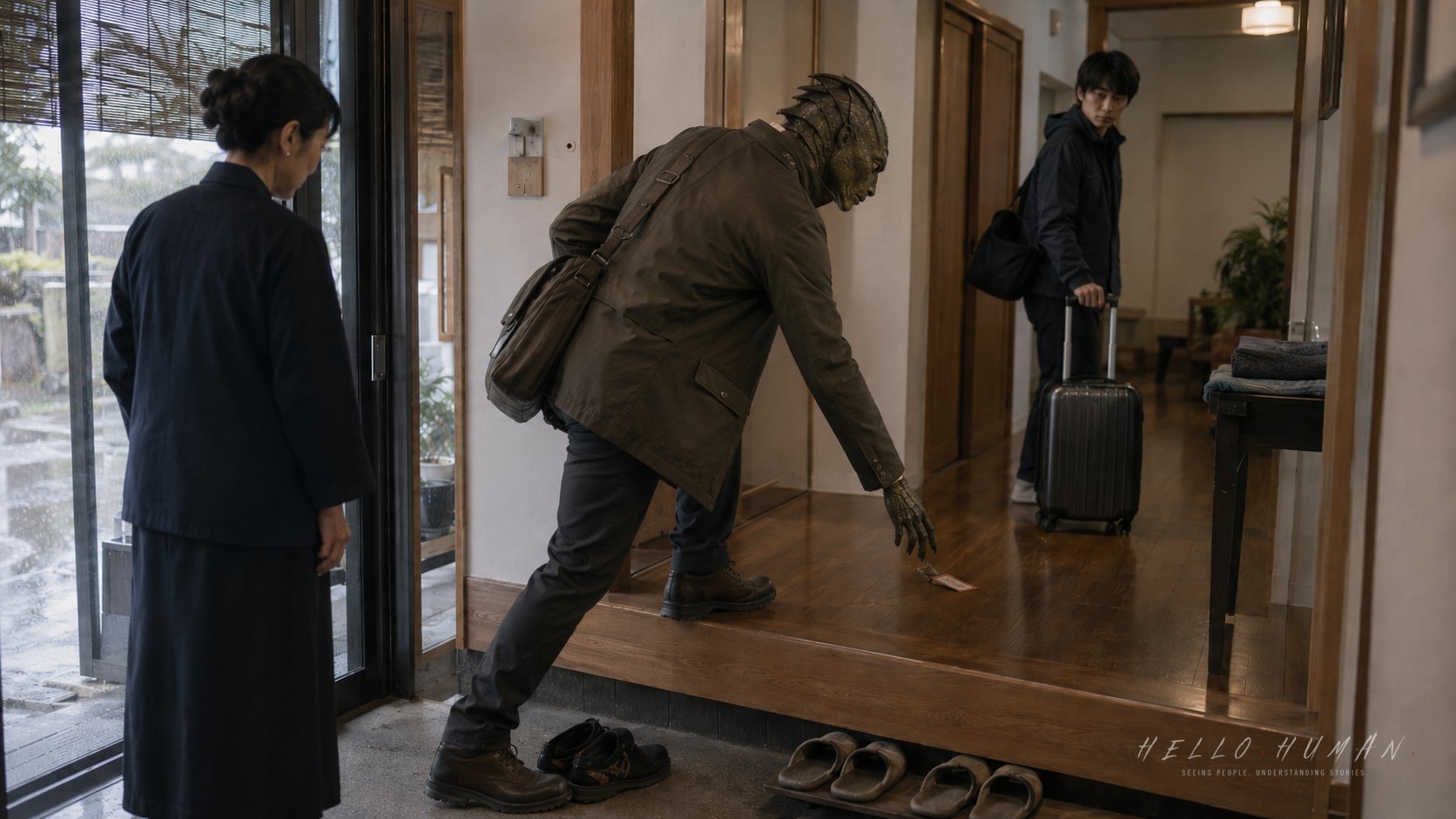
Seiro held a luggage tag between two long scale-joint fingers. The tag had slipped toward the raised hallway, so the bronze-green traveler stepped after it with outdoor shoes still on.
Observation 01The Moment Something Changed

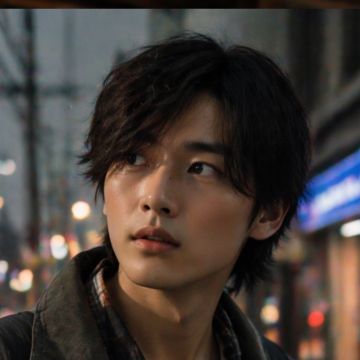
The guesthouse shared hallway was not wide. A low wooden step divided the entrance tiles from the raised floor, and the afternoon checkout flow moved around that line with soft, practiced adjustments.
Seiro had been sorting a satchel, umbrella sleeve, and luggage tag near the entrance. The offset shoulder sling sat clear of the clean cranial ridge and neck plates, its padded route keeping pressure away from the bronze-green scales.
When the luggage tag slid forward, Seiro followed it automatically. One outdoor shoe crossed the raised threshold, then the other, and the long fingers reached down toward the tag on the hallway side.
Another guest, a Japanese father carrying a child’s small backpack, slowed at the hallway edge. His hand stayed half-lifted, as if he had been about to pass through but could no longer tell where to step.
The staff member near the entrance did not call out. Her eyes dropped to Seiro’s shoes, then to the threshold, then to the slippers waiting beside the raised floor.
The visible cue was the raised threshold separating outdoor shoes from the guesthouse shared hallway.
The Japanese reaction began as a slowdown: a stopped guest, a lowered gaze, and a staff member looking toward the boundary instead of speaking first.
Seiro first noticed that the luggage tag was not the only object everyone was watching.
Observation 02The Reactions No One Explained
A woman beside a suitcase lowered her eyes to the floorboards, then shifted her bag back onto the entrance tiles. The wheels made one tiny sound before she stopped moving them.
The father at the hallway edge turned his shoulders slightly, creating space without entering it. His child looked down too, following the adult gaze to Seiro’s outdoor shoes on the raised wood.
Near the umbrella stand, an older guest placed one hand on a wall for balance and waited. A staff member touched the edge of a slipper with her toe, a small redirection that pointed to the system without turning it into a public correction.
The shared hallway held that quiet pressure. Nobody looked angry. Nobody laughed. The pause simply spread from person to person until the line between tile and raised floor felt more visible than any sign could have made it.
Seiro’s scale edges caught a muted copper light when the hand paused near the luggage tag. A low copper warmth showed at the cuff vent, contained by the widened fabric around the scale-pad fingers.
The visible cue was not only footwear, but the location of the footwear after crossing the raised threshold.
The Japanese reactions stayed indirect through lowered eyes, angled shoulders, stopped luggage, and a staff member quietly indicating the slippers.
Seiro began to understand that one step could shift the shared hallway from clean passage to disturbed boundary.
Observation 03What the Traveler Finally Understood
Seiro stopped reaching for the luggage tag. The long precise fingers lifted away from the hallway floor, and the heavier shoulder line settled back.
First came the physical correction. Seiro stepped down from the raised threshold to the entrance tiles, turned carefully, and removed the outdoor shoes before touching the hallway side again.
The father moved after that, quietly and without ceremony. The woman with the suitcase rolled her bag toward the exit. The staff member’s hand returned to the check-out papers, and the hallway resumed its afternoon rhythm.
The lesson arrived after the body had already corrected it. In a Japanese guesthouse, the raised threshold is not just a change in height. It marks a change in floor status, shoe status, and the way people protect a shared interior space together.
Seiro picked up the luggage tag from the correct side, then held it close to the satchel. The copper warmth at the cuff vent faded to a soft edge, and the traveler bowed once toward the staff member without making the pause larger.
The visible correction was stepping back down, removing outdoor shoes, and returning to the raised hallway only after the boundary was respected.
The Japanese reaction softened through resumed movement, released shoulders, and staff attention returning to ordinary checkout flow.
Seiro understood that the luggage tag mattered less than the line crossed while trying to retrieve it.
Practical Takeaway
At a guesthouse in Japan, pause at any raised threshold and check whether outdoor shoes should come off before stepping up. If luggage tags, bags, or papers drift onto the hallway side, correct your shoes first, then retrieve the item.
This matters because the threshold protects a shared interior space without needing much verbal explanation. Crossing it with outdoor shoes can make other guests slow down, reroute, or wait, even if your reason is practical.
Pay attention during checkout, rainy afternoons, family-heavy entrance areas, and any moment when luggage makes you hurry. If eyes drop toward your feet or someone slows at the hallway edge, the boundary is probably the signal.
More Observations
A realistic editorial still from the article’s central scene in a Japanese guesthouse shared hallway during a cold rainy-season afternoon checkout flow, framed as an eye-line reaction triangle between the traveler, another guest at the hallway edge, and a staff member near the entrance. Seiro, a refined humanoid Scale-ridge traveler, is crossing the raised threshold with outdoor shoes while reaching toward a luggage tag near the guesthouse shared hallway, causing another Japanese guest to slow at the hallway edge. Seiro is humanlike but not fully human, a public-space-compatible draconic humanoid: clean cranial ridge integrated into the skull rather than a costume feature, subtle jaw and neck scale plates without a monster snout, long precise fingers with scale-joint knuckles, grounded slightly heavier shoulder posture, deep bronze-green body palette with warm scale-brown and muted copper undertones. The scale edges catch a low localized copper warmth at the cuff vent when the hand pauses, a natural body-bound glow, not LED, not magic, not a gadget. Clothing is clean travel-ready and anatomy-fit, with a friction-soft collar lining below the neck ridge, widened cuffs around scale-pad fingers, matte ceramic-coated canvas, muted copper fasteners, and an offset shoulder sling with a padded route clear of the cranial and neck ridge. The central visual mistake is readable: outdoor shoes have crossed onto the raised hallway while the luggage tag lies just beyond the threshold. Nearby Japanese reactions are subtle and indirect: one guest slows at the hallway edge, eyes drop toward the shoes, shoulders angle away, a suitcase hand pauses, a staff member quietly looks from the shoes to the slippers. Documentary editorial photography, realistic indoor natural light, rain-muted entrance atmosphere, no readable text, no logos, no posters, no signs, no phone UI, no brand names, no anime style, no fantasy illustration, no centered hero portrait, no fashion pose, no dragon warrior, no armor, no wings, no monster snout, no lizard beast, no superhero styling.
Describe the visitor as a true resident of another civilization, a refined humanoid traveler who is humanlike but not fully human and not a modified human with fantasy add-ons. The traveler species must remain the selected species from HH_SEED when provided; do not replace it with a generic refined humanoid, elf-like traveler, plantlike visitor, or unrelated species, and preserve its body logic plus at least three species-specific proof zones. When the selected species is wood-, bark-, cedar-, plant-, mineral-, textile-, glass-, metal-, paper-, or other material-based, interpret it as refined body logic rather than a monster or fantasy creature; keep the face calm and socially believable, the head silhouette clean rather than spiky or crown-like, material surfaces refined rather than rough armor, and hands dexterous rather than claws, roots, or talons. Maintain a distinct body palette for the selected species; do not default to pale white, ivory, ash-gray, linen beige, or near-monochrome body tones unless the species explicitly requires it, and keep the body palette visually separate from clothing so the species identity remains readable. Root archetype traits must be integrated into anatomy, not added as accessory-like ears, horns, wings, tails, scales, fangs, or glow. The traveler must not read as a normal human with one symbolic fantasy feature attached. Do not limit species-adaptive wear to fit. Clothing, bags, straps, pouches, footwear, fasteners, and small carried items should function as quiet everyday containment or regulation tools, helping carry, soften, stabilize, vent, buffer, conceal, or guide selected-species heat, light, moisture, growth, resonance, particles, or material traits in human public spaces. The final prompt must name one or two camera-readable containment features tied to the selected body logic, such as a split collar around a neck fin, moisture-safe strap route, heat-diffusing bag panel, growth-guiding stitched edge, widened cuff, glow-softening lining, stabilizing fastener, light-buffering pocket, or pressure-diffusing strap geometry. If a bag, pouch, backpack, tote, satchel, document case, strap, or carried item appears, at least one camera-facing species-containment proof detail must be visible in its routing, opening, lining, seam, vent, hardware, material family, surface behavior, or subtle leakage sign; a generic ordinary bag is insufficient. The feature must be readable without zooming and not hidden by shadow, crop, pose, table, outer clothing, or sleeve overlap. Keep it practical, ordinary, non-weaponized, non-magical, non-costume-like, and secondary to the body; never weapons, armor, battle gear, ritual props, cosplay, tokusatsu props, superhero equipment, decorative-only motifs, or the source of body-bound glow. Any leakage sign must remain subtle daily evidence, not spectacle. Keep the visitor clean, dignified, approachable, quietly strange, slightly future-facing, and socially believable in real Japan. Build from body logic first, not from a human base; body, clothing, carried objects, posture, material, and glow should feel evolved from the same civilization. Include at least three visible non-human proof zones at a glance, such as silhouette, hands, neck/face structure, surface material continuity, localized body-bound glow, clothing-body integration, posture, or carried-object logic. Ears, skin color, hand color, face markings, hair/eye color, or glow alone are not enough. Avoid a normal attractive human, elf hero, fashion model, cosplayer, ordinary tourist, insect monster, dirty creature, horror figure, tokusatsu villain, rubber suit, mascot, toy, superhero costume, or fashion advertisement. Non-human traits and the localized glow must look biological or naturally part of the body, not accessories, makeup, prosthetics, gadget lights, LED props, glowing tattoos, costume parts, armor details, or decorative fashion gimmicks. Include one subtle but visible localized body-bound glow as a natural body trait, never LED, gadget, armor light, tattoo, or makeup. Good locations include eyes, ear edge, collarbone, throat, wrist, fingertips, hair material, or neck transition; no magical aura, scene-wide glow, neon overload, or cyberpunk armor light. Keep the face approachable but slightly otherworldly, with believable humanoid proportions, refined skin or material depth, pleasant unusual eyes, soft asymmetry, and no compound eyes, mouthparts, sharp teeth, corpse face, hollow eyes, or horror mask look. Use clean travel-ready layered clothing that physically fits the visitor’s anatomy; sleeve-to-arm transitions look integrated rather than costume-like, and any shoulder strap naturally fits the unusual torso. Clothing, footwear, bags, straps, hats, scarves, umbrellas, and travel items must physically fit the visitor’s anatomy without clipping through ears, horns, wings, tails, shoulders, hair, feet, or luminous features. Use gentle shadowed torso contour, soft interior dusk tone, or collarbone-like luminous line; avoid skeletal, corpse-like, horror hollow, exposed-rib, or frightening torso-void interpretations. Authentic public markings such as a correct Japanese road marking may appear only when necessary for realism; no fake, garbled, invented, decorative, or mistranslated text, and no invented readable shop names, station names, product labels, menus, posters, brand logos, phone UI, ticket text, or map text. If text cannot be rendered accurately, keep it blurred, cropped, distant, worn, angled, or unreadable. When products, packages, sealed goods, menus, posters, notices, non-essential signs, or retail displays appear, avoid both plain blank white surfaces and crisp fake print. Use non-readable package-like structure such as subtle color bands, blank label panels, pastel backing cards, transparent sleeves, silver backs, folded plastic reflections, soft gradients, non-text divider lines, low-detail print areas, or small color tabs. Keep any print or imagery unreadable and unrecognizable through glare, soft blur, reflections, distance, shallow depth of field, or low-detail printing; no pseudo-Japanese, pseudo-English, random glyphs, readable letters, logos, brands, mascots, faces, character art or silhouettes, barcode-like detail, woodgrain, leather texture, or unrelated material patterns. This does not remove the text policy exception for an accurate public marking when it is necessary to the scene. The editorial Japanese setting, subtle human hesitation, and central social mistake must remain readable at a glance; do not turn the image into a character portrait.
[/IMAGE_PROMPT_BLOCK]