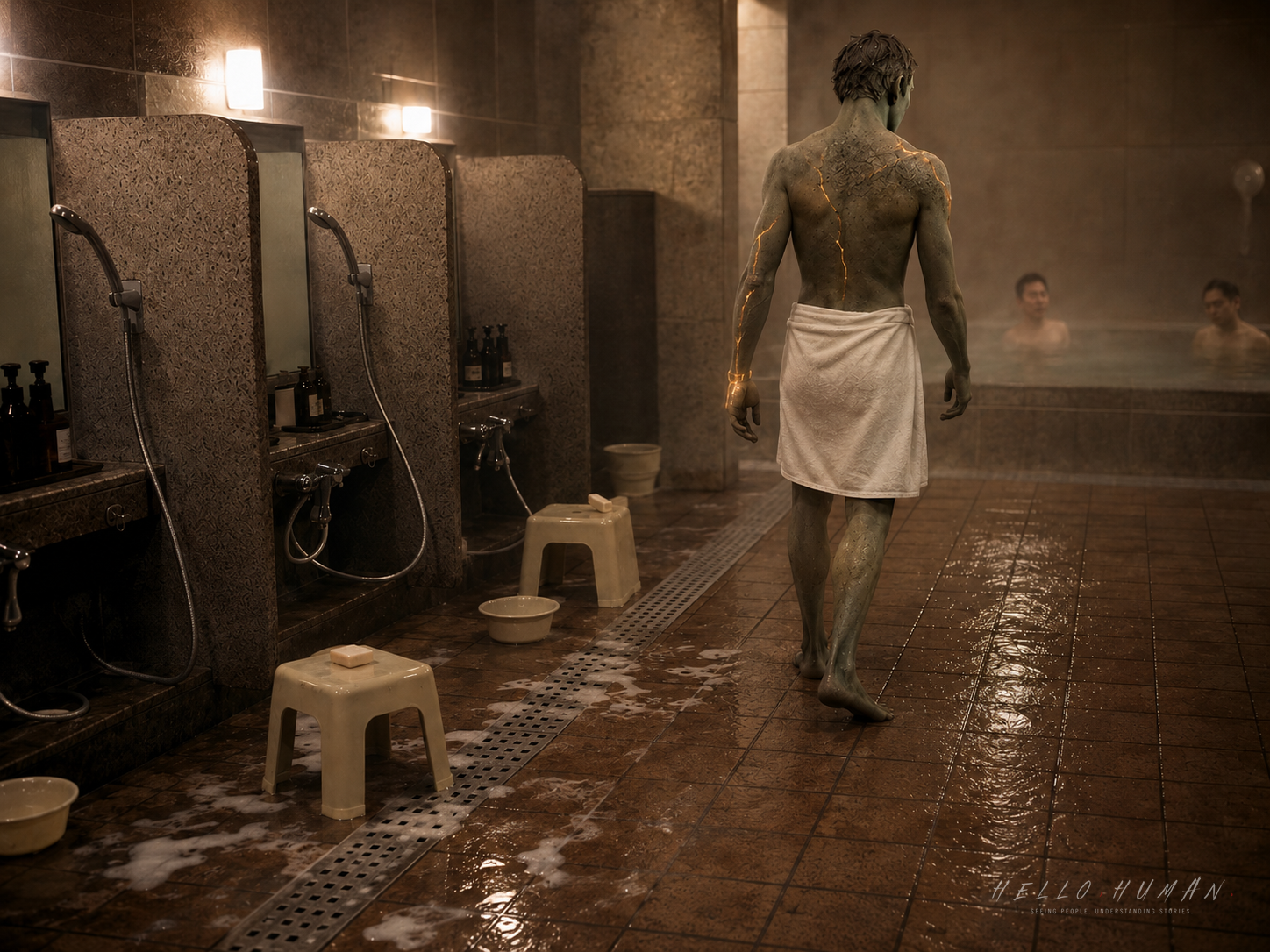
The hotel bath in Osaka was almost empty, but not silent. Water tapped into plastic bowls, shower hoses brushed tile, and the last-train rush lived quietly in the shoulders of everyone trying to finish before sleep.
Iro sat on a low stool near the wall, moss-green brow ridges darkened by steam, the soft amber line at one wrist glowing only where warm water touched it.
Observation 01The Moment Something Changed

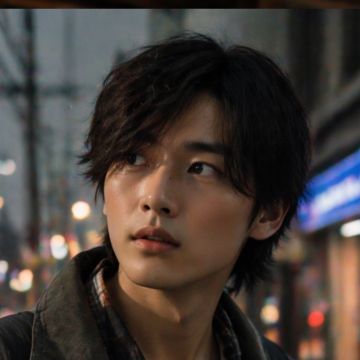
Iro had watched the others briefly, but he had watched the destination more than the process. The bath itself looked like the main place for cleaning, a long rectangle of still water under pale indoor light.
He soaped his shoulders and arms carefully, moving around the raised lichen patches that grew into his brow bones and along one temple. His clean travel clothes were folded in the basket outside; here, his unusual body looked quiet, not theatrical, just a little more mineral and forested than human skin.
Then he rinsed fast. Water passed over his chest, his arms, his knees. A thin trace of foam slid from the stool toward the drain as he set the shower head back and began to stand.
One seated Japanese bather beside him did not speak. He only turned his own shower head downward, away from the open space, and held it there. Another man’s hand paused above his wash bowl, fingers still under the running water.
Iro took one careful step toward the shared bath. Behind him, the wash-stool area lost its ordinary rhythm.
The visible cue was not a dramatic mess, only a quick rinse, a damp stool, and a faint line of foam still moving toward the drain.
The Japanese reaction arrived through reduced motion: a shower head angled down, a hand stopping, water sounds becoming smaller.
Iro did not yet understand the routine, but he understood that his movement toward the bath had changed the room.
Observation 02The Reactions No One Explained
The man nearest the bath lowered his eyes to the water surface, then looked once toward Iro’s stool. The look did not stay long enough to become accusation. It moved like a small pointer and disappeared.
A second bather shifted his knees inward on his stool, making his body narrower. His shoulders angled away from the bath entrance, as if leaving more room for a decision that had not yet been made.
Near the far wall, an older man rinsing his towel slowed down. He squeezed the cloth once, held it over his bowl, and waited instead of entering the bath. His gaze stayed on the tile between Iro and the shared water.
The staff member who had come in to check the buckets did not approach. He glanced at the wash area, then at the bath, then lowered his voice to a soft phrase for another guest. The words were ordinary, but the volume had changed.
Iro felt the silence before he could name it. His lichen brow, already dim in the indoor steam, tightened slightly above his eyes. He had not meant to make anyone hesitate; he had only mistaken the bath as the place where washing would continue.
The cue repeated in several bodies: eyes moving to the stool, shoulders turning away, a towel held in mid-task.
The Japanese bathers avoided direct correction, but their pauses protected the shared water without embarrassing the visitor openly.
Iro began to read the quiet as coordination, not rejection.
Observation 03What the Traveler Finally Understood
Iro stopped with one foot still dry at the edge of the bath area. He looked back at the stool, then at the last threads of soap near the drain.
He returned without speaking. He sat again, picked up the shower head with both hands, and rinsed the stool first. Then he rinsed the bowl, his feet, his knees, the underside of his arms, and the small grooves beside his lichen-browed temples where soap could hide.
The movement was slower now. Not anxious, not performative. Just complete.
The room began to loosen. The nearest bather lifted his shower head again. The older man at the far wall rinsed his towel and entered the bath before Iro, settling into the water with his eyes lowered.
Only after that did Iro understand the shape of the rule. In this hotel bath, the shared water was not the place to become clean. It was the place everyone entered after making themselves clean enough not to change it for others.
The correction was physical and visible: Iro returned to the stool, rinsed the surrounding tools, and washed again before approaching the bath.
The Japanese reaction softened only after the shared-water routine became readable to everyone in the room.
Iro learned that the quiet pause was not about shame; it was a request to protect what everyone would share.
Practical Takeaway
In a Japanese public bath or hotel bath, sit at the washing area first, wash thoroughly, and rinse your body, stool, bowl, and surrounding soap traces before entering the shared bath. Treat the bath itself as soaking water, not as the main washing step.
This matters socially because the water is shared by people who may never speak to each other. Cleanliness is shown through preparation, and everyone watches the routine lightly so no one has to give a direct correction.
Pay attention when nearby hands pause, shower heads turn down, voices drop, or people delay entering after you move. Those small changes may be the room asking you to finish one step before joining the shared space.