The last train had already gone quiet behind the station when Roka reached the small guesthouse in Kyoto, rain beads darkening the stone tiles at the entrance.
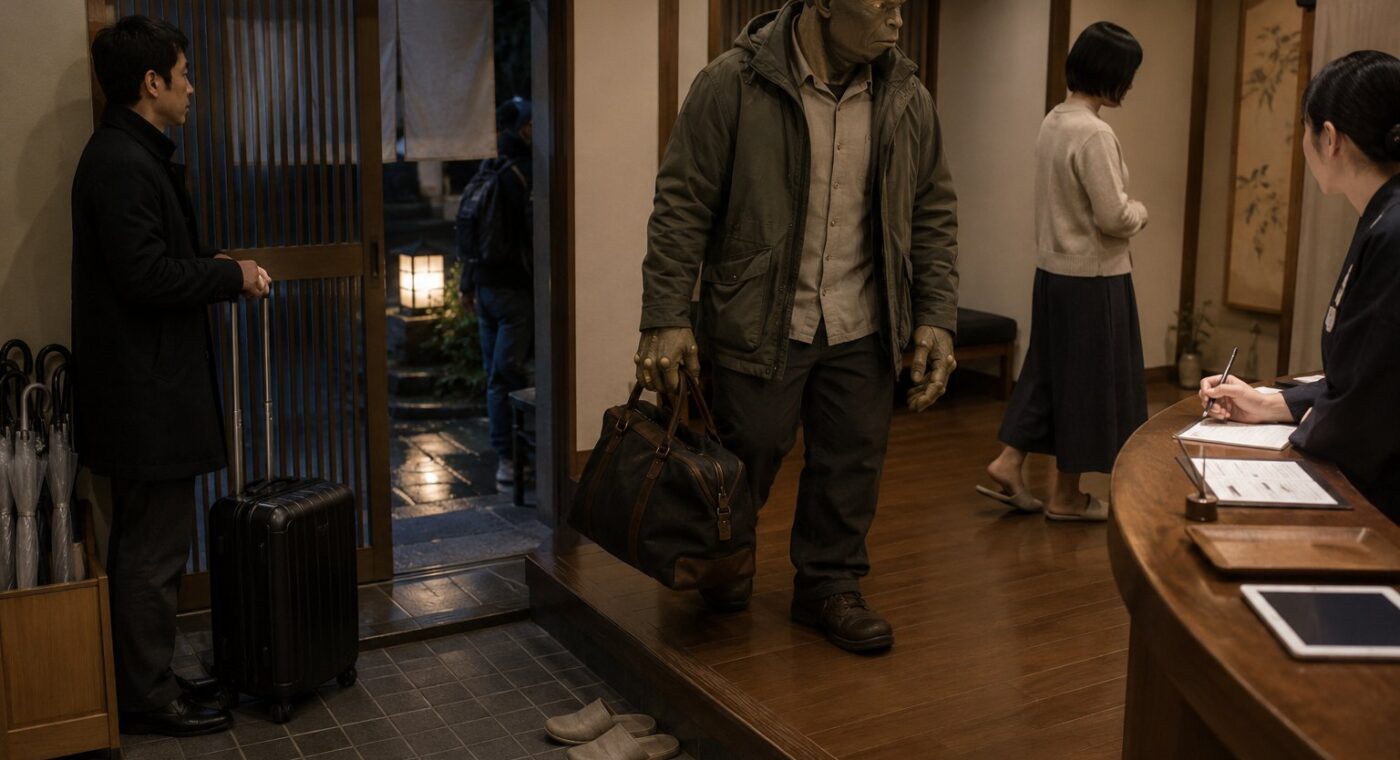
Inside, a row of slippers waited below a raised wooden hallway, and several Japanese guests were moving through the entryway without saying much.
Observation 01The Moment Something Changed

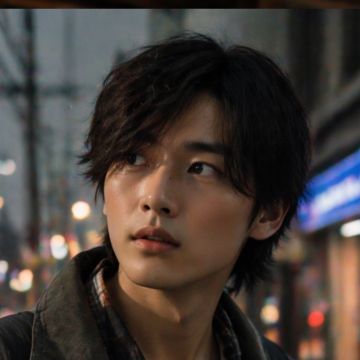
Roka paused on the entry tiles with his overnight bag held low against one broad palm. His small brow hornlets caught the ceiling light softly, and the ochre seams across his knuckles gave off a faint, body-bound warmth that faded as he looked around.
The guesthouse entryway was narrow. A suitcase stood near the wall, two umbrellas leaned in a stand, and the slipper shelf left just enough room for one person to change footwear without making the next person wait.
Roka saw the raised wooden hallway, saw the slippers, and saw a woman ahead of him already walking toward the rooms. He missed the moment when she had removed her shoes. Still wearing his damp outdoor shoes, he stepped up from the tile onto the wood.
The change was small but immediate. A man behind him stopped with one hand still on his suitcase handle. The front-desk staff member’s fingers paused above a check-in form. The woman in the hallway turned her shoulders slightly sideways, not enough to face him, only enough to mark the place where his shoes now stood.
Roka did not hear a warning. No one said “stop.” The guesthouse stayed quiet, but the quiet became arranged around his feet.
The visible cue was the raised wooden floor after the entry tiles, with slippers placed at the boundary.
The Japanese reaction appeared through stopped hands, angled shoulders, and attention moving toward the traveler’s shoes.
Roka started to feel that the problem was not his arrival, but the line he had crossed without noticing it.
Observation 02The Reactions No One Explained
The man with the suitcase did not step up behind Roka. He stayed on the tile and shifted his bag closer to his knees, making his body smaller in a space that was already small.
The front-desk staff member lowered her gaze to the row of slippers, then back to the form. Her voice softened when she spoke to the next guest, as if keeping the room from hardening around the mistake.
A younger Japanese guest arriving from outside opened the door, noticed the pause, and stopped before the tile became crowded. He looked once at Roka’s shoes, once at the raised hallway, then bent to loosen his own laces very carefully.
The woman already in the hallway moved her toes inward inside her slippers and took one half-step away from the center of the corridor. She did not glare. Her shoulders simply made a narrow passage that avoided the spot where Roka’s outdoor shoes had touched the wood.
Only after those small changes did Roka understand that everyone was responding to the same thing. His wide palms lowered a little more. The ochre seams at his knuckles dulled, as if his body had absorbed the lowered eyes around him.
The visible cue repeated through feet: shoes on tile, slippers on wood, and one pair of outdoor shoes in the wrong zone.
The Japanese guests protected the shared space through hesitation, spacing, quiet sidesteps, and lowered voices instead of direct complaint.
Roka began to read the room as a sequence of physical permissions, not a place where silence meant everything was acceptable.
Observation 03What the Traveler Finally Understood
Roka stepped backward carefully, one foot at a time, from the raised hallway down to the entry tiles. He did it slowly, keeping his shoulders rounded and his palms visible, so no one had to move suddenly for him.
Then he bent low. His compact frame made the motion look deliberate rather than hurried. He removed his outdoor shoes on the tile, turned them neatly toward the door, and placed his feet into the guesthouse slippers waiting below the step.
The front-desk staff member resumed writing. The man behind him released the suitcase handle and moved forward. The younger guest finished untying his laces. The hallway did not become cheerful; it simply began moving again.
Roka looked once more at the boundary. The difference was not only cleanliness, although that mattered. In this shared Japanese lodging space, the step marked a change from outside movement to inside care. Crossing it correctly let everyone else trust the hallway, the floor, and the rhythm of arrival.
When Roka bowed his head slightly, no one made a scene of accepting it. The woman in the hallway gave him just enough space to pass, and that was the reply.
The correction was physical first: stepping back to the tile, removing outdoor shoes, aligning them, and changing into slippers before returning to the raised floor.
The Japanese response softened through resumed hands, released luggage, and the restored movement of people through the entryway.
Roka understood that some boundaries in Japan are not announced loudly because the space itself, and the people around it, are already giving the instruction.
Practical Takeaway
At a guesthouse, hotel room entrance, restaurant shoe area, or shared lodging hallway in Japan, pause before stepping onto a raised floor. Look for slippers, shoe shelves, tile-to-wood changes, and the direction of other people’s feet before crossing the boundary.
This matters socially because the entryway is shared by everyone arriving after you. Changing footwear at the right place protects the clean interior space and keeps other guests from having to signal discomfort indirectly.
Pay special attention when you are tired, carrying luggage, arriving late at night, or following someone ahead of you. Those are the moments when the boundary is easy to miss because the room stays quiet even when people have already noticed.