The reception desk was quiet enough to hear the soft click of the card tray returning to its square position.
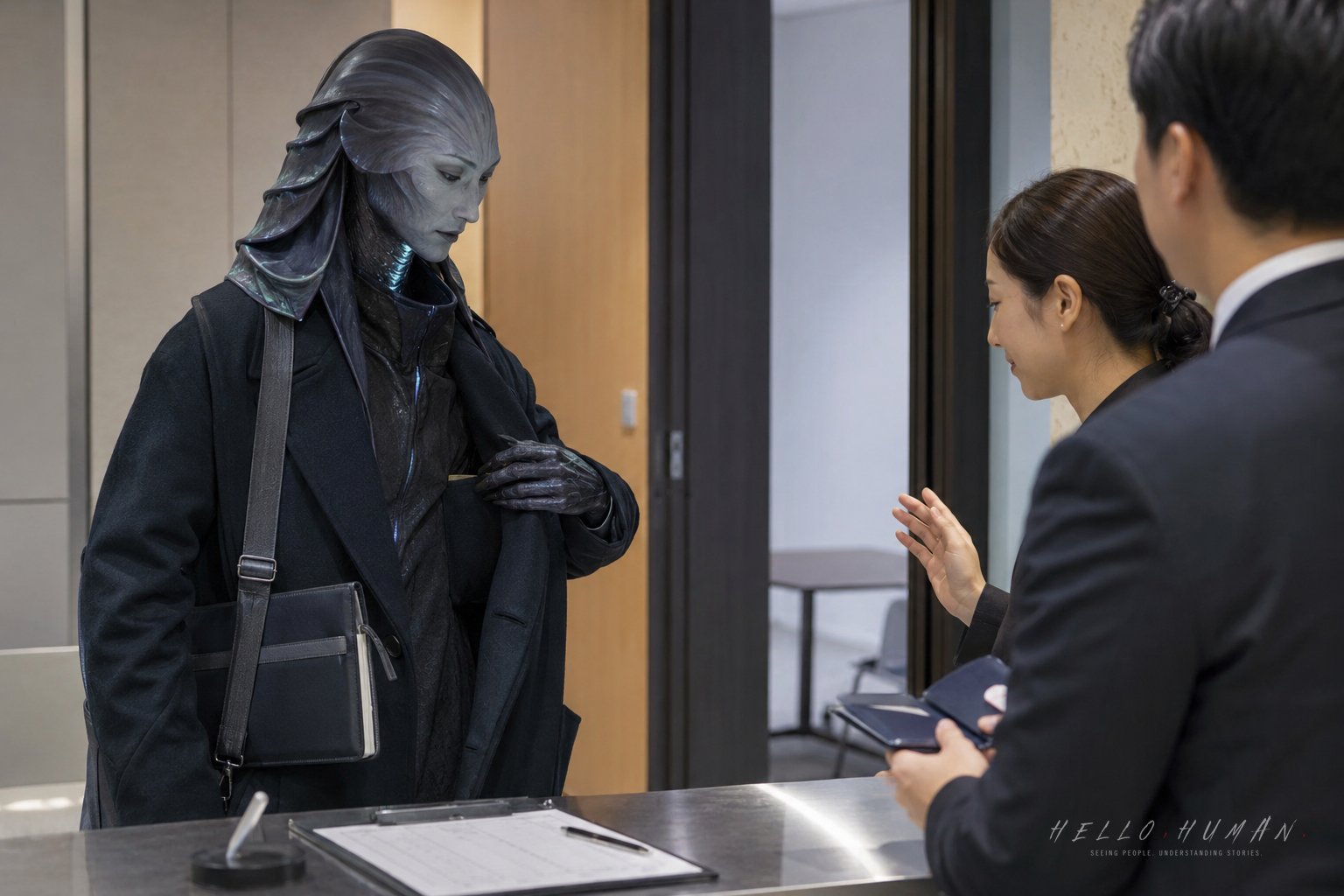
Outside a glass meeting room in Osaka, Naru bowed with both hands extended, the new business card resting across many-jointed fingers for only a moment.
Observation 01The Moment Something Changed

Naru had arrived early for the late-morning appointment, careful not to let the structured book sling brush against the desk. The sling sat low across his torso, routed clear of the soft mantle folds at his neck, its deep ink canvas fastener showing only a subdued sheen where his body’s quiet resonance met the lining.
The receptionist stood and offered her card with both hands. Her name, company, and department faced him. Naru accepted it with equal care, his blue-black fingers closing delicately along the edges, the low silver edge light near his throat steady and small.
For a few seconds, everything matched the rhythm of the room. Bow, name, company, a quiet confirmation. Then Naru, wanting his hands free before greeting the manager, slid the card into the inside pocket of his coat.
The action was smooth, almost elegant. It was also early. The card vanished before the receptionist had fully lowered her hands, before the manager beside her had completed his own bow, before the small professional group had finished recognizing one another.
The receptionist’s smile stayed in place. But her eyes moved to the pocket. The manager’s right hand, already reaching toward his own card case, paused in the air for half a breath.
The visible cue was not loud: a received business card went from both hands to a coat pocket while the exchange was still unfolding.
The Japanese reaction came through timing, not words: a held smile, a paused hand, and attention settling briefly on the place where the card disappeared.
Naru first sensed that the room had not rejected him, but it had slowed around one small movement.
Observation 02The Reactions No One Explained
The receptionist did not ask for the card to be taken out again. She adjusted the card tray by a few millimeters and lowered her eyes to the visitor badge form, though the form had already been completed.
The manager beside her brought his own card case closer to his chest instead of opening it immediately. His shoulders angled slightly toward the meeting room door, as if creating a new route for the next step.
A younger employee waiting behind him shifted her document folder from one arm to the other. She looked at Naru’s pocket, then at the tabletop, then down at her own card case without speaking.
The receptionist’s voice softened when she gave the next instruction. “This way, please,” she said, and the words were ordinary. The quiet around them was less ordinary.
Naru followed, but his mantle folds settled closer to his collar. In his own cities, a presented name-token was memorized, secured, and protected quickly. Pocketing it meant attention, not dismissal. His many-jointed fingers curled near the empty place where the card had been.
At the meeting room threshold, the manager opened the door and waited. On the table inside, three card cases were already placed neatly beside notebooks. No one had started the meeting, but the surface looked prepared for names to remain visible.
The visible cue repeated in the room: Japanese staff kept their own card cases and cards in sight, close to notebooks and aligned with the meeting space.
The reactions stayed indirect: lowered eyes, a delayed card-case opening, a folder shift, and a softer voice all pointed toward the same missing object.
Naru began to understand that the card had not simply been received; it was still participating in the introduction.
Observation 03What the Traveler Finally Understood
Naru stopped just inside the meeting room. He did not apologize loudly or make a display of confusion. He touched the edge of his coat pocket, felt the card there, and drew it out with both hands.
The card returned to the open air. He placed it on the table in front of him, straightened it once with the careful pads of his fingers, and kept his book sling tucked close so it would not cross the tabletop. The subdued ink sheen near his fastener faded as his mantle folds loosened.
The receptionist noticed first. Her shoulders eased, and her eyes returned to his face. The manager opened his own card case and continued the exchange, placing his card so the printed side faced Naru.
Only after the physical correction did the meaning become clear. In this setting, the business card was not just a container for contact information. For the first minutes of the meeting, it stood in for the person’s name, role, and formal presence.
Putting it away immediately had made practical sense to Naru, but in the Japanese room it looked as if the person had been filed away before the relationship had begun. Keeping the card visible allowed everyone to continue the exchange without forcing a direct correction.
The visible correction was simple: the card came back out, was handled with both hands, and stayed on the table where others could see it.
The Japanese response shifted just as quietly: shoulders relaxed, card cases reopened, and the meeting rhythm returned without anyone naming the problem.
Naru understood that some objects in Japan carry the timing of respect, not only the information printed on them.
Practical Takeaway
When you receive a business card in Japan, hold it carefully with both hands, look at it briefly, and keep it visible during the first part of the exchange or meeting. Place it neatly on the table in front of you instead of pocketing it immediately.
This matters socially because the card is treated as part of the introduction. Handling it gently gives the other person’s name, position, and role a visible place in the room while everyone settles into the relationship.
Pay attention whenever the atmosphere is formal but quiet: reception desks, meeting rooms, company visits, public offices, and first greetings. If Japanese people glance at an object instead of correcting you, the object may be carrying the signal.