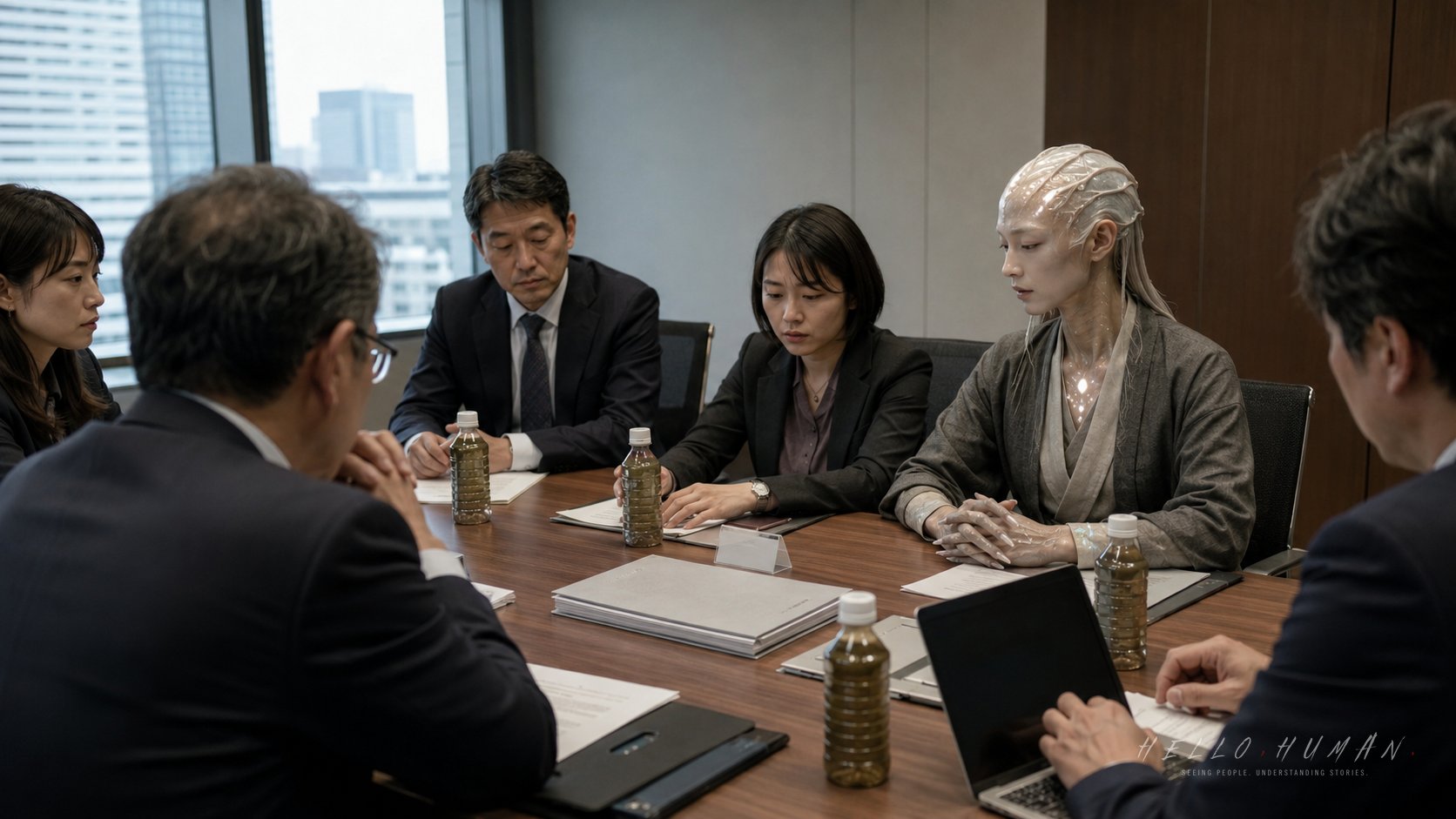
The client meeting room in Yokohama was warm from the noon sun, though everyone still wore their winter jackets neatly over chair backs.
On the long table, tea bottles, name cards, and slim folders formed a careful row until Sera added one more packet to the center.
Observation 01The Moment Something Changed


Sera had prepared the proposal carefully. The pages were clipped in pearl-gray covers, each one marked with neat tabs that matched the small luminous points under their collarbone. Their layered neck structure tilted forward with quiet concentration as they set the packet down.
The coordinator from the Japanese side, Ms. Hayashi, had been arranging the agenda beside her notebook. Her hand stopped above the first page. Not for long, only a second, but the pause reached the people beside her before any words did.
Sera did not notice at first. They thought the new proposal would feel helpful because everyone could see the latest idea at the same time. Their temples held a soft pearl depth, and when several eyes moved away from them toward the table, the light near their collarbone seemed to gather closer to the body.
The packet sat where the shared agenda had been. It did not block a doorway or a seat, but it occupied the invisible path of the meeting. The conversation had been moving from greeting to confirmation, and now the room had to step around something no one had prepared to receive.
The visible cue was small: a new proposal packet placed in the center before the coordinator had introduced it.
The Japanese reaction began with paused hands and eyes shifting toward the person responsible for the meeting order.
Sera started with confidence, not realizing the object had arrived before the room was ready for it.
Observation 02The Reactions No One Explained
Ms. Hayashi lowered her eyes to the packet, then to the printed agenda in front of her. She did not move the proposal away. Instead, she aligned the agenda corner with her notebook, making the old order visible again without touching Sera’s pages.
A senior client on the far side of the table angled his shoulders toward Hayashi, not toward Sera. His pen remained capped. Another person slid his tea bottle a few centimeters inward, clearing space near the agenda as if the table itself needed a route back to the planned sequence.
The youngest staff member, who had been ready to take notes, opened her laptop halfway and then stopped. Her gaze moved from the packet to Hayashi’s face. When Sera began to explain the strongest point of the proposal, the staff member’s fingers rested still above the keyboard.
One of Sera’s colleagues gave a small breath through the nose and looked down at the copy he had never seen. He did not correct Sera. He simply placed his own folder slightly behind the shared agenda, a quiet sign that the official line of the meeting still belonged there.
Only after these shifts did Sera feel the difference. The room was not rejecting the idea. It was not yet holding it. The proposal had entered as content, but the Japanese meeting was still asking a prior question: who has aligned this, and where does it belong in today’s order?
The visible cue was the table reorganizing around the original agenda without anyone openly removing the new packet.
The Japanese reactions stayed indirect: lowered eyes, capped pens, angled shoulders, a paused laptop, and small adjustments in table space.
Sera began to understand that silence here was not empty; it was measuring whether the proposal had a proper route into the room.
Observation 03What the Traveler Finally Understood
Sera stopped speaking before the next slide of their explanation. With both long, smooth-fingered hands, they lifted the proposal packet from the center of the table and placed it beside their own notebook instead of the shared agenda.
Then they turned slightly toward Hayashi. “I should have sent this first,” they said, keeping their voice low. The words were simple, but the correction had already happened physically. The table’s center was open again.
Hayashi’s hand resumed moving. She touched the agenda, then looked to the client side. “Perhaps we confirm today’s points first,” she said. Her tone did not punish Sera. It gave the room a way to continue without making the mistake the main subject.
The pearl light under Sera’s collarbone settled into small points. They kept the packet closed. When the meeting reached the final agenda item, Hayashi mentioned that there was “one additional idea for later review,” and only then did Sera slide one copy toward her, not across the whole table.
What Sera learned was not that new ideas were unwelcome in Japan. The issue was timing and route. In this client meeting room, the coordinator was not just scheduling speech. She was protecting the shared order so no one had to react publicly to something they had not been given time to place.
The visible cue changed when Sera moved the packet back to their own side and reopened the center of the table.
The Japanese reaction softened through resumed writing, restored eye contact, and a return to the agenda without direct criticism.
Sera understood that pre-alignment can be a form of care, allowing a new idea to enter without forcing everyone to adjust in public.
Practical Takeaway
Before bringing a new proposal into a Japanese client meeting, send the outline to the coordinator or main contact beforehand. If the idea is truly new, keep the material beside you and ask where it should fit instead of placing it at the center of the table.
This matters socially because the meeting room often confirms a prepared direction, not only discovers one. A surprise packet can make people pause, check hierarchy, and protect the agenda, even when they think the idea itself may be useful.
Pay attention when hands stop, pens stay capped, eyes move toward the coordinator, or people quietly rebuild space around the original agenda. Those small reactions often mean the content needs a route before it needs explanation.