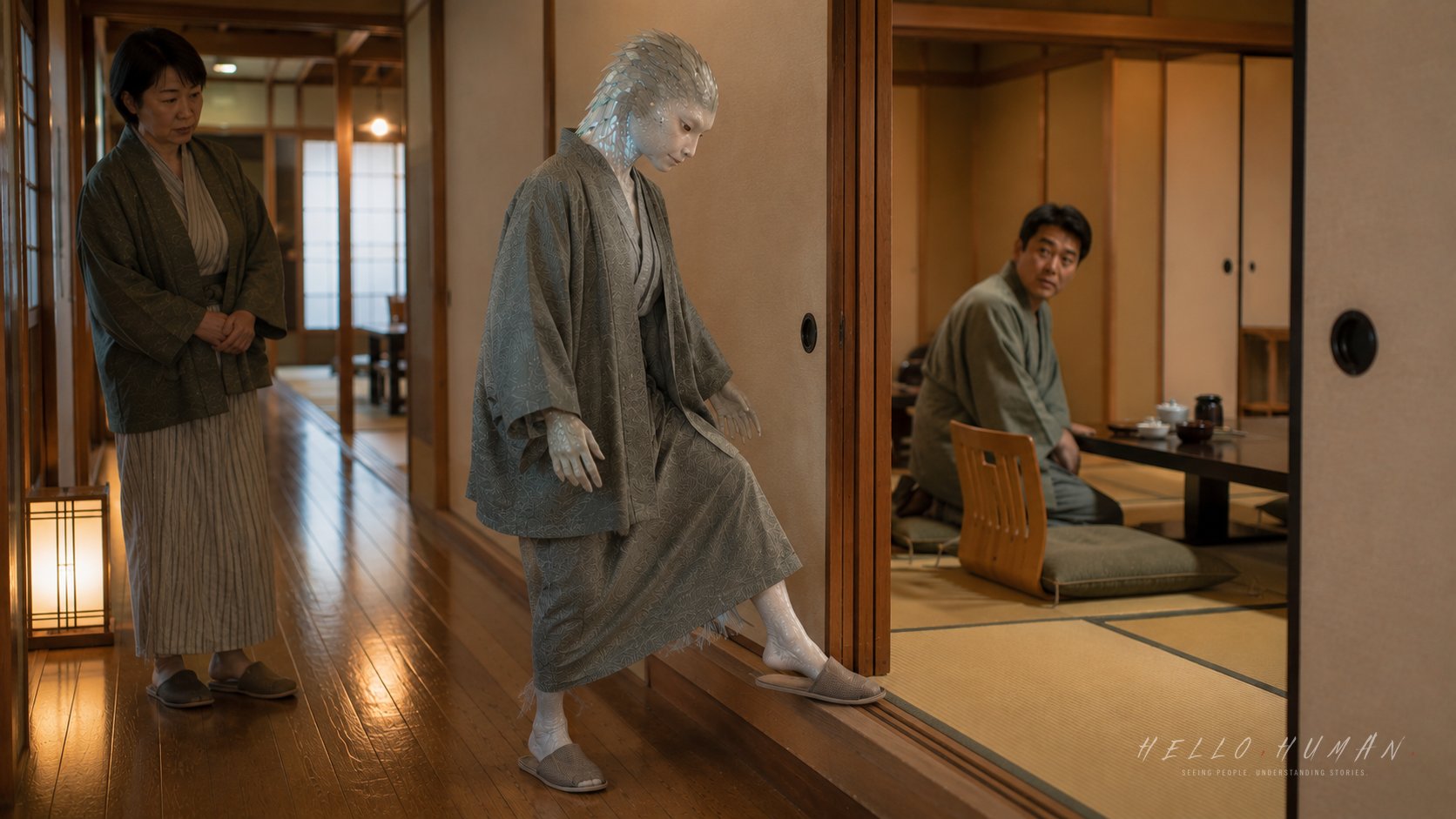
The guest room door stood open, revealing a low table, floor cushions, and pale tatami divided by dark fabric borders. At the threshold, the traveler took one smooth step forward without changing pace.
The sole of an indoor slipper landed across the first mat.
Observation 01The Moment Something Changed


The slippers had already replaced the traveler’s outdoor shoes near the ryokan entrance. They were soft, clean, and clearly meant for the interior, so the traveler treated them as permission to keep walking through every part of the building.
The first step onto the tatami made almost no sound. The second slipper hovered over the mat while the traveler looked into the room, taking in the low furniture and folded bedding stored beyond the sliding panels.
Behind them, the pearl-soft plates along their cheeks reflected the warm room light. A faint sheen ran over the scales of the neck, and their web-spaced fingers rested carefully against the doorframe as if the entrance required only balance, not a decision.
Then the rhythm at the doorway stopped. Someone approaching from the corridor slowed without passing. Another person inside the room shifted their knees beneath them but did not rise.
The visible cue was one indoor slipper resting on the first tatami mat.
The people nearby paused at the doorway instead of moving around the traveler.
The traveler noticed the hesitation but had not yet understood the floor boundary.
Observation 02The Reactions No One Explained
A guest waiting in the corridor lowered their gaze toward the traveler’s feet. Their own slippers remained on the hard flooring, aligned just short of the tatami edge.
Inside the room, another guest glanced at the slipper, then at the uncovered feet beneath their own robe. Their hands paused above a teacup before continuing the movement more slowly.
A ryokan staff member standing farther back made a small shift toward the threshold. The movement stopped before becoming an interruption. Their shoulders remained relaxed, but their attention stayed on the point where the slipper met the mat.
The guest in the corridor turned one foot slightly outward, making the removal gesture more visible without performing it for the traveler. The second slipper slipped free from their heel and remained neatly beside the first before they stepped onto the tatami in socks.
Only then did the traveler look down. The hard corridor floor ended in a straight line. On one side stood the pair of slippers; on the other stretched the woven surface of the guest room. What had looked like a single indoor space was divided into two different kinds of interior.
Nearby guests directed their attention toward the slippers and the edge of the tatami.
One guest quietly demonstrated the boundary by leaving both slippers on the corridor floor.
The traveler began to understand that “indoors” did not mean the same footwear belonged everywhere.
Observation 03What the Traveler Finally Understood
The traveler corrected the mistake with their feet first. They drew the slipper back from the tatami, returned both soles to the corridor, and stepped out of them one at a time.
With the slippers left together at the threshold, the traveler entered again in socks. The guest behind them resumed moving. Inside the room, the paused hand lifted the teacup, and the staff member’s attention returned to the rest of the corridor.
The difference was not between dirty outdoor shoes and clean indoor slippers alone. The tatami created another boundary inside the ryokan. Slippers were acceptable for the corridor, but they did not continue across the woven mats.
The traveler looked again at the entrance. No barrier rose from the floor, and no spoken instruction had interrupted the moment. The change in material carried the message: smooth corridor under slippers, tatami under socks or bare feet.
The pearl edges along the traveler’s neck brightened softly as the room quieted again. Their fingers relaxed at their sides, and their posture settled into the slower scale of the room. The correction had been small, but it revealed that a Japanese interior could contain several footwear zones within what first appeared to be one continuous indoor space.
The traveler physically corrected the mistake by stepping back and removing the slippers.
The nearby guests resumed their movements once the tatami boundary was respected.
The traveler understood that indoor slippers stop where the tatami begins.
Practical Takeaway
At a ryokan, remove both outdoor shoes and indoor slippers before stepping onto tatami mats. Leave the slippers together on the hard flooring beside the threshold.
This respects the separation between the corridor and the tatami room. The slippers may belong inside the building, but the woven floor marks a more specific footwear boundary.
Pay attention whenever the floor surface changes at a guest room, dining room, or other tatami space. A visible row of slippers or people stepping out of them usually shows where the boundary begins.
More Observations
A realistic editorial still at the entrance to a tatami guest room in a Yokohama ryokan, framed as a wide room-rhythm shot from the corridor. One indoor slipper has crossed the wooden threshold and rests visibly on the first tatami mat while the traveler’s second foot pauses behind it. A nearby Japanese guest stops in the corridor with both slippers aligned on the hard floor, and another guest inside lowers their gaze toward the mistake. The Pearl-scale resident is a refined pearl_scale_humanoid in pearl gray, muted teal, soft umber, and low shell-white highlights, with pearl-soft cheek plates, a smooth neck scale sheen, web-spaced fingers, and calm fluid posture. A faint body-bound glow brightens along the neck scale edges. Quiet ryokan clothing with a moisture-safe collar and soft hand openings fits the anatomy naturally. Documentary photography, warm realistic indoor light, restrained tension. Not a normal human with decorative scales. No readable text, logos, phone UI, anime, fantasy illustration, portrait, or hero shot.
[/IMAGE_PROMPT_BLOCK]