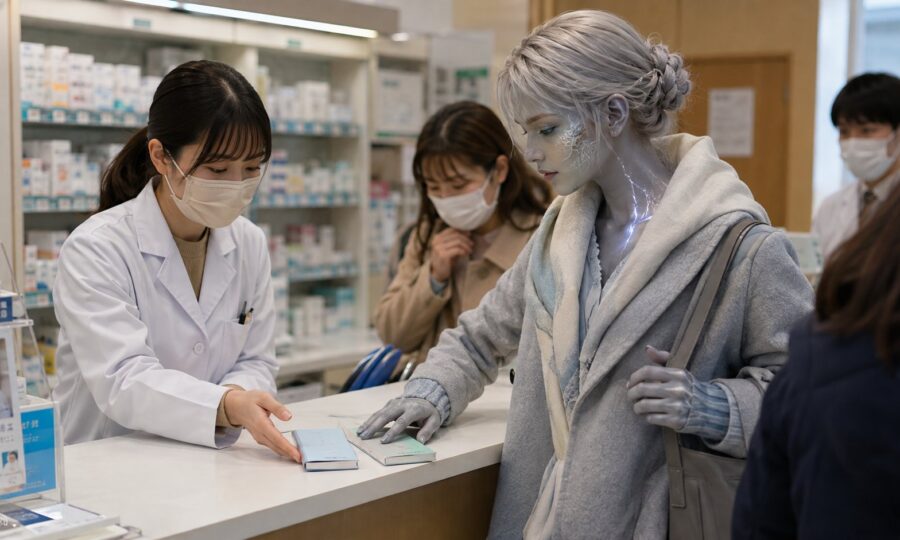
The outpatient consultation was over, and the Cloud-marked traveler stepped away from the medical institution with a prescription among their papers. Instead of staying to receive the prescribed medicine there, they carried the prescription out into Tokyo.
At an outside pharmacy, the traveler placed the paper forward with the same small, practiced motion as the customers around them. The expected handoff did not continue.
Observation 01The Moment Something Changed

The traveler had followed a simple idea: consultation first, prescription second, pharmacy third. The paper in their hand looked like the part that should travel with them, so they had left the medical institution and brought it to an outside pharmacy.
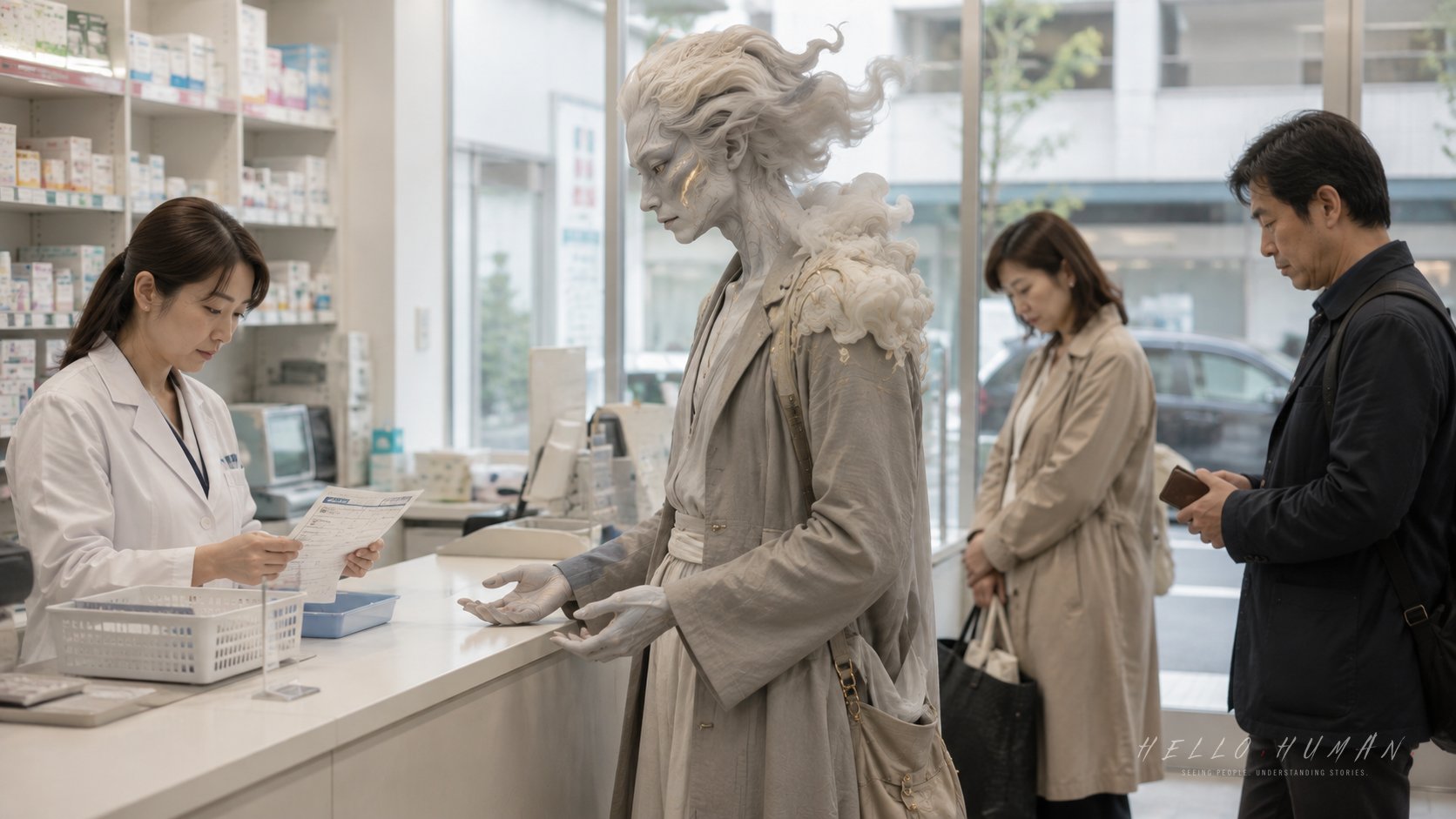
The pharmacy staff member took a closer look at what had been presented. Their hands paused over the counter rather than moving into the ordinary medicine handoff the traveler had expected.
The traveler leaned slightly forward, one open hand still resting near the prescription. Soft cloud-gray markings followed the line of their shoulders, and the markings seemed quieter as attention settled on them.
Nothing dramatic had gone wrong. But the traveler had treated two different routes for receiving prescribed medicine as though they were interchangeable.
The visible mistake was the in-hospital prescription being carried away from the medical institution and presented at an outside pharmacy.
The pharmacy handoff paused instead of continuing through the route the traveler expected.
The traveler began to realize that the important difference was not simply having a prescription, but what kind of prescription it was.
Observation 02The Reactions No One Explained
The staff member kept their attention on the prescription for another moment. There was no sharp correction, only a break in the expected counter rhythm while the traveler waited for medicine that this prescription was not directing them to receive there.
A nearby customer lowered their eyes toward their own papers rather than watching the exchange. Another person waiting behind the traveler left a little more room at the counter instead of stepping closer.
Beside them, a customer preparing for their own handoff kept their documents gathered and waited. The staff member’s posture remained calm, but the prescription stayed at the center of the conversation rather than disappearing into the next stage of service.
The traveler finally looked down at the paper differently. Their elongated throat line straightened, and the open hand that had been waiting expectantly near the counter drew back toward their body.
The misunderstanding was becoming clearer. In Tokyo’s medical system, an in-hospital prescription and an out-of-hospital prescription lead to different places for receiving medicine.
The surrounding reactions stayed small: lowered attention, extra counter space, and patient waiting around a stalled handoff.
The staff response kept the focus on the prescription itself rather than treating the traveler as disruptive.
The traveler began to understand that the paper determined where the medicine was supposed to be received.
Observation 03What the Traveler Finally Understood
The traveler lifted the prescription back from the outside-pharmacy counter and gathered it with the rest of their papers. The correction began physically: stop trying to use this prescription here and return attention to the route connected to the medical institution.
The distinction was simple once it became visible. With an in-hospital prescription, the patient receives the prescribed medicine directly from the medical institution. With an out-of-hospital prescription, the patient takes the prescription to an external pharmacy to obtain the medicine.
The traveler had not misunderstood the purpose of a prescription. They had misunderstood where this particular prescription was meant to lead them.
The difference was easy to miss because both routes begin after medical care and both involve prescribed medicine. But the next destination is not automatically an outside pharmacy. The prescription type determines whether the medicine is received inside the medical institution or beyond it.
The Cloud-marked traveler’s shoulders settled. A faint warm body-bound glow remained along the cheek edge, while their offset shoulder bag rested below the cloud-marked shoulder flow. The awkwardness had reduced itself to one useful question for the next consultation: which dispensing route does this prescription belong to?
The traveler’s first correction was to remove the in-hospital prescription from the outside-pharmacy handoff.
The social pause made a system difference visible without turning the mistake into a public confrontation.
The traveler understood that checking the prescription type comes before deciding where to go for the medicine.
Practical Takeaway
After an outpatient consultation, check whether you have an in-hospital prescription or an out-of-hospital prescription. Receive the medicine inside the medical institution for an in-hospital prescription; take an out-of-hospital prescription to an external pharmacy.
The distinction matters because the two prescription types belong to different dispensing routes. Treating them as interchangeable can send you away from the place where your medicine is supposed to be received.
Pay attention before leaving a medical institution with prescription paperwork in hand. The useful question is not simply whether you have a prescription, but whether that prescription sends you to the institution’s own dispensing route or to an outside pharmacy.
More Observations
A realistic editorial wide-room still at an outside pharmacy in Tokyo after an outpatient consultation, with the medical visit clearly preceding the moment. An in-hospital prescription rests at the counter after the traveler mistakenly carried it away from the medical institution and tried to use it here. The pharmacist pauses over the paper; one nearby Japanese customer lowers their gaze and another leaves slightly more counter space. The Cloud-marked traveler is a refined humanoid in soft cloud gray, warm ivory, and muted gold, with structural cloud-mark shoulder flow, an elongated throat and cheek transition, and unusually still open hands. Matte everyday outerwear has shoulder-seam relief, with an offset shoulder bag routed below the marked shoulder structure. A faint warm body-bound glow traces the cheek edge. Documentary indoor photography, realistic pharmacy light, quiet procedural tension; not an angel-costumed human or cloud mascot. No readable text, logos, phone UI, anime, fantasy illustration, portrait, or hero shot.
[/IMAGE_PROMPT_BLOCK]