The first dish had arrived before the traveler had settled fully into the chair: something small, neatly portioned, and placed beside the first drink without a spoken order.
Much later, when the bill reached the table, one precise quartz-lined finger stopped beside an unfamiliar charge.
Observation 01The Moment Something Changed

The traveler looked from the total to the nearly empty little dish still resting near the edge of the table. The dish had appeared at the beginning of the meal, before the larger plates, without being requested by name.
That sequence seemed simple enough to interpret. No order had been placed for it, so the traveler had treated it like a complimentary appetizer: a small welcome from the house, separate from the things that would later appear on the bill.
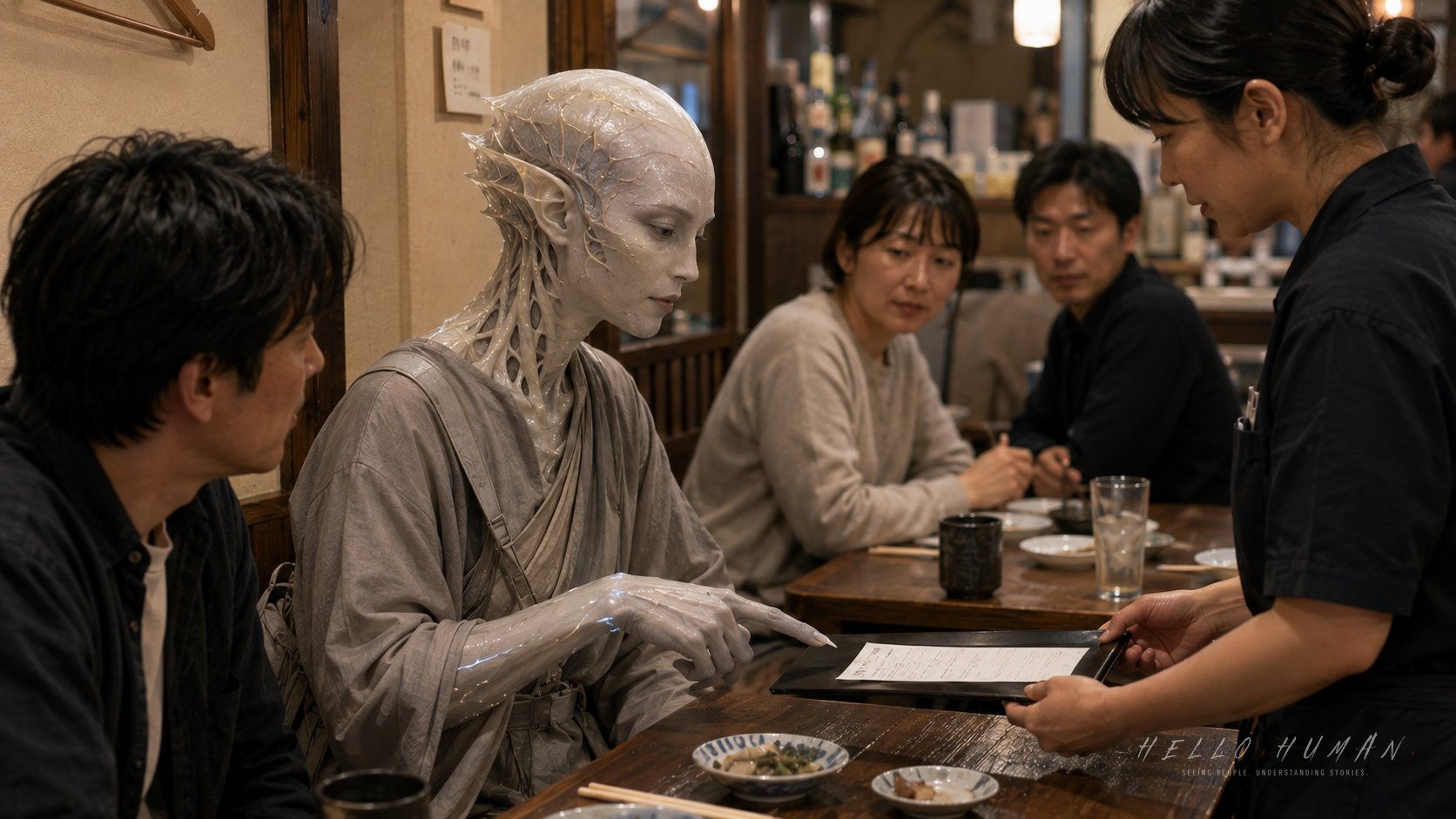
Now the traveler lifted the bill slightly and pointed toward the corresponding charge. The gesture was controlled rather than angry, but the meaning was unmistakable: this item had not been ordered, so why was it being charged?
The staff member leaned closer to the table. For a moment, the surrounding rhythm of clearing glasses, passing plates, and calling for another drink seemed unchanged. Then a few tiny movements nearby began to register.
The visible cue is the traveler’s finger moving between the bill and the small dish that arrived automatically.
The staff response is a short pause rather than an immediate removal of the charge.
The traveler begins to suspect that the dish and the bill are connected by a system that was never obvious from the act of ordering.
Observation 02The Reactions No One Explained
At the next table, one diner paused with a glass halfway back to the tabletop. Their eyes moved briefly toward the traveler’s bill, then toward the small dish, before returning to their companion.
Another diner turned one shoulder slightly inward, reducing their attention to the exchange without fully ignoring it. A third person, closer to the aisle, glanced toward the staff member and then lowered their gaze to their own plates.
None of them intervened. Nobody explained the charge across the room, and nobody treated the traveler as if some enormous offense had occurred. The reactions were smaller than that: recognition, mild awkwardness, and the quick retreat of attention once the situation became clear.
The traveler noticed this only after the second explanation from the staff member. The dish had not been a mistake in service. It had not accidentally wandered onto the table from someone else’s order. The strange part was that everyone else seemed to understand its role without needing to choose it from the meal.
A faint blue-white glint surfaced along the quartz nerve-line at the traveler’s wrist as the hand holding the bill became still. The question was no longer whether the restaurant had charged for something unordered. It was why an unordered dish could legitimately belong to the meal in the first place.
The nearby reactions are brief glances toward the bill and dish, followed by people returning to their own tables.
No one treats the automatically served dish itself as unusual; the hesitation begins when its charge is challenged as though it must be an ordering error.
The traveler starts separating two ideas that had seemed identical: not explicitly ordered does not necessarily mean complimentary.
Observation 03What the Traveler Finally Understood
The traveler lowered the bill onto the table first. The pointing finger withdrew, and the small dish was no longer held up as evidence of a mistaken charge.
That physical correction came before the full understanding. At an izakaya, the small dish known as an otoshi is usually served at the beginning of the meal, charged per person, and generally not optional. Its arrival does not depend on the diner explicitly selecting it as an individual menu item.
The traveler had interpreted the service using a familiar equation: unordered food equals free food. Here, that equation had failed. The important clue had been present from the opening minutes of the meal, when the small dish arrived automatically as part of the izakaya’s dining system.
Nothing about the correction required a dramatic apology. The traveler simply stopped arguing from the absence of an explicit order, accepted the charge, and let the exchange return to its ordinary scale. The staff member moved on, neighboring diners resumed their conversations, and the table became only a table again.
The quiet lesson was less about memorizing the contents of one small plate than recognizing what the plate represented. In this particular Japanese dining setting, an automatically served item could carry a standard per-person charge even though the diner never spoke its name.
The correction becomes visible when the traveler lowers the bill and stops using the unordered dish as proof that the charge must be wrong.
The staff and nearby diners return quickly to normal once the traveler accepts that the dish belongs to the izakaya’s standard service pattern.
The traveler understands that the useful signal is not whether the otoshi was verbally ordered, but that it arrived automatically as part of the dining system.
Practical Takeaway
When a small otoshi dish is automatically served after you sit down at an izakaya, expect that it is usually charged per person rather than assuming it is a complimentary appetizer simply because you did not order it.
Recognizing the system prevents a routine izakaya charge from turning into an unnecessary billing dispute. The social friction comes from treating the absence of an explicit order as proof that the restaurant made an error.
Pay attention when a small dish appears automatically near the beginning of an izakaya meal. Its unrequested arrival can be the clue that you are encountering the standard otoshi system rather than receiving free food.
More Observations
A realistic editorial still at a lightly busy Tokyo izakaya table after the meal, side-on composition. A small mostly finished otoshi dish sits beside the bill while the traveler points at its charge, visibly disputing it because the dish was never explicitly ordered. A staff member pauses at the table; two nearby Japanese diners make brief restrained glances toward the bill and dish before returning to their meals. The traveler is a Quartz-nerved resident, a refined quartz-pearl-gray humanoid, not a normal human with decorative crystals: mineral cheek depth around warm unusual eyes, quartz nerve structure through the temples and collarbone, and precise fingers with quartz wrist lines. Soft layered clay-gray clothing has a collar shaped around the collarbone nerves and an offset shoulder-pouch strap. A subtle blue-white body-bound glint shows at the wrist nerve. Documentary indoor photography, natural izakaya lighting, no readable text, logos, phone UI, anime, fantasy illustration, portrait, or hero shot.
[/IMAGE_PROMPT_BLOCK]