The food court above Osaka’s evening station flow was bright with tray steam, summer shirts, and the soft fatigue of the heatwave outside.
Naru found a narrow place at a shared table, set down a bowl of rice beside a noodle tray, and tried to read the laminated menu before the seat could be needed again.
Observation 01The Moment Something Changed

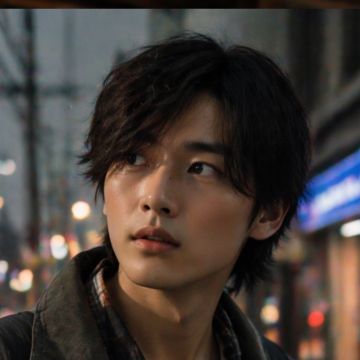
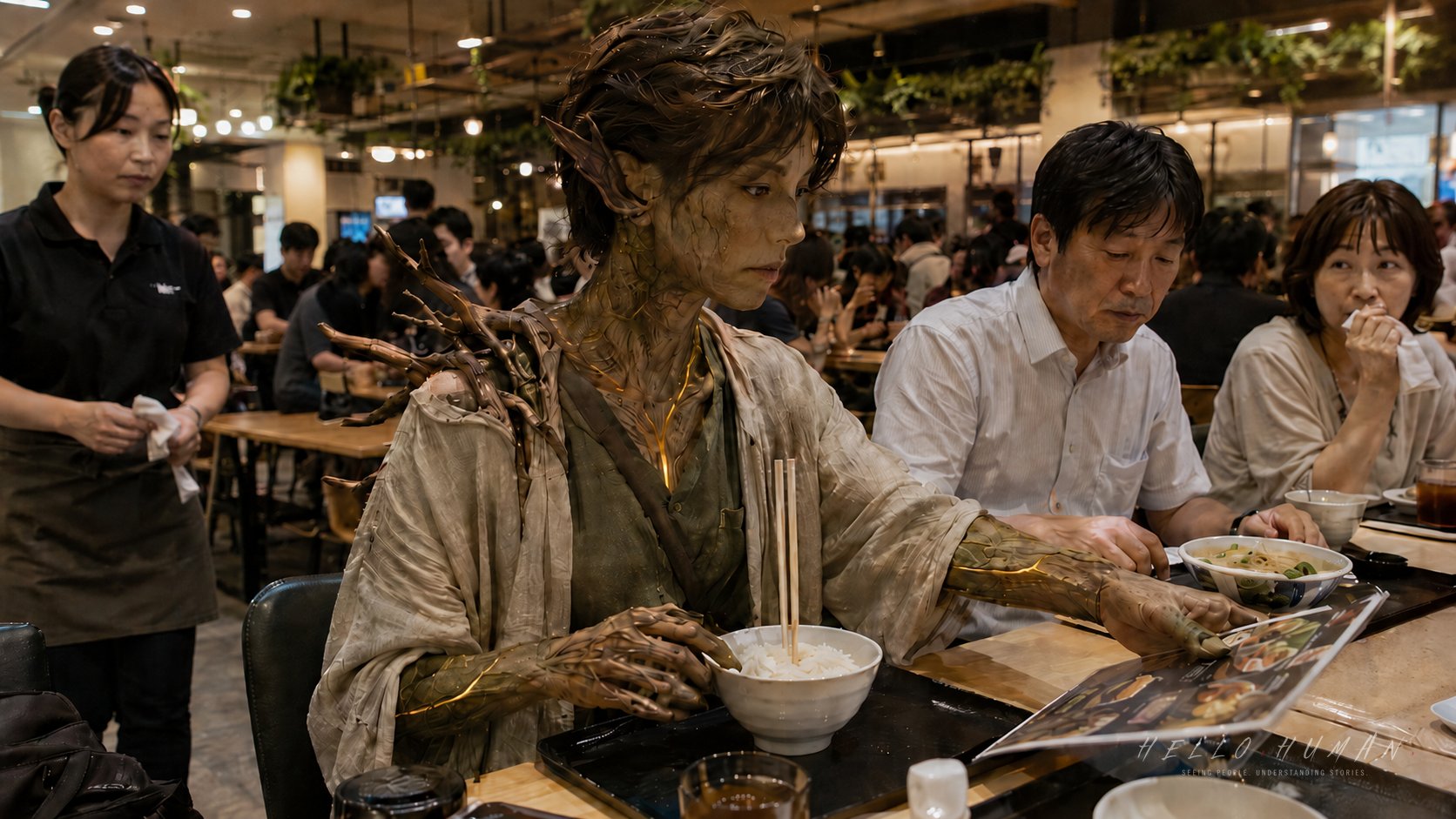
Naru was a Root-shoulder resident, humanlike at a glance but shaped by a quieter body logic. Smooth branching lines lifted beneath a loose linen overshirt, leaf-vein texture ran from the throat to the jaw, and long twig-joint fingers moved carefully around the small tray.
Their amber sap seams, usually faint at the collarbone and wrists, dimmed slightly in the packed indoor air. It was not fear. It was the way their body answered crowd pressure.
They lifted the chopsticks, tasted the rice, and then noticed a menu card sliding close to the table edge. Without thinking, Naru put the chopsticks straight down into the rice bowl, upright and still, so both hands could reach for the card.
The mistake lasted only a few seconds. But in the food court seating area, where trays were turning over fast and an elderly couple had just approached with hot tea, those few seconds became visible.
A woman across the table stopped tearing open her hand wipe. A salaryman beside her lowered his eyes to Naru’s bowl and then immediately looked at his own tray. The elderly man near the aisle slowed his step, as if deciding whether the empty half-seat was still comfortable to take.
The visible cue was small: two chopsticks standing upright in white rice while Naru reached away from the bowl.
The Japanese reaction came as a pause, a lowered gaze, and a slight hesitation around the shared table rather than a spoken correction.
Naru first understood only that the object arrangement had changed the air around the meal.
Observation 02The Reactions No One Explained
The woman with the hand wipe folded it once, slower than before, and moved her elbow inward. She did not stare. Her eyes touched the rice bowl, moved to Naru’s twig-joint fingers, and settled on the table surface between them.
The salaryman adjusted his tray by two careful centimeters, creating a clean line between his bowl and Naru’s. His shoulders angled away, not in disgust, but in the practical way people make a boundary when they cannot speak into someone else’s meal.
The elderly woman standing near the aisle whispered something to her husband without pointing. Her hand remained around the paper cup of tea. The husband gave a small nod, then chose the next table over, even though it had less space.
A staff member passing with a wet cloth noticed the upright chopsticks, slowed just enough for the cloth to hover above an already clean spot, and then continued toward the tray return area. The lowered motion said more than an instruction would have said.
Naru felt the attention only after it had already dispersed. In their own home meal customs, a vertical tool could mean “I am not finished; I will return to this.” Here, the same shape had made the shared table feel suddenly ceremonial and wrong.
The visible cue remained fixed in the bowl while the surrounding hands, shoulders, and trays quietly changed their rhythm.
The Japanese diners avoided direct correction, but their pauses, tray shifts, and seat choices showed that the gesture had landed badly.
Naru began to sense that silence in Japan could be a soft warning, not permission.
Observation 03What the Traveler Finally Understood
Naru stopped reaching for the menu. Their long fingers returned to the bowl, careful now, and lifted the chopsticks out of the rice without a clatter.
They did not wave an apology across the table or make the moment larger. They laid the chopsticks flat along the tray edge, tips resting away from the rice, then drew the bowl a little closer to their own space.
The woman across from them resumed opening her hand wipe. The salaryman’s shoulders loosened. The staff member, now returning past the same table, wiped the far corner with an ordinary rhythm and moved on.
Only then did the meaning settle. In Japan, chopsticks standing upright in rice are strongly associated with funeral offerings and the presence of death. At an everyday meal, especially at a crowded shared table, the shape can feel jarring even if the traveler intends nothing by it.
Naru looked once at the empty place where the elderly couple might have sat, then back at the rice bowl. Their amber seams warmed faintly again at the wrist. The correction had not repaired everything dramatically; it had simply returned the table to being a table.
The physical correction was simple: chopsticks removed from the rice and placed flat on the tray edge.
The Japanese reactions softened only after the object no longer held the funeral-like shape in the middle of the meal.
Naru understood that some dining signals are read by arrangement before intention can be explained.
Practical Takeaway
When eating in Japan, do not stand chopsticks upright in a rice bowl, even for a moment while reaching for something. Place them flat on a chopstick rest, the tray edge, a wrapper, or across the bowl rim if there is no better option.
This matters socially because the upright shape is not just a casual storage position. For many Japanese people, it recalls funeral practice, so it can make an ordinary shared meal feel suddenly uncomfortable or heavy.
Pay attention when you are eating under pressure: crowded food courts, shared tables, quick turnover restaurants, and moments when your hands are full. Urgency makes temporary placements easy, but small object positions can carry strong meanings.