The typhoon had not arrived yet, but the office windows in Tokyo were already holding a gray reflection of rain.
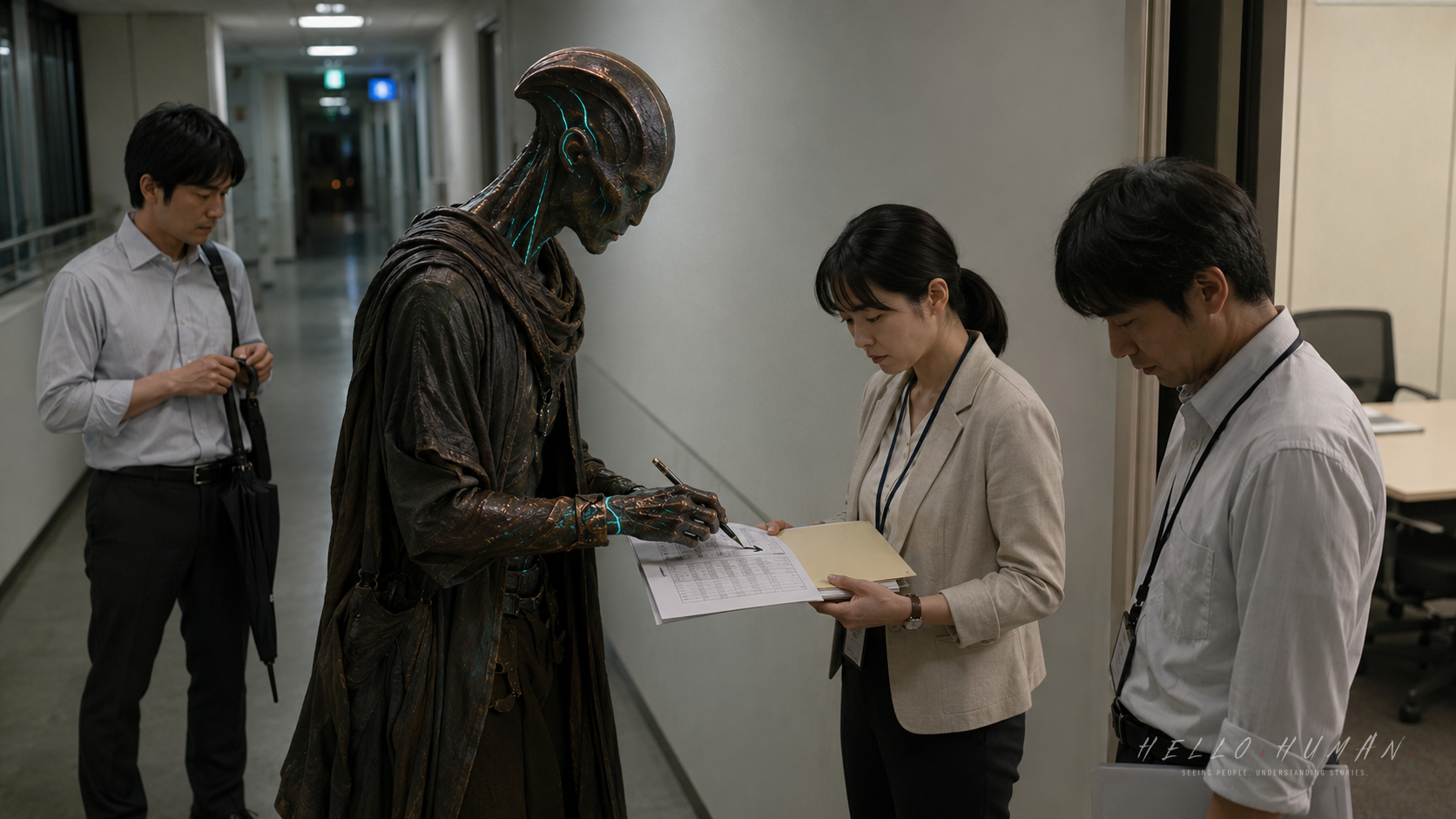
In the hallway outside a small meeting room, Ren pressed one copper-edged finger to a printed schedule and heard a Japanese coordinator say, very softly, “Hai.”
Observation 01The Moment Something Changed


Ren was a copper-horned student from a place where spoken acknowledgment carried weight like a stamped seal. His ridges grew through his skull line in uneven bands, dark green oxidized seams running along both temples. Under the hallway lights, the copper warmed faintly, not enough to glow, only enough to make the air near his brow look dry.
The coordinator, Ms. Hayashi, had been explaining that the next day’s office visit might change if the trains slowed under the approaching typhoon. Her voice stayed gentle. She pointed once to the printed schedule, then let her hand fall back to the folder against her chest.
Ren listened carefully. When she finished, she gave a small nod and said, “Hai,” as if placing a bookmark in the conversation.
Ren understood it as approval. He turned the schedule sideways, pressed it against the hallway wall at an awkward angle, and wrote a firm arrow toward the morning appointment. The paper slipped slightly and ended up tucked half under Ms. Hayashi’s folder, out of its original order.
The first change was almost invisible. Ms. Hayashi’s smile tightened, and her eyes dropped to the schedule instead of Ren’s face. A coworker beside her looked down at the printed page too, then at the closed meeting-room door, then back to the page.
The mistake was not loud, but the hallway stopped moving naturally.
No one corrected Ren directly after his pen touched the schedule.
The first signal was physical: eyes lowered, smiles held in place, and hands stayed close to the documents.
Observation 02The Reactions No One Explained
The office hallway was lightly busy, the way workplaces become after hours when people are trying to leave before weather turns serious. A man carrying an umbrella cover slowed near the group, noticed the open schedule, and stepped around without joining the conversation.
Ms. Hayashi did not take the paper back at once. She kept one hand on her folder and the other near her phone, as if deciding whether to check a message. Her smile stayed polite, but the corners no longer moved with her eyes.
The coworker beside her, Mr. Sato, lowered his voice. He said something about “tomorrow morning” and “depending on the train situation,” but he did not point at Ren’s arrow. Instead, he looked at the printed schedule as though the paper itself might explain the hesitation.
Another staff member came out of the meeting room and paused behind them. She saw Ren’s mark, then looked at Ms. Hayashi. She did not ask what had been decided. She folded her umbrella strap twice, slowly, while waiting for someone else to speak first.
Ren stood very still. The copper ridges along his temples held warmth from the fluorescent lights. His fingers, jointed with thin metal cartilage, remained on the schedule as if keeping the plan steady would keep the people steady too.
Ms. Hayashi gave another small nod. This one was shallower. “We understand,” she said in English, careful and kind. She did not say yes. She did not say no. She looked at the arrow again, then at the blank space beside the appointment.
Only then did Ren notice that no one had moved toward the next action. No phone call had begun. No one had opened the booking screen. No one had copied his arrow into another document. The group had accepted that he had heard them, but not that the plan had been approved.
The Japanese reactions gathered around the schedule instead of around Ren.
The pause protected the relationship while leaving the decision unfinished.
A soft hai had closed one part of the listening, not opened the next step of action.
Observation 03What the Traveler Finally Understood
Ren’s home language had no separate sound for “I hear you” and “I accept this.” Agreement there was a door: once someone touched it, everyone passed through. In this hallway in Japan, the door had not opened. Someone had only shown that they were standing beside it.
His correction came before his words. Ren lifted his finger from the schedule, turned the page back to its original direction, and slid it out from under Ms. Hayashi’s folder. He placed the paper flat between them, no longer angled toward his own decision.
The movement changed the hallway more than an apology would have. Ms. Hayashi’s shoulders eased a little. Mr. Sato looked up from the schedule. The staff member by the meeting-room door stopped folding the umbrella strap.
Ren touched the arrow he had drawn, then placed his pen beside the page instead of above it. “This was only understood,” he said. His English was slow. “Not decided.”
Ms. Hayashi’s smile became smaller but softer. “Yes. We will check once more tomorrow morning.”
Ren nodded, this time without writing. The oxidized seams at his temples cooled under the hallway air. He kept his hands folded close to his body while the staff discussed the train warning, the possible delay, and who would send the final message before departure.
By the time the elevator chimed at the end of the corridor, the schedule had become shared again. It was not Ren’s arrow or Ms. Hayashi’s hesitation. It was a plan waiting for one more clear confirmation.
Ren understood when the room failed to act on his assumed decision.
His physical correction gave the others room to clarify without embarrassment.
In Japan, acknowledgment can be sincere without being permission to proceed.
Practical Takeaway
When you hear a soft hai during a conversation in Japan, do not automatically treat it as approval. Before changing a plan, booking something, marking a schedule, or moving to the next step, ask a gentle follow-up such as, “So should we do this?” or “Is this confirmed?”
This matters because hai often shows that the listener has received the information, not that the decision is finished. People may avoid saying a direct no in the hallway, at a desk, or in front of coworkers, especially when the situation is still uncertain.
Pay attention when the response is quiet, when people look at the paper instead of starting the action, or when someone repeats conditions like weather, timing, or checking later. Those pauses may be the real message.