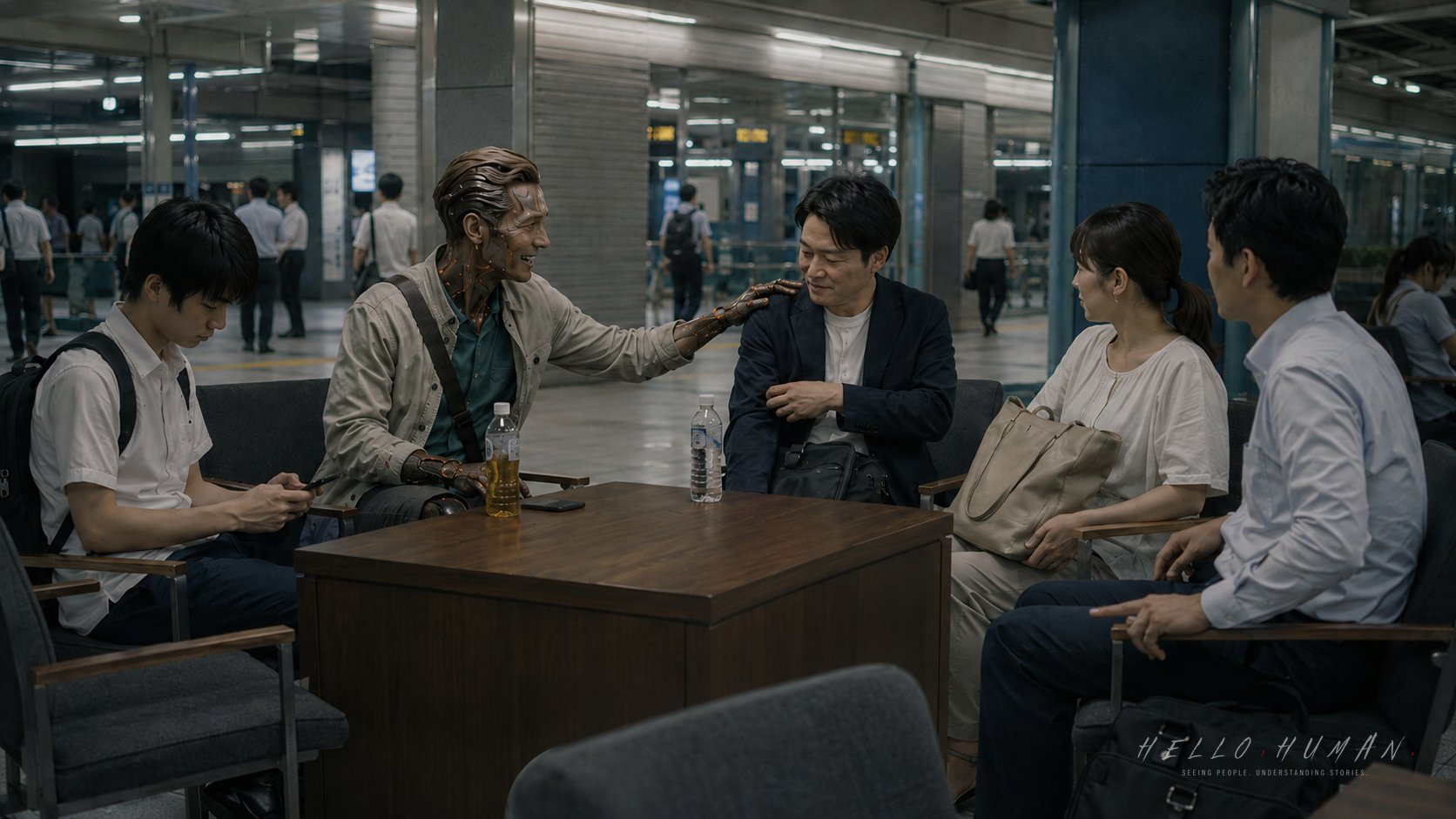
The shared waiting table near Kanda Station had one narrow strip of empty space between two commuters’ bags. Outside the windows, the evening heat still shimmered above the tracks.
Venn laughed softly at a new acquaintance’s joke and, for half a second, rested precise copper-jointed fingers on the person’s shoulder. The smile across from them stayed in place, but became smaller.
Observation 01The Moment Something Changed


The introduction had started smoothly. A mutual coworker had brought Venn to the table, gave both names, and then left to answer a message near the vending machines. The station lounge was not private, but the shared table made strangers feel temporarily arranged together.
The new acquaintance, Morita, smiled through the first exchange. He asked where Venn was staying, nodded at the answer, and gave a small laugh when Venn mispronounced the neighborhood name in a careful way.
Venn took the laugh as permission to become warmer. In their own city, a brief touch at the shoulder could mark that embarrassment had safely turned into humor. Their oxidized wrist mechanics opened and closed with natural precision, then their hand crossed the small table edge and landed lightly on Morita’s shoulder.
It was not hard. It did not last. But Morita’s shoulder lowered a little under the touch, then moved back as soon as Venn’s hand left.
Across the table, a woman checking train times lifted her eyes and looked not at Venn’s face, but at the space between Venn’s hand and Morita’s jacket. A man with a loosened tie pulled his phone closer to his chest. The table stayed quiet enough to make the movement visible.
The visible cue was small and exact: Venn’s friendly hand crossed into a new acquaintance’s shoulder space during a first introduction.
The Japanese reaction began with a shorter smile, a shoulder shifting back, and nearby eyes measuring the touch without openly commenting.
Venn first understood only that the laugh had not expanded the space as much as they thought.
Observation 02The Reactions No One Explained
Morita answered the next question with fewer words. His smile stayed polite, but it no longer reached the small lines beside his eyes. His gaze moved to the tabletop, then to the train information screen, then back to Venn for just long enough to remain kind.
The woman with the train app angled her shoulders away from the conversation. She did not leave the table. She only moved her tote bag from the floor to her lap, making a soft boundary where there had been open space.
The man with the loosened tie shifted his chair by a few centimeters. The chair legs made a brief sound against the floor, and he stopped moving immediately, as if even the correction should not become too loud.
Morita lifted one hand toward his own shoulder, then changed the gesture into smoothing his jacket sleeve. The motion was almost invisible, but the meaning gathered there. The touched place had become something to reset.
A student at the far end of the table lowered her eyes and pretended to read a message. Her thumb did not move on the screen. She was waiting for the conversation to find a safer distance.
Venn noticed the changes one by one. Their angular temple-to-neck metal-fiber flow caught the fluorescent light, and embedded copper lines under the throat warmed faintly where embarrassment gathered. The hand that had touched Morita’s shoulder folded back near Venn’s own cup.
No one looked offended in a dramatic way. That made the signal easy to miss and hard to ignore. The room had not rejected Venn’s friendliness; it had narrowed the path through which that friendliness could travel.
The visible cue repeated through distance: Morita reset his shoulder, and others created small personal borders with bags, chairs, and lowered eyes.
The Japanese reactions stayed indirect through shorter answers, angled shoulders, quiet object movement, and a polite refusal to stare.
Venn began to understand that a first meeting could be warm without becoming physically close.
Observation 03What the Traveler Finally Understood
Venn corrected the mistake before finding a perfect sentence for it. They drew both hands fully back to their side of the table and placed them around the paper cup, fingers close together, oxidized wrist joints still.
Then they shifted their chair a small distance away from Morita. The motion was careful, not theatrical. It gave the shoulder back its air.
Morita’s next breath seemed easier. He looked up again and answered with a little more detail, mentioning the crowded train line and the heat trapped in the evening platforms. His smile did not become large, but it became less guarded.
Venn bowed their head slightly and said, softly, that they had been too familiar. Morita gave a quick smile and a small wave of the hand, as if to keep the apology from becoming another burden. The conversation resumed, now carried by words rather than contact.
The lesson arrived late, after the body had already learned it. In Japan, especially at a first introduction, comfort is often shown through listening, timing, and respectful distance. A smile or laugh may keep the exchange smooth, but it does not automatically invite touch.
Venn had misread politeness as closeness. Morita’s smile had meant the conversation could continue, not that the relationship had crossed into physical ease.
When the mutual coworker returned, Venn greeted them with the same warmth in voice and face, but their hands stayed near the cup. The copper seams under fluorescent light cooled to a low amber line, no longer asking the room to make space for a gesture that had arrived too soon.
The visible correction was physical first: Venn brought both hands back, shifted the chair slightly, and restored personal space around Morita’s shoulder.
The Japanese response softened through a steadier gaze, a longer answer, and the disappearance of protective object movement around the table.
Venn understood that indirect comfort signals are not always invitations to reduce distance.
Practical Takeaway
At a first meeting in Japan, keep friendliness in your voice, expression, listening, and timing rather than touching someone’s shoulder, arm, or back. Even a light touch while laughing can feel too familiar before the relationship has clearly developed.
This matters socially because many people will protect the smoothness of the moment instead of correcting you directly. A polite smile may remain on the face while the body is quietly asking for more space.
Pay attention when someone gives shorter answers, resets their sleeve or shoulder, angles their body away, moves a bag between you, or keeps their gaze lowered after contact. Those small changes often mean the touch arrived before the relationship was ready for it.