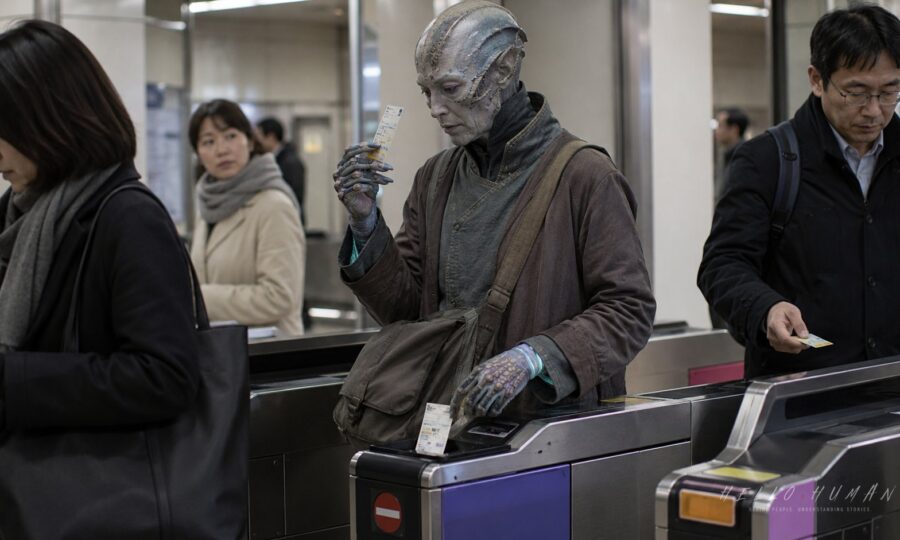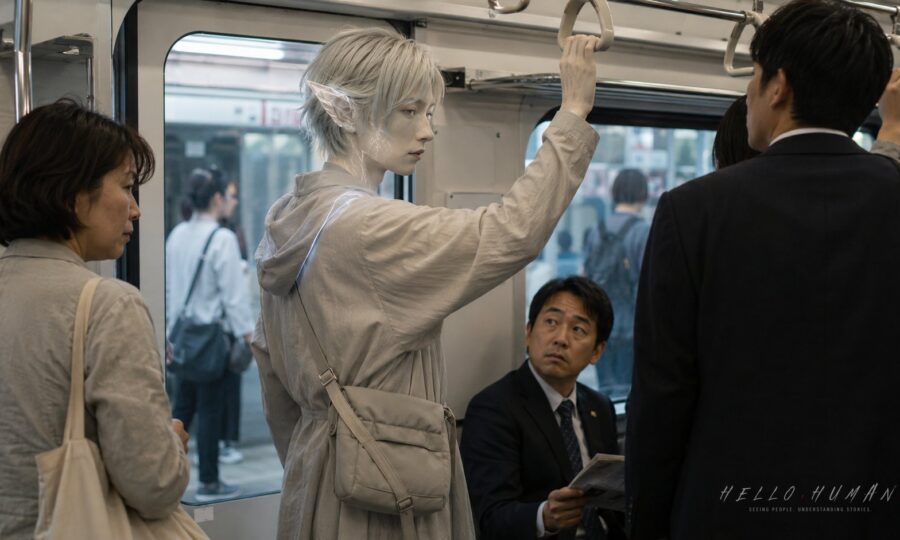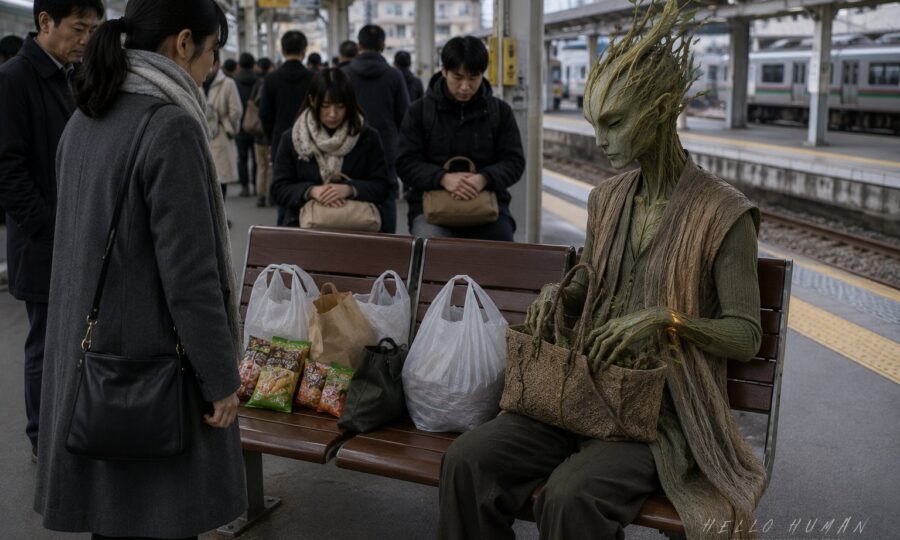
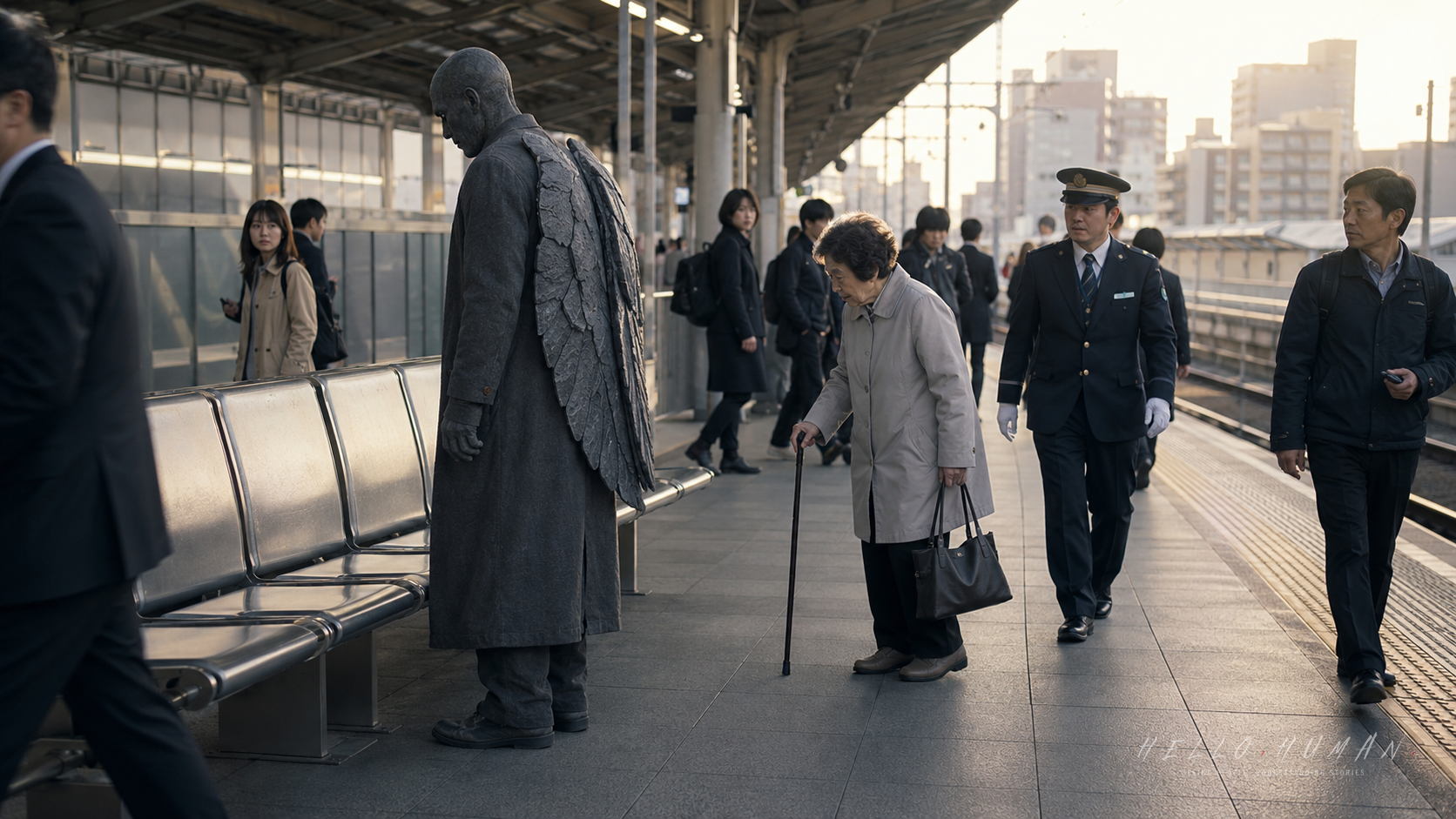
The silver seats on the Nagoya Station platform were empty except for one folded umbrella, one paper shopping bag, and Nareh’s stone wing plates resting against the back rail.
The late afternoon train had not arrived yet. People stood in a loose line under the platform lights, looking at the empty seats, then looking away.
Observation 01The Moment Something Changed

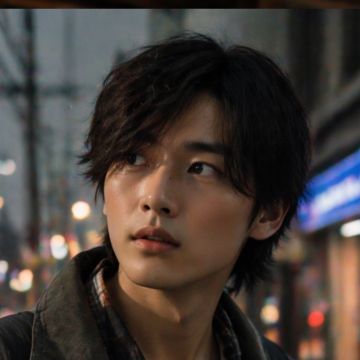
Nareh had arrived in Japan that morning, carrying no bag and leaving small gray dust where his feet stopped too long. He was not tall, but he seemed heavy, as if the platform floor had agreed to hold him only after careful negotiation.
His eyelids looked carved from dark mineral. When he blinked, they closed sideways with a dry click. From his shoulder blades grew layered stone wing plates, not feathers, not costume panels, but ridged mineral shelves that shifted when he breathed.
He saw the empty priority seats and lowered himself with great care. The wing plates spread slightly behind him. One edge touched the back rail with a faint scrape.
A woman with a cane slowed near the seating area. Her eyes moved from the priority sign to Nareh’s wings, then to the floor. She did not speak. She stepped past the seats and stood beside a pillar.
A young office worker half-lifted his hand, as if he might point at the sign. Then his hand became a phone-checking motion. Two students stopped chatting for one second and made their voices smaller.
The first reaction was not correction. It was hesitation around the space.
People looked at the sign, then at the traveler, then chose another place.
The empty seats stayed empty because the social meaning of the area had changed.
Observation 02The Reactions No One Explained
The platform grew busier. A local train emptied across the tracks, and a small wave of passengers came up the stairs. The priority seating area should have filled first. It did not.
An older man with a white cap approached, saw the seat beside Nareh, and paused with his shoulders slightly turned away. He pretended to study the route map above the platform. His wife touched his sleeve once, and both of them moved farther down.
A station staff member walked by with a clipped rhythm. His gaze landed briefly on the wing plates, then on the priority mark. He slowed just enough for Nareh to notice the change in pace, but not enough to become a confrontation.
A mother carrying a sleeping child shifted the child’s weight from one arm to the other. The boy’s shoe knocked softly against her knee. She looked at the empty seat, smiled with closed lips, and stayed standing.
Nareh’s breathing deepened. The mineral plates at his back settled lower, making another faint scrape. He did not understand the words printed on the sign, but he understood pressure. On his world, silence before a storm meant stone was about to split.
MILO leaned forward, worried. LISA did not move toward him yet. She watched the small circle of absence forming around the seats: no anger, no loud complaint, only a repeated decision not to use what should have helped someone.
Nareh finally turned his carved eyelids toward the sign above the seats. The pictograms were simple: a cane, a pregnant figure, a person with a child, a medical cross. His wing plates tightened close to his back.
Several people needed or considered the seats, but each avoided direct complaint.
The lowered voices and sideways glances were doing the work of a warning.
In Japan, a public space can signal “please adjust” before anyone says it aloud.
Observation 03What the Traveler Finally Understood
Nareh rose too quickly. The edge of one stone wing touched the metal rail, scraping louder this time. Several heads turned, then turned back almost immediately.
He bowed late, not to one person but to the seating area itself. The motion was awkward. His mineral wings did not fold like cloth; they shifted in plates, heavy and slow, until they were narrow enough not to reach over the seats.
The woman with the cane was still by the pillar. Nareh stepped away from the priority area and placed one palm, made of dark stone with pale veins, against his own chest. He did not speak. His posture became smaller.
The woman noticed. She hesitated, then returned to the silver seats. Before sitting, she gave him a brief nod that was almost invisible unless someone was watching for it.
Nareh’s stone eyelids closed once. Not fear. Recognition. The seat had not been empty in the simple sense. It had been reserved by need, by possibility, by the quiet expectation that someone else might require it more.
When the train arrived, Nareh stood near the door but not in the opening. His wings stayed folded close. He watched passengers board first, especially those moving slowly, and adjusted his feet before anyone needed to ask.
LISA nodded once. MILO’s shoulders relaxed. The platform did not applaud him or forgive him out loud. It simply began flowing around him again.
The traveler understood when the same avoidance repeated around different people.
His correction was physical first: stand, fold in, clear the reserved space.
The social repair was quiet because the mistake had also been handled quietly.
Practical Takeaway
In Japan, check the signs and markings around seats before using them, especially in stations, buses, and trains. Priority seating may look empty, but it is meant to remain easy for elderly passengers, pregnant passengers, injured people, people with small children, and others who may need it.
It matters socially because people may avoid correcting you directly. Instead, they may pause, glance at the sign, lower their voices, stand nearby without sitting, or create a small space around the mistake.
Pay attention when an area stays oddly unused even though it looks convenient. That silence may be information. Step aside, fold in large belongings or body space, and leave the priority area clearly available.