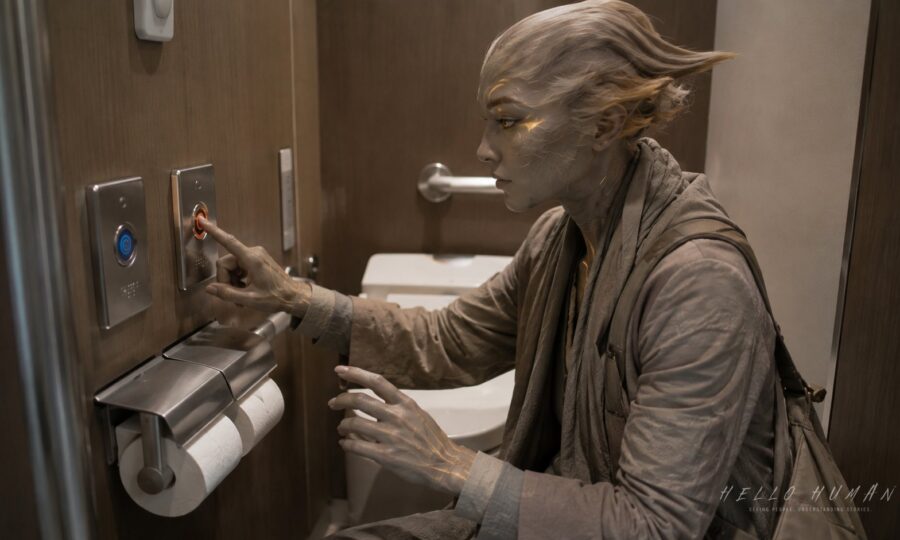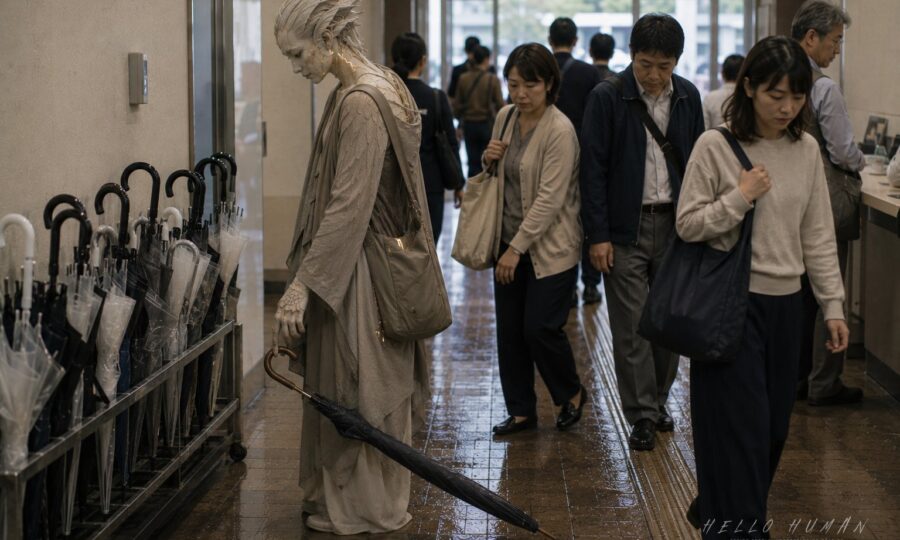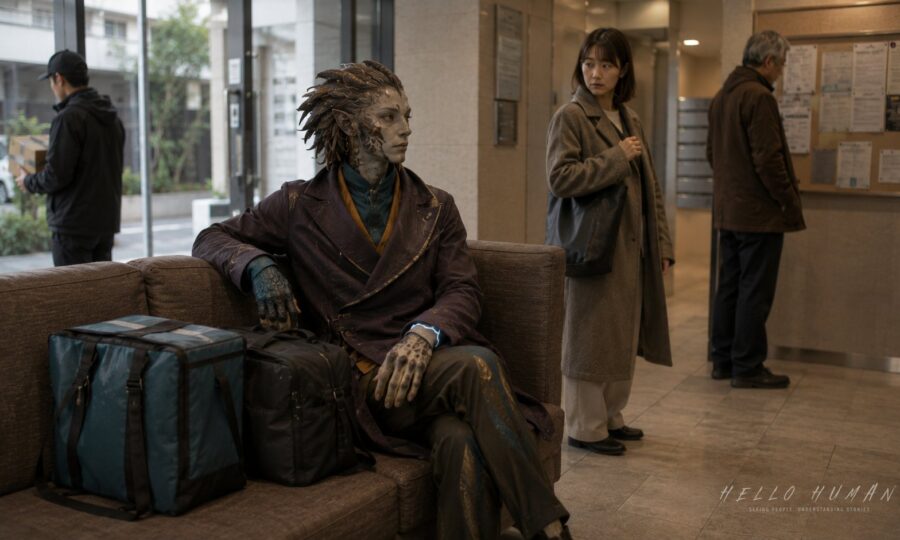
The late morning elevator opened onto a narrow service alcove behind an apartment-style hotel in Osaka, Japan.
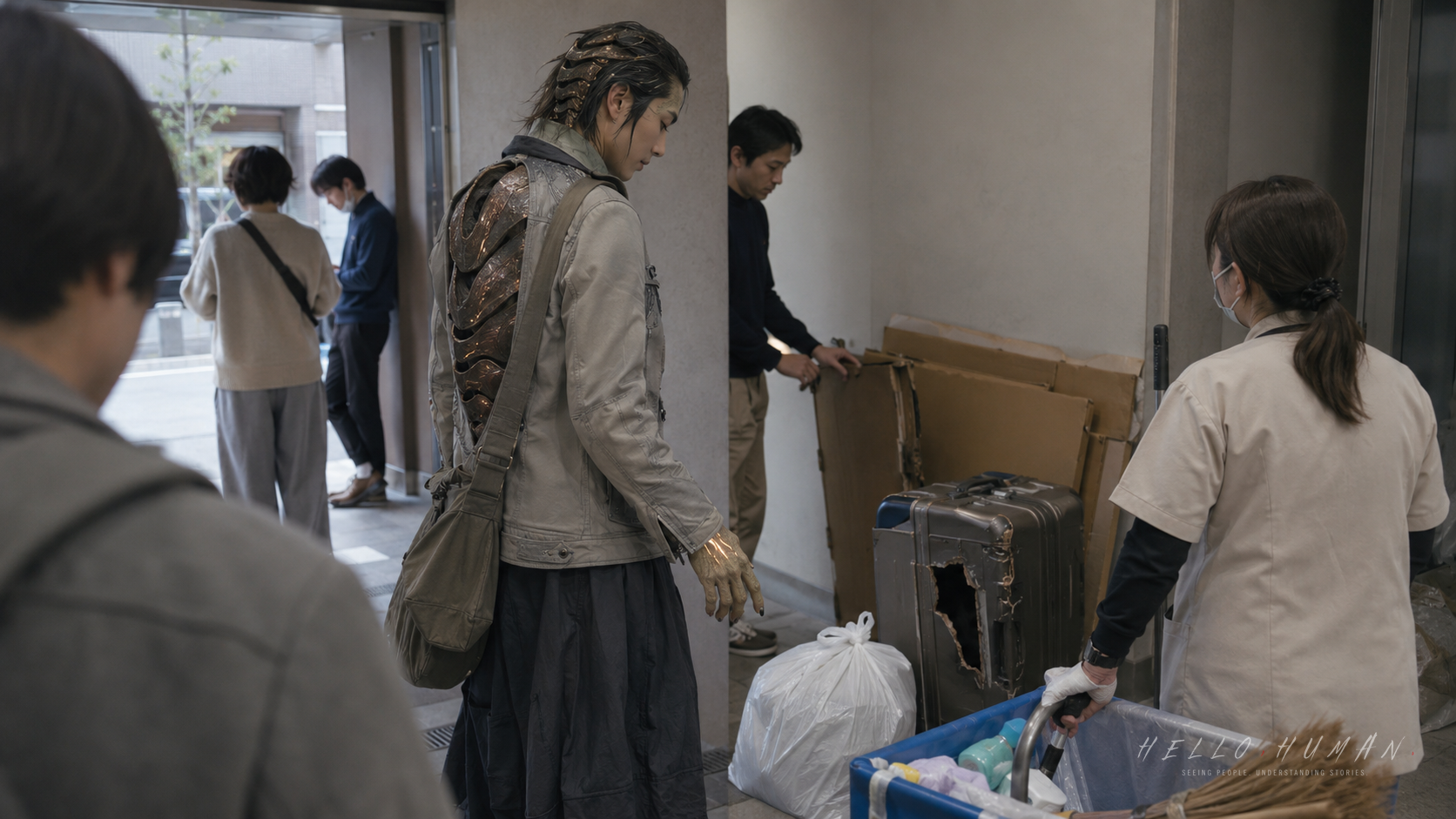
A broken suitcase stood beside the bulky-trash collection area, and Naro placed one last white cleaning bag next to it before turning toward checkout.
Observation 01The Moment Something Changed

Naro was a cicada-backed runner, mostly human in outline, with narrow bronze plates resting flat beneath his travel jacket. When he moved too quickly, the plates gave a small dry hum, like paper brushed by air.
He had checked the room twice. The towels were gathered, the floor was clear, and the broken suitcase no longer rolled. Its handle had snapped the night before, leaving him with one awkward object and one cleaning bag full of folded packaging, cracked plastic, and small things that no longer belonged in the room.
The bulky-trash area looked practical and plain. A few tied bags waited in a neat corner. The suitcase stood upright near them. Naro set his bag beside it, pressed the loose top down with both long hands, and let the small glow along his left wrist fade as if the task were finished.
Behind him, an older resident stepped out of the elevator holding flattened cardboard. She did not speak. Her eyes lowered to the bag, then to the suitcase, then to Naro’s hand already reaching for his shoulder strap.
The alcove became quiet in a different way. The resident’s hand paused over her cardboard bundle. Naro smiled softly, mistaking the pause for permission, and stepped back toward the elevator.
The visible cue was small: one extra trash bag left beside a bulky item, as if the shared area would complete the task by itself.
The Japanese reaction was not a warning, but a pause, a lowered gaze, and a hand that stopped before placing its own cardboard down.
Naro first understood only that the space had become tense, not yet why his finished room had created unfinished work outside it.
Observation 02The Reactions No One Explained
A man in a dark work coat entered from the side door with a folded umbrella. He saw the bag, slowed, and placed his umbrella closer to his leg. His shoulders angled toward the wall, giving the trash area more room than it needed.
A cleaning staff member arrived with a small cart. She did not look at Naro’s face. She looked at the tied top of the bag, then at the broken suitcase, then at the clean rectangle of floor where the bag probably should not have been resting yet.
Near the elevator, a young woman holding a laundry basket shifted her weight from one foot to the other. She glanced toward the management notice board, then away before her eyes could settle on it too obviously. Her mouth closed around a comment she did not make.
The older resident finally bent down. She did not sigh loudly. She did not say, “This is wrong.” She simply set her cardboard aside, touched the top of Naro’s bag with two careful fingers, and nudged it inward, then back out again, as if checking whether it had been prepared in the right local order.
Naro watched from the elevator threshold. The bronze plates beneath his jacket gave one faint click. He had thought no objection meant the space had accepted his decision. Now the silence looked less like approval and more like everyone trying not to hand him embarrassment directly.
The visible cue repeated through several bodies: people noticed the bag, changed their spacing, and treated the object as unfinished.
The Japanese reactions stayed indirect: paused hands, lowered eyes, a cart held still, a glance toward the notice board, and quiet physical adjustment.
Naro began to understand that the problem was not dirt alone, but leaving the next person to repair the order of a shared place.
Observation 03What the Traveler Finally Understood
Naro stepped out of the elevator again before the doors could close. He bowed once, not deeply enough to make a scene, and reached for the bag himself.
First he lifted it away from the bulky-trash corner. Then he tightened the loose top, checked the items inside, and carried it back toward the small management counter near the lobby. His wrist glow returned in a thin amber line, held close to the bone, visible only when his sleeve shifted.
The staff member followed at a slight distance. At the counter, she spoke quietly and pointed to the local disposal instructions without making the moment larger. Naro nodded. The broken suitcase had one process. The cleaning bag had another. The shared alcove was not a place to leave uncertainty for the next set of hands.
When he returned, he placed only the suitcase where it belonged for pickup and kept the bag with him. The older resident set down her cardboard at last. The cleaning cart moved forward. The young woman with the laundry basket entered the elevator without changing her pace.
No one congratulated him. That was part of the relief. The space simply returned to normal, and Naro understood that in this part of Japan, a quiet shared area could be full of instructions even when nobody wanted to pronounce them aloud.
The visible correction was physical first: Naro removed the bag, tightened it, and stopped treating the bulky-trash corner as a general leftover zone.
The Japanese response softened through resumed movement rather than praise: cardboard was placed, the cart rolled, and the elevator rhythm returned.
Naro finally understood that checkout cleaning does not end at making the room empty; it also means not transferring unfinished residue into shared space.
Practical Takeaway
In Japanese lodging or apartment-style stays, do not leave an extra cleaning bag, broken item, or uncertain trash beside a bulky-trash area just because the corner looks related to disposal. Separate the object, check the local step, and ask staff or management before placing anything that does not clearly belong there.
The social issue is not only cleanliness. A misplaced or unfinished trash item quietly assigns someone else the work of deciding, sorting, resetting, or apologizing for it. In shared spaces, people may protect your dignity by fixing the problem silently instead of pointing it out.
Pay attention when hands pause around your item, when someone glances toward a notice board, when cleaning staff look at the object rather than at you, or when people adjust their route without speaking. Those small reactions often mean the space is asking for one more step.