The small clinic waiting room in Kyoto was quiet under the heatwave, with a fan turning slowly near the reception desk and elderly patients sitting with folded towels on their laps.
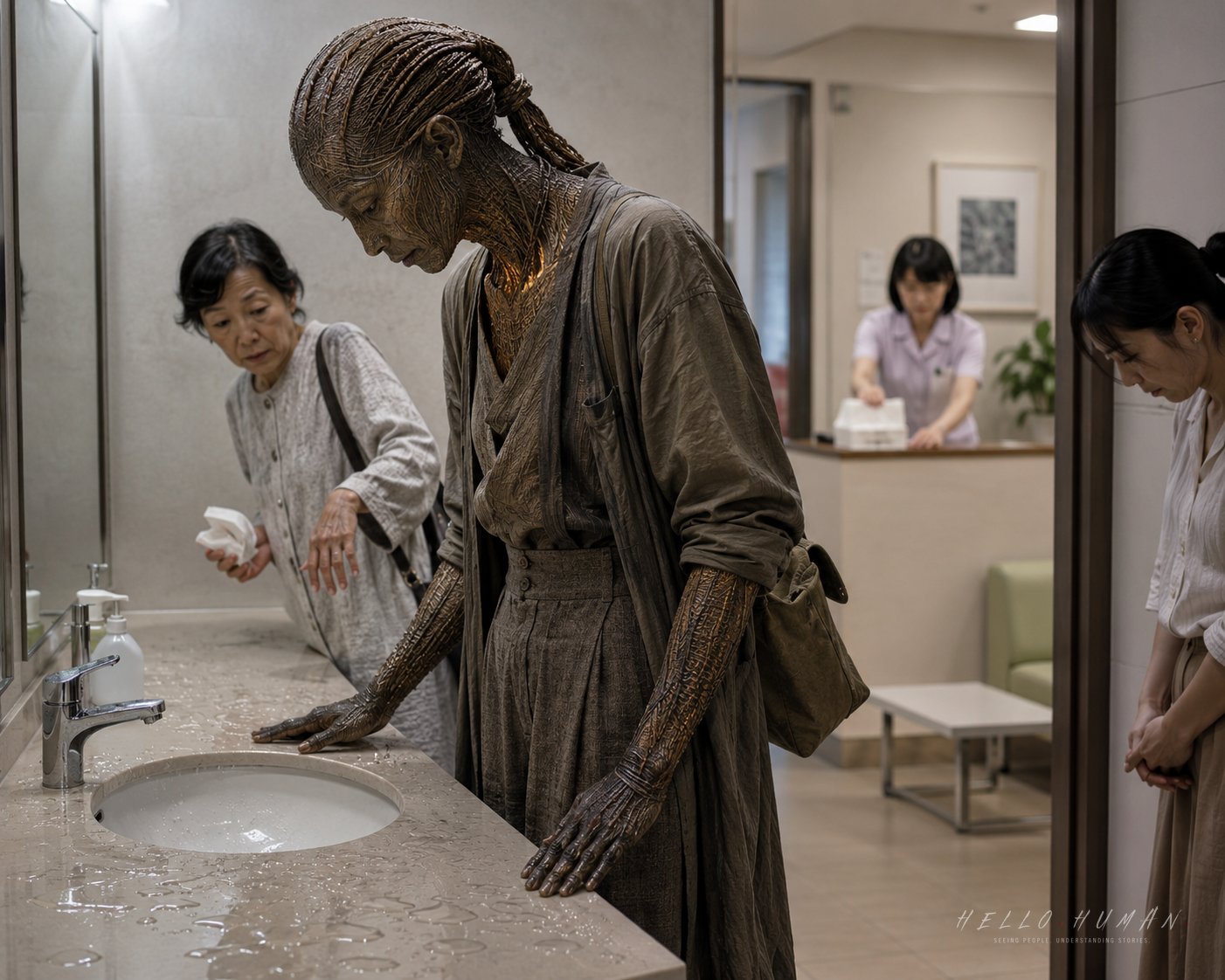
Runo stepped out of the restroom with damp fingers, his face cooled from the sink, while a thin trail of water remained shining across the counter behind him.
Observation 01The Moment Something Changed

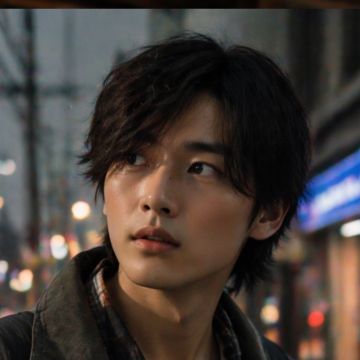
The afternoon had been heavy enough to make the clinic windows sweat. Runo had washed his hands first, then leaned closer to splash water over his cheeks and the woven grain along his neck.
He was careful with the faucet. He did not leave the tap running or drop paper on the floor. His soft woven knuckle ridges moved delicately over the handle, and the loom-like structure beneath his shoulders settled under his light summer jacket.
But water had spread wider than he noticed. It lay in a thin sheet around the faucet base, then broke into droplets across the counter where the next person would set a hand, a pouch, or a walking stick.
Runo patted his face with a handkerchief and returned to the waiting room. The fabric-grain continuity from his neck to his hands darkened slightly with dampness, and a small warm glow at his collarbone dimmed as the cooler air touched him.
The restroom door opened behind him. An elderly woman stepped in with a small cloth bag hooked over her wrist. She stopped before the sink, not long enough to make a scene, but long enough for the wet counter to become visible.
The visible cue was water left across the sink counter after washing hands and face, turning a shared surface into something the next person had to manage.
The Japanese reaction began as a pause at the threshold, a sleeve lifted away, and a careful look at the wet area rather than a direct complaint.
Runo first understood only that someone had hesitated behind him, not yet that the restroom had not been reset for the next user.
Observation 02The Reactions No One Explained
The elderly woman drew her sleeve closer to her body before reaching for the faucet. Her eyes moved over the droplets, then away from the mirror, as if not wanting her own face to make the reaction too clear.
She took a folded tissue from her cloth bag and pressed it once along the edge of the counter. The motion was practical and small. It did not accuse Runo, but it restored a dry place for her belongings.
Near the restroom door, a man waiting with a prescription envelope shifted his knees inward so the woman could step out more easily afterward. He glanced toward the sink, then lowered his gaze to the envelope again.
A receptionist behind the counter paused with a pen above a form. She looked toward the restroom entrance, then placed a small stack of paper towels nearer the edge of the reception counter without saying anything.
Another elderly patient, seated beside the fan, adjusted the towel on her lap and turned her shoulders slightly away from the restroom door. The movement was not disgust. It was a quiet refusal to enlarge the discomfort by watching it.
Runo noticed the tissue in the woman’s hand when she came out. He saw the careful sleeve, the receptionist’s paused pen, the paper towels now placed where they could be found, and the lowered eyes in the waiting room. No one named him. That made the signal harder, not easier.
The visible cue became the cleanup after the fact: tissue pressed to the counter, sleeves protected, and paper towels quietly made more available.
The Japanese reactions stayed indirect because the wet surface could be corrected more gently than it could be discussed in a small clinic waiting room.
Runo began to see that the issue was not water itself, but leaving a shared place in a condition that made the next person repair it.
Observation 03What the Traveler Finally Understood
Runo stood from his chair without making the movement large. He took one paper towel from the newly placed stack and returned to the restroom doorway when it was clear.
Inside, he did not wash again. He looked at the counter, the faucet base, the line where water had collected near the wall, and the small dry square the elderly woman had made for herself.
Then he wiped the surface fully. Around the faucet. Along the front edge. Beside the soap dispenser. His woven fingers moved slowly, and the soft ridges over his knuckles pressed the paper flat until the counter no longer reflected the ceiling light in broken wet shapes.
When he stepped out, he gave a small bow toward the waiting room, not to demand forgiveness, but to acknowledge the space he had returned to order. The receptionist lowered her eyes briefly and resumed writing. The man with the envelope shifted back into his seat. The fan continued turning.
Only then did Runo understand the local size of the mistake. In a small clinic restroom in Japan, especially with elderly people present, the sink counter is not just a place to finish your own washing. It is a narrow shared surface passed from person to person.
Leaving water there made the next visitor protect sleeves, bags, papers, medicine pouches, and balance. Drying it afterward was not extra politeness. It was returning the room to the condition that allowed the next person to use it without thinking about him.
The correction was physical first: Runo returned with a paper towel and dried the counter, faucet base, and front edge before sitting down again.
The Japanese reactions eased because the shared restroom no longer required elderly users or staff to quietly clean up after his cooling-down ritual.
Runo understood that in compact shared spaces, cleanliness is often shown by removing your trace before anyone has to ask.
Practical Takeaway
After using a public or clinic restroom sink in Japan, check the counter before you leave. Wipe away water around the faucet, soap area, front edge, and any place where your hands, face, bottle, or towel left droplets.
This matters socially because the next person may be elderly, carrying medicine, wearing long sleeves, or needing the counter for balance. A dry sink area lets them use the room without silently cleaning up your residue first.
Pay attention in small clinics, waiting rooms, public toilets, bath facilities, humid weather, and any place where people use the same narrow sink one after another. A pause, a sleeve pulled back, or someone quietly wiping after you is the signal that the space needed resetting.