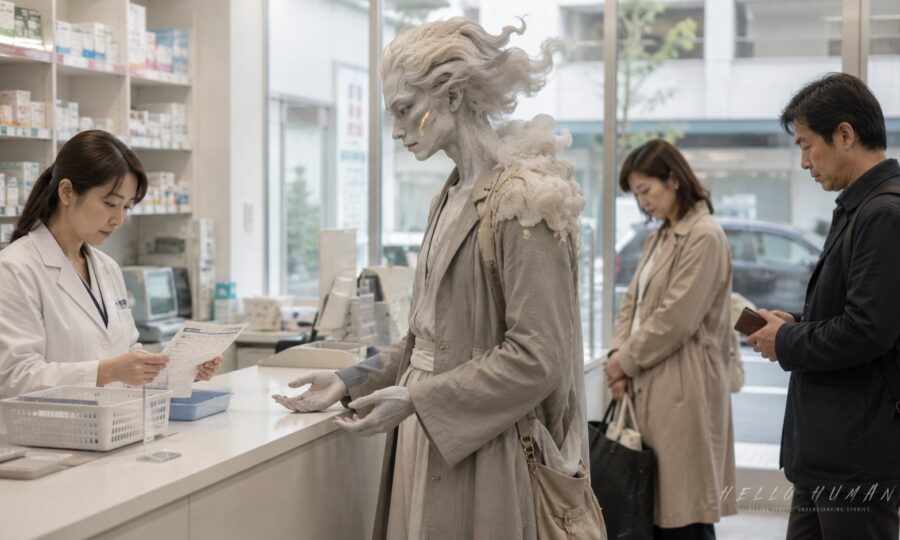
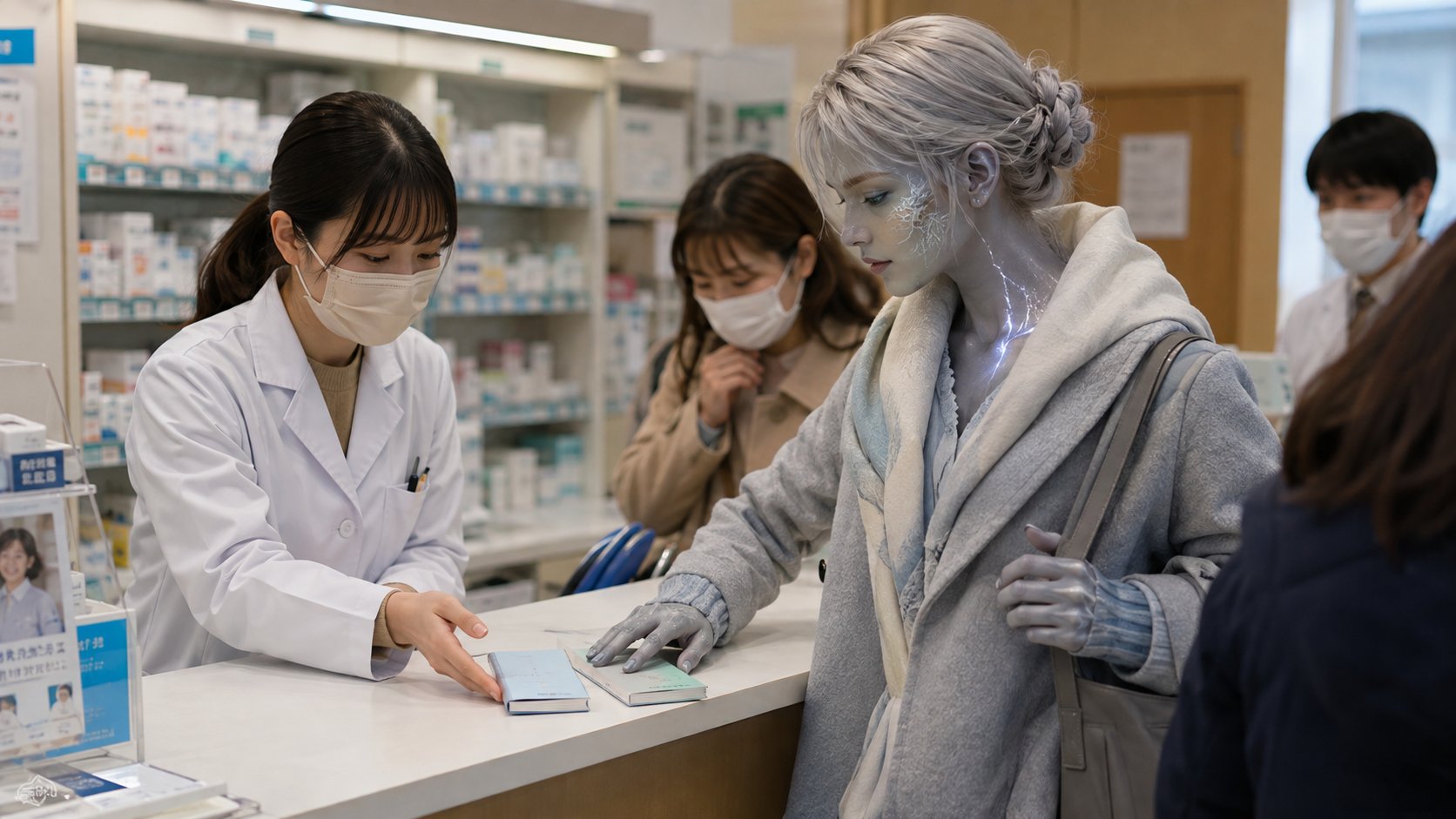
At a lightly busy community pharmacy in Sapporo, the traveler opens a document pouch and places a medication notebook (okusuri techo) on the counter. A second notebook remains tucked beside it, its edge visible beneath the traveler’s careful cool fingers.
When the pharmacist begins checking the record, the traveler touches the second notebook and indicates that it contains prescription records from another pharmacy. The gesture is neat, logical, and just slightly wrong.
Observation 01The Moment Something Changed

The traveler had treated the notebooks almost like separate files. Prescription records from one pharmacy stayed in one booklet, while records from another pharmacy stayed in the other.
Nothing about that arrangement had felt careless. It felt orderly. When visiting a pharmacy, the traveler simply reached for the notebook associated with the records from that place.
But when the pharmacist noticed the second one, the rhythm at the counter slowed. A hand that had been moving toward the first notebook paused, and the pharmacist’s gaze shifted briefly from one booklet to the other.
The traveler lifted the second notebook a little higher, as if clarification would restore the original flow. Instead, both booklets now seemed to belong to the same conversation.
The visible cue was not the existence of a medication notebook, but the separation of prescription records between two of them.
The pharmacist’s brief pause and attention to both notebooks suggested that the division mattered more than the traveler expected.
The traveler began to sense that keeping different pharmacies’ prescription records in separate notebooks was the part worth reconsidering.
Observation 02The Reactions No One Explained
The pharmacist first angled both notebooks closer together on the counter rather than continuing with only the one already open. The movement was small and practical, almost easy to miss.
A second staff member passing behind the counter glanced toward the pair of booklets, then returned to work without entering the exchange. Nearby, a waiting customer lowered their eyes again after a brief look toward the counter, leaving the pharmacist and traveler space to sort out the records.
The pharmacist’s hands remained calm, but the checking rhythm had changed. One notebook was no longer sitting alone at the center of the exchange while the other remained outside it.
Only then did the traveler look down at the two covers side by side. The cool pearl-gray edge along their cheek softened under the fluorescent light, and their fingers stopped separating the notebooks into two tidy piles.
The misunderstanding had not come from ignoring the medication records. It came from treating each pharmacy’s records as something that should remain in its own separate notebook.
The clearest reaction was the pharmacist physically bringing the two notebooks into one working space.
Other people nearby did not correct or confront the traveler; the response stayed quiet and limited to the immediate counter interaction.
The traveler started to understand that separating the notebooks also meant separating prescription information that Sapporo City advises keeping together.
Observation 03What the Traveler Finally Understood
The traveler makes the correction with their hands before saying anything else. Instead of returning the second notebook to the document pouch, they place it beside the first and stop treating the two sets of prescription records as records that should remain separated by pharmacy.
Sapporo City advises patients to record all prescribed medicines in one medication notebook. It also states that having multiple medication notebooks makes medicines harder to check and can create a risk of duplicate prescribing.
That advice changes how the traveler understands the two booklets in front of them. Rather than continuing to maintain a different notebook for each pharmacy, the practical direction is to keep the prescribed-medicine records together in one medication notebook.
The traveler slides one notebook back toward the document pouch while keeping the other in hand, now with a different intention for future records. The correction is small, but the separation that once seemed tidy no longer feels like the right way to organize them.
The physical correction is simple: stop maintaining separate medication notebooks by pharmacy.
Sapporo City’s advice is to record all prescribed medicines in one medication notebook because multiple notebooks can make medicines harder to check and can create a risk of duplicate prescribing.
The traveler now reads the pharmacist’s earlier pause as a signal that the two separated records needed attention together.
Practical Takeaway
When using a medication notebook, keep prescribed-medicine records together in one notebook rather than maintaining a different notebook for each pharmacy.
Sapporo City advises this because having multiple medication notebooks makes medicines harder to check and can create a risk of duplicate prescribing.
Pay attention when prescription records from different pharmacies have started accumulating in separate medication notebooks. That is the point to avoid continuing the pharmacy-by-pharmacy split.
More Observations
A realistic tight editorial still at a lightly busy community pharmacy counter in Sapporo. Two separate medication notebooks containing prescription records from different pharmacies lie side by side as the traveler presents one for this pharmacy while keeping the other visibly separate. A pharmacist pauses with one hand near both notebooks; one nearby customer briefly lowers their gaze while another staff member glances over without intervening. The traveler is a Frost-marked resident, a refined frost-gray-pearl humanoid, with structured cool temple planes, a pearl-gray frost-marked cheek edge, a soft collarbone transition, and careful cool fingers visibly distinct from normal human anatomy. They wear layered soft wool clothing with a light-softening collar, warm cuff integration, and a matte shoulder bag. A muted body-bound gleam follows the collarbone edge. Not a normal human with decorative frost effects. Documentary photography, realistic pharmacy lighting, no readable text, logos, phone UI, anime, fantasy illustration, portrait, or hero shot.
[/IMAGE_PROMPT_BLOCK]