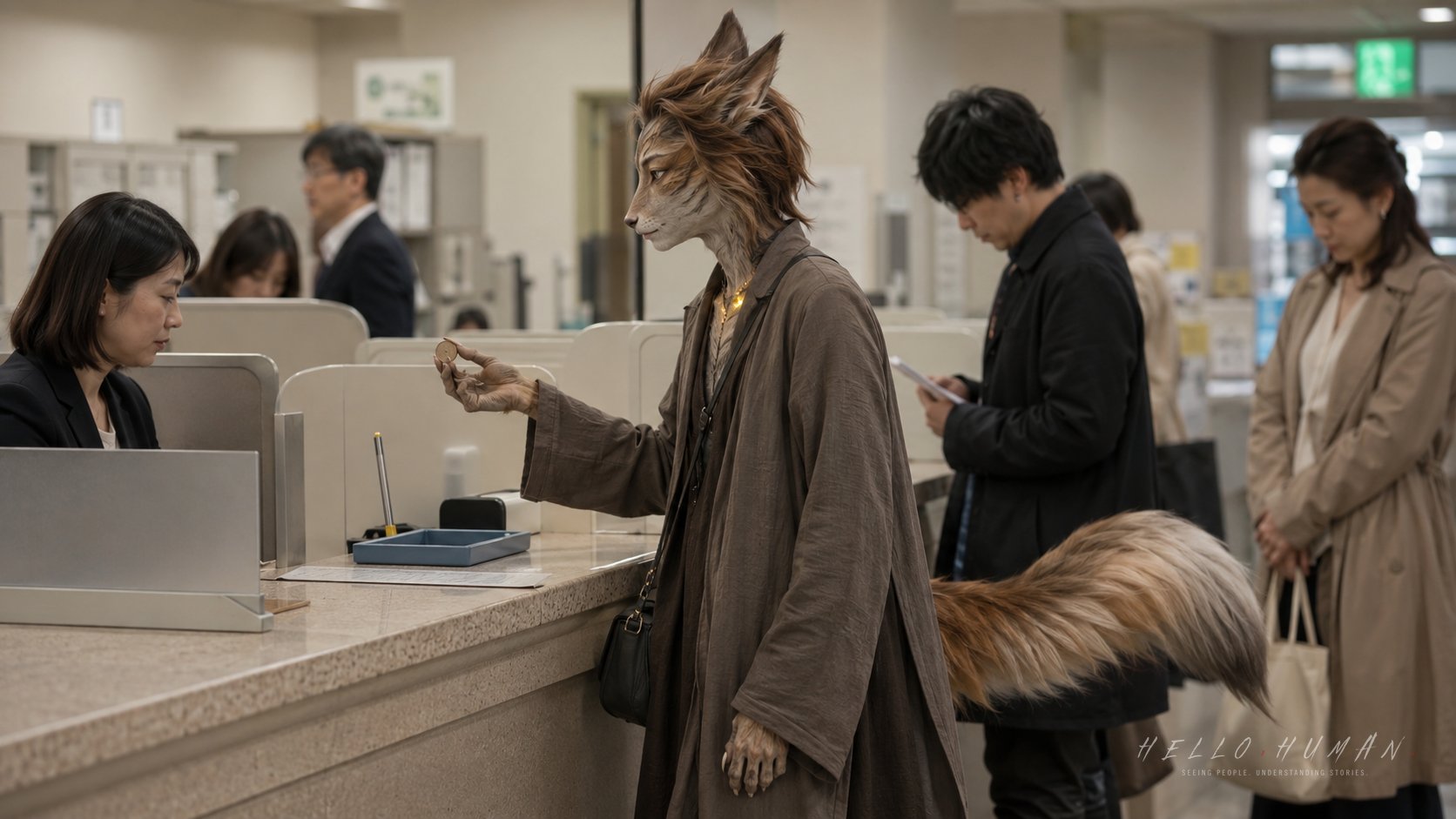
The small personal seal sat upright between two careful fingers at the Family Registry Division counter in Yokohama. Its face carried the resident’s name in Katakana, cut cleanly enough that the traveler had expected the next step to be routine.
The staff member looked at the seal, then back at the resident record in front of them. Their hand stopped before reaching for the next part of the registration process.
Observation 01The Moment Something Changed


The fox-tailed visitor had come prepared for the visible part of the procedure. The seal was theirs, the Katakana rendering was intentional, and they presented it with the quiet confidence of someone who believed the object itself carried the necessary proof.
Instead of continuing, the staff member checked the resident record again. The motion was small: eyes down, a brief return to the same section, then a pause with the documents still resting in place.
The traveler shifted one hand closer to the seal as if they might have presented the wrong item. Their low-routed crossbody stayed clear of the integrated tail line, but the tail-base shadow deepened slightly as they noticed that nothing on the counter was moving forward.
The problem was not the physical condition of the seal. The interruption existed somewhere between the Katakana engraved on its face and the information already recorded in the city’s resident record.
The visible cue was a registration process that stopped immediately after the Katakana-name seal was presented.
The staff response stayed procedural: the resident record received more attention than the seal itself.
The traveler began to sense that ownership of the seal and eligibility to register that rendering were two different things.
Observation 02The Reactions No One Explained
The staff member did not treat the seal as strange. They simply kept their attention on the record, then indicated that the Katakana reading needed to exist there before this particular seal could be registered.
A nearby person waiting for another procedure glanced toward the counter, then lowered their eyes back to their own papers. Another visitor, standing with documents held against a folder, stopped shifting forward until the exchange at the desk became clear.
Behind them, someone adjusted their position by half a step rather than crowding the counter. A second staff member briefly looked toward the stalled paperwork, then returned to their own task. No one behaved as though something dramatic had happened; the local rhythm simply held around an administrative mismatch.
Only after those small reactions accumulated did the traveler stop inspecting the seal itself. Their foxlike cheek angle turned toward the paperwork instead, and their precise hands settled lower on the counter.
The traveler had assumed the engraved Katakana was merely a readable version of their own name. At this Yokohama counter, however, that rendering had to correspond to a Katakana reading already recorded in the remarks section of the resident record before the registration could proceed.
Nearby people reacted to the pause rather than to the traveler, quietly leaving the counter exchange room to finish.
The staff kept returning to the resident record, making the missing link visible without turning the moment into a confrontation.
The traveler realized that the obstacle was not how the seal looked, but whether its Katakana name already existed in the required municipal record.
Observation 03What the Traveler Finally Understood
The traveler drew the seal back from the center of the counter and placed it carefully beside their own papers. That small physical correction came first: stop trying to advance the seal registration, and deal with the resident-record entry that had to precede it.
The sequence now made sense. For a foreign resident from a non-kanji-using country who wants to register a personal seal bearing the Katakana reading of their name in Yokohama, that Katakana reading must first be recorded in the remarks section of the resident record.
The misunderstanding had been easy to make because the seal felt like the central object. It was visible, personal, and already engraved. But the decisive step lived earlier in the administrative chain, inside the resident record.
The traveler’s posture softened. A restrained amber shadow remained visible at the collar opening, but the deeper tail-base shadow receded as their attention moved away from the rejected object and toward the correct order of procedures.
Nothing about the encounter required embarrassment. The counter had exposed a sequence: record the Katakana reading first, then return to the registration attempt with a seal whose engraved name matches that recorded reading.
The traveler’s first correction was physical: the seal came back from the registration position while attention shifted to the resident record.
The staff pause signaled a prerequisite in the municipal process, not a judgment about the traveler or the seal.
The traveler understood that in this case the name rendering had to exist in the record before the engraved object could be accepted into the next procedure.
Practical Takeaway
If you plan to register a personal seal in Yokohama using the Katakana reading of your name, have that Katakana reading recorded in the remarks section of your resident record before presenting the Katakana-name seal for registration.
The order matters because the counter needs the engraved Katakana rendering to correspond to the reading already recorded in the resident record. Having the seal made first does not by itself create that municipal match.
Pay particular attention when a Japanese administrative procedure connects a physical object to information already held in an official record. A small pause at the counter may mean the missing step happened earlier in the sequence, not that the object in your hand is necessarily the problem.
More Observations
A realistic editorial still at the Family Registry Division registration counter of a Yokohama ward office, eye-line reaction triangle composition. A personal seal engraved with the resident’s name in Katakana is held forward while the registration process pauses because the matching Katakana reading is not yet recorded in the resident record. Two nearby Japanese visitors respond subtly: one lowers their gaze to papers, another leaves a little extra counter space. The traveler is a Fox-tailed visitor, refined humanoid, russet-smoke-cream palette, with an integrated foxlike cheek structure, alert skull ear-base flow, anatomically integrated low tail, and precise non-human hand posture. Everyday smoked-cotton outerwear is cut around the tail base, with a low-routed crossbody avoiding the tail line. A restrained amber body-bound glow shows at the collarbone transition. Documentary indoor photography, natural municipal-office light, quiet social tension; not a normal human with fox ears or a decorative tail. No readable text, logos, phone UI, anime, fantasy illustration, portrait, or hero shot.
[/IMAGE_PROMPT_BLOCK]