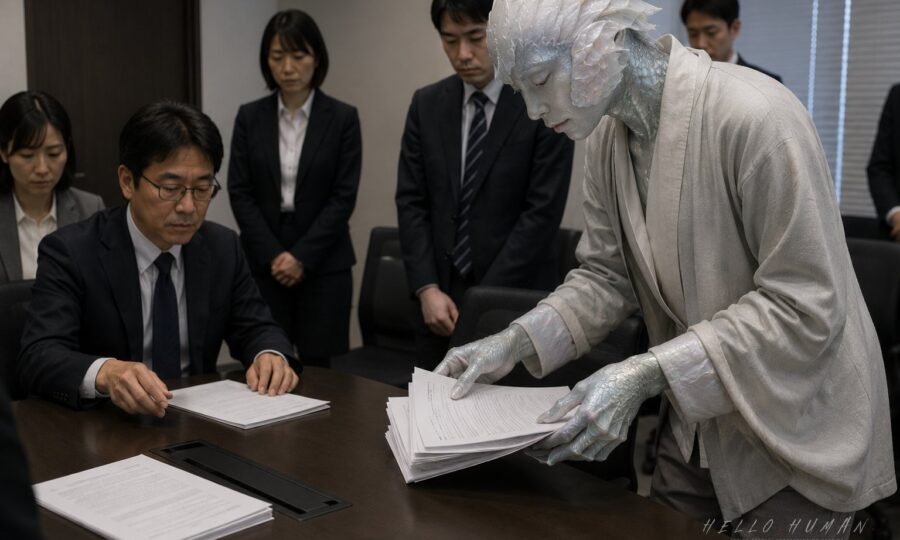
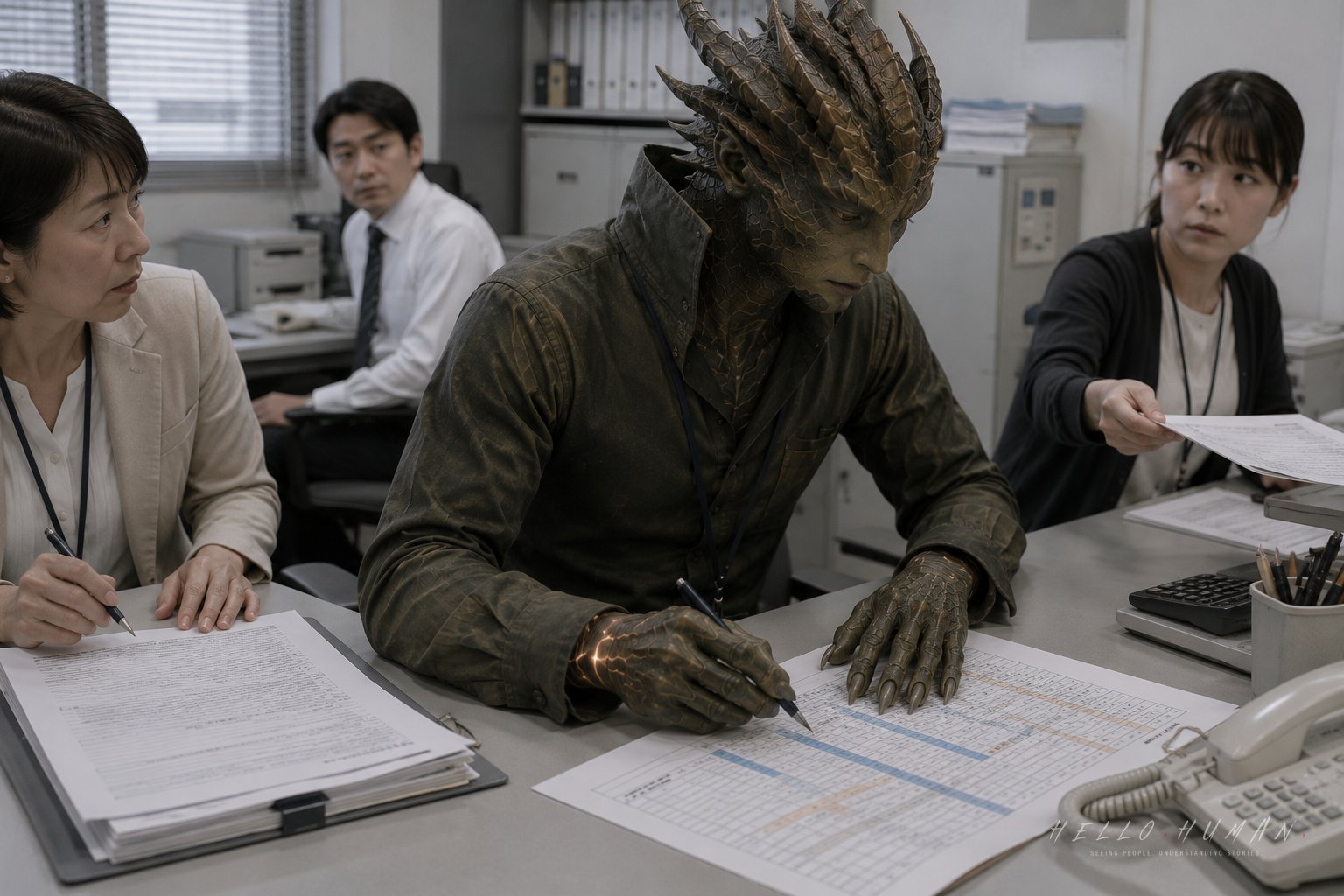
The personnel desk in the Okayama office was lightly busy, with ordinary papers moving from one pair of hands to another. Beside the traveler lay a completed Notification of Agreement on Overtime and Work on Days Off, the document commonly called a 36 Agreement notification.
The traveler placed one long, scale-jointed finger beside an employee’s schedule and began marking statutory overtime. The agreement was finished, after all. The next step seemed obvious.
Observation 01The Moment Something Changed


The traveler’s hand stopped only because the person across the desk stopped first. A pen that had been moving through another stack of paperwork hovered above the page. No one reached for the schedule.
The completed notification sat between them with the visual confidence of a finished task: boxes filled, signatures in place, nothing obviously missing from the sheet itself. To the traveler, that made the overtime assignment feel like administration following administration.
But the staff member’s attention did not stay on the completed document. Their eyes moved from the schedule back toward the notification, then toward the part of the desk where unfinished procedural work was still being handled. The distinction was small enough to miss if you were watching only the paper.
The traveler drew back slightly. A muted copper line caught at the base of the integrated horns as the gesture stopped, then faded back into the deep bronze-green structure of the face and neck.
The visible cue was not an error written on the completed notification; it was the pause that appeared when overtime was about to be assigned.
The nearby staff treated the document as part of a process that had not yet reached its operative point.
The traveler began to suspect that “completed” and “ready to act on” were not the same status.
Observation 02The Reactions No One Explained
One staff member lowered their pen and left the overtime entry untouched. Another paused with a document in hand instead of passing it across the desk. A third glanced toward the completed 36 Agreement notification, then back to the assignment sheet without continuing the workflow.
The reactions were modest. No one treated the traveler as reckless, and no one turned the moment into a public correction. The desk simply lost its previous rhythm around that one action.
A chair shifted a few centimeters as someone leaned closer to check the paperwork. A voice that had been discussing schedules became quieter. The next handoff waited.
Only then did the traveler look again at the sequence rather than the appearance of the document. The notification had been completed, but the required submission to the Labour Standards Inspection Office had not yet happened. The traveler had mentally treated document completion as permission to move into statutory overtime assignments.
That was the mismatch everyone else at the desk had noticed. The paper itself was not being rejected. The timing of the action was.
Several small interruptions appeared around one attempted action: the untouched schedule, the paused handoff, and the repeated glance back to the notification.
The Japanese staff did not need a dramatic reaction; their shared hesitation marked that the personnel process had been advanced too soon.
The traveler could now see that the missing step was procedural, not cosmetic.
Observation 03What the Traveler Finally Understood
The traveler removed the hand from the overtime entry first. The schedule slid back into its previous position, and the completed notification remained separate from any new statutory overtime assignment.
Then the distinction became clear. Under the system represented by this 36 Agreement, concluding the labor-management agreement and completing its notification are not enough by themselves. The agreement must also be submitted to the Labour Standards Inspection Office before statutory overtime or statutory-holiday work is performed within its scope.
The traveler had mistaken a finished-looking object for a finished legal step. At a personnel desk, that difference can be visually quiet: the same document remains on the desk, the same schedule remains nearby, and nobody needs to raise a voice. What changes is whether the process has actually crossed the required filing point.
The traveler’s long fingers settled flat beside the paperwork instead of moving it forward. The scale plates along the jaw and throat relaxed with the posture. Nothing spectacular had happened, but the order of operations had become visible.
The physical correction was simple: stop assigning the statutory overtime and return the schedule to its waiting state.
The reaction at the desk reflected a procedural boundary: the completed agreement still required submission before the overtime step could proceed.
The traveler learned to read completion of a form separately from completion of the process that gives it practical effect.
Practical Takeaway
Before assigning statutory overtime or statutory-holiday work under a 36 Agreement, make sure the labor-management agreement has been concluded and the required notification has been submitted to the Labour Standards Inspection Office.
The distinction matters because a completed notification sitting on a personnel desk is not, by itself, the end of the required procedure. Performing the covered work without the filing step violates the Labour Standards Act.
Pay particular attention when a form looks complete and staff are about to move directly into scheduling or work assignments. In this kind of Japanese personnel procedure, the important question is not only whether the document is finished, but whether the required submission has already occurred.
More Observations
A realistic editorial still at a personnel desk in an Okayama office, framed as a hands-and-object detail with enough upper body visible. A completed 36 Agreement notification lies beside an employee schedule while the traveler is visibly beginning to assign statutory overtime before the notification has been submitted. Two nearby Japanese staff pause: one leaves a pen suspended above paperwork, another holds back a document handoff, their attention quietly returning to the completed notification. The traveler is a Dragon-horn traveler, a refined dragon_horn_humanoid in deep bronze green, warm horn brown, and muted copper: integrated horn bases reshape the forehead, jaw and neck carry continuous scale plates, and long scale-jointed fingers rest precisely over the schedule. Everyday office-ready clothing has a friction-soft collar shaped below the horn-root ridge and widened cuffs. A low copper body-bound glow shows at the wrist joint. Not a normal human with decorative horns. Documentary indoor realism, natural office light, no readable text, no logos, no phone UI, no anime, no fantasy illustration, no portrait, no hero shot.
[/IMAGE_PROMPT_BLOCK]