The fuel nozzle clicked back into place, and the screen beside the pump settled into its finished state. A narrow receipt slid out below it, curling slightly in the afternoon air.
The traveler took the paper, closed the fuel door, and turned back toward the car. Elsewhere on the forecourt, the separate automatic change machine remained unused.
Observation 01The Moment Something Changed


The traveler had paid in advance with cash, selected an amount, and returned the nozzle after the tank stopped taking fuel. The pump had printed a receipt. Every visible movement at the dispenser seemed complete.
The mistake could be stated plainly: take the receipt from the fuel dispenser and return toward the car without scanning its barcode at the separate automatic change machine, even though change was still due.
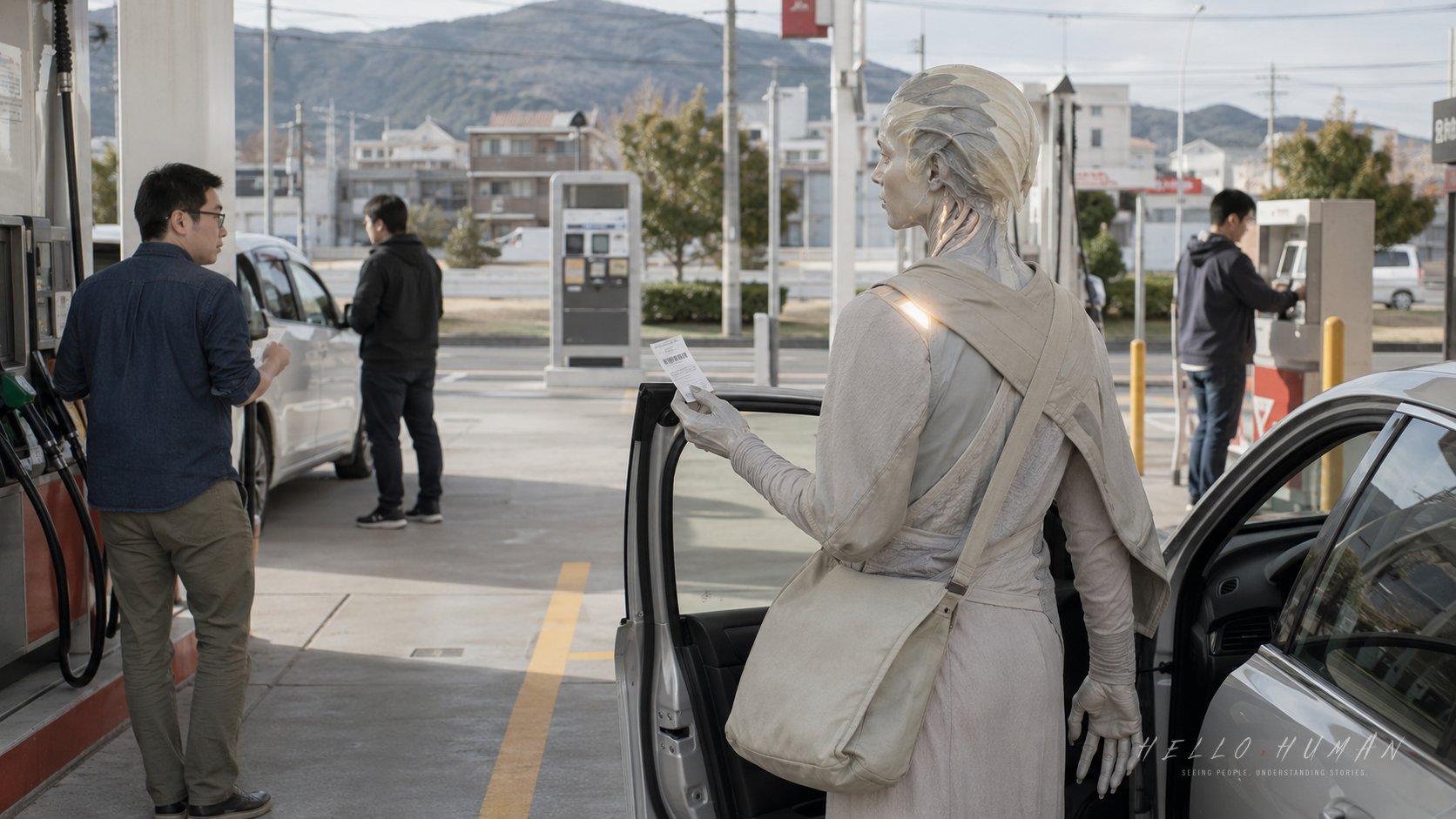
The Wing-marked resident folded the receipt once and held it between two still fingers. Beneath a soft gray travel layer, the shoulder line curved around faint wing-root anatomy, and a muted gold seam-light gathered briefly where the fabric relieved its pressure.
At the next pump, a Japanese customer returned a nozzle and took a receipt of his own. He glanced at the paper in the traveler’s hand, then toward the machine used to complete the return of change.
He did not call out. He simply carried his own receipt in that direction.
The traveler treated the printed receipt as proof that the transaction had ended.
A nearby customer connected the receipt to another machine without explaining the connection.
The unfinished part of the process was visible only in the relationship between the receipt and the separate change machine.
Observation 02The Reactions No One Explained
The first customer placed his receipt flat against his palm and walked to the automatic change machine with the unhurried certainty of someone following the next ordinary step.
Another driver at a nearby dispenser finished fueling and looked briefly at the traveler’s folded receipt. Her gaze shifted toward the same machine before she returned to her own payment flow.
A third customer held the barcode portion of a receipt to the reader. A small mechanical movement followed inside the machine, and the customer lowered one hand to collect the returned change.
No one rushed across the forecourt. No warning was shouted, and no staff member appeared to stop the traveler. The reactions remained small: a brief glance, a familiar walking path, and the repeated movement of receipts toward the separate reader.
The traveler paused beside the car. The pump had finished dispensing fuel, but the surrounding customers were showing that the cash transaction had one more stage.
The Japanese customers revealed the missing step by completing it themselves.
Their attention followed the receipt toward the change machine rather than treating it as a final record.
The traveler began to understand that fueling had ended before the advance-payment process had fully ended.
Observation 03What the Traveler Finally Understood
The traveler turned away from the car and unfolded the receipt. The printed strip had looked like an ordinary record of a completed purchase. In this payment flow, it also carried the information needed to collect the remaining money.
At the automatic change machine, the traveler watched the customer ahead place the barcode section of a receipt against the reader. When the machine became available, the Wing-marked resident repeated the same movement.
The barcode was accepted. The change that had not been dispensed at the fuel pump became available through the separate machine.
The traveler collected the money, smoothed the receipt, and returned to the car. No one acknowledged the correction. The next nozzle lifted, another receipt printed, and the forecourt continued in its ordinary rhythm.
What had caused the confusion was not simply forgotten cash. It was the assumption that one machine handled every part of the transaction. At this type of advance-payment self-service station, the fuel dispenser can issue the receipt while a separate automatic change machine completes the return of change.
The traveler corrected the mistake by carrying the receipt to the separate barcode reader.
The surrounding customers had communicated the missing step through ordinary repeated behavior.
When change was due, the receipt was not merely proof of payment; it was also the key to receiving the remaining money.
Practical Takeaway
At an advance-payment self-service apollostation, check the receipt after fueling. When change is due, take the receipt to the automatic change machine and scan its barcode before leaving.
Do not assume that the fuel dispenser will return the change directly. The receipt and the separate change machine may form the final part of the same cash-payment process.
Pay particular attention when paying cash in advance, when the tank takes less fuel than the amount selected, or whenever the printed receipt indicates that another step remains.
More Observations
A realistic editorial still at an advance-payment self-service apollostation gas station in Japan, framed across a fuel-dispenser lane. The traveler has finished fueling and is turning back toward the car while holding the printed barcode receipt, unaware that change is still due. A separate automatic change machine is clearly visible elsewhere on the forecourt but not tied to a specific exit position or distance. One Japanese customer carries a receipt toward it, while another quietly scans a receipt and collects change. The traveler is a refined Wing-marked resident in warm ivory, soft gray, and muted gold, with integrated wing-root shoulder anatomy, an elongated throat line, unusual calm hands, and a subtle body-bound glow at one shoulder seam. Matte travel clothing uses pressure-relieving shoulder seams, and an offset bag strap routes beneath the wing-root contour. Documentary photography, natural daylight, restrained social tension, no readable text, no logos, no phone UI, no anime, no fantasy illustration, no portrait, no hero shot.
[/IMAGE_PROMPT_BLOCK]