The red-capped condiment jar belonged in the narrow rail between the ramen bowls and the wall, not beside one customer’s elbow.
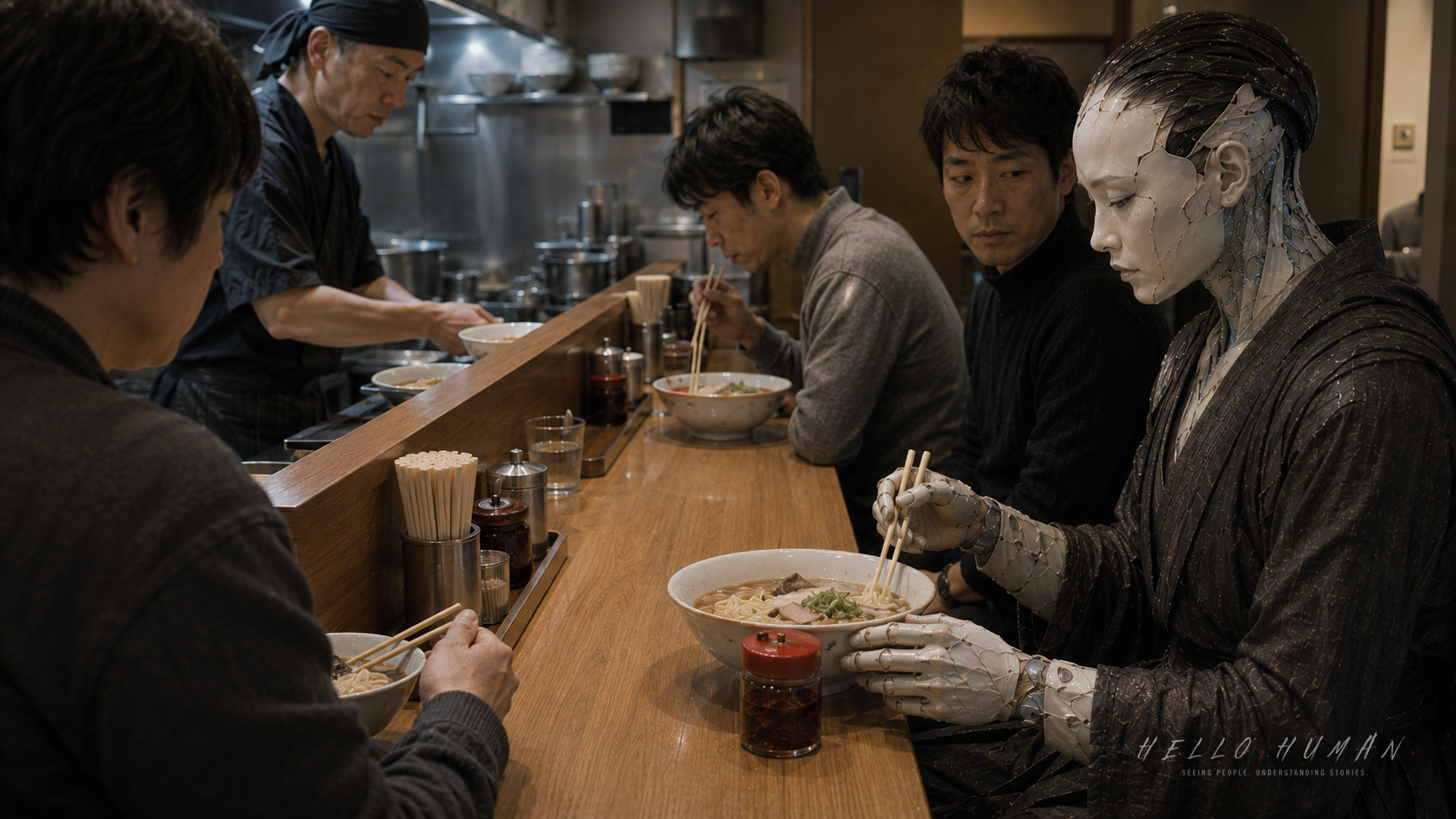
At a small counter restaurant in Sapporo, Sen lifted it carefully, seasoned his soup, and kept it next to his bowl.
Observation 01The Moment Something Changed


The restaurant had twelve counter seats and no spare space. Coats hung under stools. Bowls arrived from behind a half-height partition. Between each pair of seats, small items lined the counter rail: chopstick cases, napkins, vinegar, chili oil, and one red-capped jar of seasoning.
Sen sat at the end of the counter with his shoulders angled inward. His porcelain cheek plates moved slowly when he breathed, and fine ceramic seams around his mouth tightened whenever steam touched his face.
He did not look like a person in makeup. His eyelids lowered in careful, delayed stages, and the pale plates of his face met at tiny natural seams, like a living cup repaired before it ever broke.
When his ramen arrived, he watched the customer two seats away shake the condiment jar once and return it to the rail. Sen copied the first part exactly. He picked up the jar, held it over his bowl, tapped it twice, and set it down beside his water glass.
The original spot in the rail remained empty. It was a small absence, but in the tight counter it looked larger than the jar itself.
The mistake was not taking the condiment. It was keeping a shared object inside one person’s space.
The empty spot on the counter rail became the visible sign of the problem.
Sen copied the action but missed the return.
Observation 02The Reactions No One Explained
The customer on Sen’s right finished mixing noodles and reached toward the rail without looking. His fingers stopped where the jar should have been. He withdrew his hand and picked up his water instead.
The woman on Sen’s left glanced at the jar by his bowl, then at the empty place in the rail. She lifted her spoon, lowered it again, and adjusted her bowl closer to herself to make more room, though the room she needed was not for the bowl.
Behind the counter, the cook noticed the gap while sliding a fresh bowl forward. His eyes moved from the empty rail to Sen’s elbow. He did not say anything. He only placed the next bowl slightly farther left, leaving a clean path in front of the shared condiments.
A customer at the far end leaned forward, checking whether there was another jar near the napkins. There was not. He straightened, stirred his ramen once, and waited.
The sound of eating continued. No one stared for long. The room kept its rhythm, but a thin delay had entered it. People seasoned more slowly, reached less naturally, and watched the counter rail before watching their food.
Sen noticed the silence before he understood the object. The ceramic seams around his mouth tightened in small hairline lines. His fingers rested near the jar, protective for a moment, then uncertain.
Customers avoided asking for the jar directly, but their hands kept stopping near its missing place.
The cook adjusted the counter space instead of correcting Sen aloud.
At a shared counter, a small item can belong to everyone even when it sits near one seat.
Observation 03What the Traveler Finally Understood
Sen looked from the jar to the rail. The shape of the empty space matched the base of the condiment jar exactly. The chopsticks, napkins, vinegar, and chili oil all had their own small positions. Nothing on the counter had become personal just because his hand had touched it.
He lifted the jar with both hands. The movement was careful, almost formal. Instead of sliding it across the counter toward one person, he returned it to the rail where everyone could reach it.
The customer on his right waited half a breath, then took it. He seasoned his bowl once, returned the jar, and continued eating without looking at Sen.
Sen’s shoulders lowered. His porcelain face remained still, but the tightened seams around his mouth softened. He moved his water glass closer to his own bowl and cleared the shared rail completely.
A few minutes later, he wanted more seasoning. This time he looked left and right first. He picked up the jar, tapped it once over his ramen, and returned it before lifting his chopsticks again.
The counter settled back into its ordinary rhythm. Hands reached, jars moved, bowls shifted, and each object returned to a place that made the next person’s movement easy.
Sen’s correction was physical first: he returned the jar and cleared the shared rail.
No one needed a direct explanation once the condiment’s shared position was restored.
The practical message was in the object’s home: use it, then put it back where others can reach it.
Practical Takeaway
At a Japanese restaurant counter, food court table, or shared dining area, use common condiments briefly and return them to their original spot right away. Avoid keeping sauces, spice jars, chopstick holders, napkin boxes, or water pitchers beside your own bowl unless there are individual ones for each seat.
Shared items help the whole counter move smoothly. Returning them quickly lets other customers season their food without asking, reaching across you, or interrupting the quiet rhythm of the meal.
Pay attention when someone’s hand pauses near an empty spot, when customers glance toward an item beside you, or when staff quietly clears space around the counter rail. Those small reactions often mean the object is shared, not yours for the whole meal.