The rain had not reached Kyoto yet, but the museum windows carried the pressure of it. In the late-night corridor, umbrellas leaned inside plastic sleeves near the entrance, and the floor held a dull reflection from the ceiling lights.
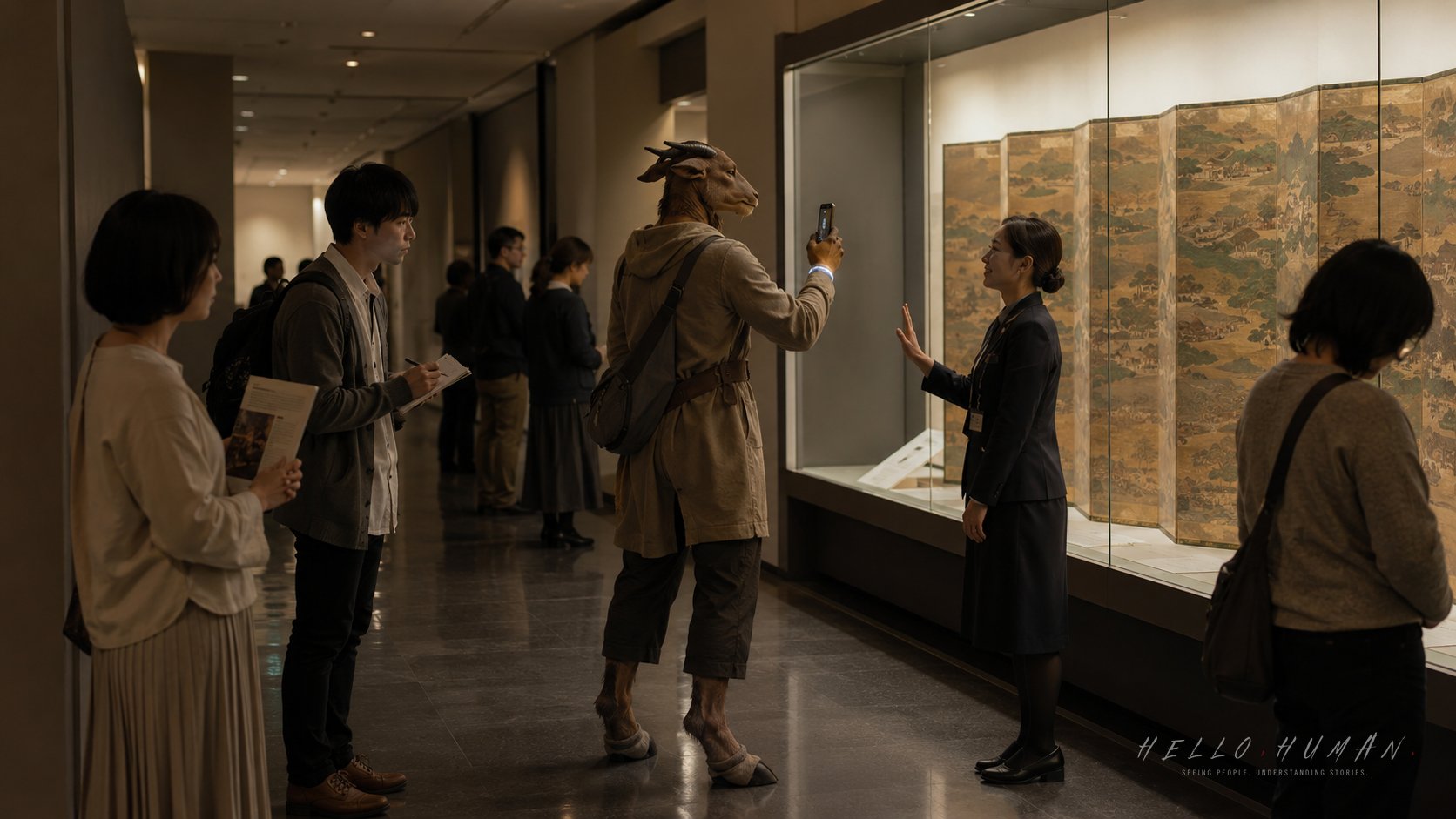
Naro stood beside a narrow wall label with a phone in one hand. His cropped trouser hems cleared his careful hoof-step legs, and the strap of his stabilized shoulder sling sat slightly behind his shoulder line, balanced for his backward-tilted posture.
Observation 01The Moment Something Changed


The corridor was not crowded, but it had that museum density where every movement arrived larger than intended. A couple stood two steps ahead, a student leaned close to a display case, and a staff member in a dark jacket waited near the corner with her hands folded.
Naro had read the English line on the small sign. It mentioned flash, and the crossed lightning symbol was the clearest part. The Japanese text above it was longer, but he did not read fast enough to hold all of it, and the room seemed too quiet for a question.
So he lifted his phone without sound. His light hands angled it toward the corridor where the lacquered object behind glass caught a low amber reflection. The short horn buds at his hairline tilted with his concentration, and a faint warm glow gathered at the edge of his wrists.
The staff member did not rush. She stepped one pace closer, then stopped just inside his side vision. Her smile stayed polite, but her eyes moved from the phone to the sign and back again.
The visible cue was small: a phone rising, not a flash firing, in a corridor where the posted rule had more information than the English phrase made obvious.
The Japanese reaction began with position, not volume: one staff member came near, and nearby visitors made their bodies quieter around the lifted phone.
Naro first understood only that the air had changed, not yet what part of his action had caused it.
Observation 02The Reactions No One Explained
The couple ahead did not turn their heads fully. One of them lowered her brochure until it covered less of her face, then looked briefly toward Naro’s raised hand. Her companion shifted half a step away from the glass, leaving a thin open lane between Naro and the staff member.
The student near the display case stopped writing. His pen hovered above a notebook, then his gaze dropped to the floor before sliding toward the sign. He did not stare at Naro. He simply paused at the exact moment the phone framed the object.
The staff member’s shoulders angled softly, as if making a small wall without becoming one. She raised one hand only to chest height, palm low, and spoke in a voice meant to reach Naro but not the whole corridor. “Sumimasen,” she said, then added a careful phrase in English: “No photo here.”
Another visitor behind Naro slowed before entering the corridor. Her umbrella bag rustled once, then became still. She waited, eyes lowered, as if the quiet itself needed to be protected until the phone came down.
Naro felt the late realization move through his posture before it reached words. His hoof-shadow seams went still. The phone in his hand suddenly felt taller than his body, brighter than the wrist glow he usually forgot was visible.
The visible cue repeated through several bodies: stopped writing, lowered eyes, a sidestep, a waiting visitor, and a staff member placing herself near the phone.
The Japanese reactions avoided embarrassment by keeping the correction small, low-voiced, and spatial rather than public or sharp.
Naro began to understand that silence did not make the photo harmless; the raised device itself had entered the shared viewing space.
Observation 03What the Traveler Finally Understood
Naro lowered the phone first. He turned the screen inward against his coat, then let his hand fall below the level of the display case. Only after that did he bow, small and immediate, careful not to let his horn buds dip too close to the glass.
The staff member’s smile softened by a degree. She nodded once, still quiet, and moved her hand toward the sign without tapping it. From close range, Naro could see that the Japanese wording covered more than flash. The English fragment had not been wrong, but it had not carried the whole rule.
He stepped back from the wall label and placed both hooves neatly inside his own space. The softened sole material under his feet made almost no sound. His shoulder sling settled against the gait-balanced coat structure, and the corridor widened again by the amount of one lowered phone.
The student resumed writing. The couple looked again at the display case. The visitor behind him entered the corridor with a slight nod to the staff member, not to Naro, which somehow made the kindness clearer.
Naro did not feel scolded. He felt the shape of the room return. The rule was not only about protecting an object from flash; it was about protecting the viewing atmosphere, the ownership of images, and the shared agreement that some things in a museum stay looked at, not taken.
The physical correction was simple and readable: the phone came down, the screen turned inward, and the traveler stepped back into his own space.
The Japanese response eased only after the action changed, because the lowered device repaired the corridor more clearly than an explanation could.
Naro finally understood that a partial translation can invite a narrow reading, but the room’s stillness was also part of the rule.
Practical Takeaway
In a Japanese museum or gallery, pause before taking even a silent phone photo. If the English sign mentions flash but the local-language text is longer, treat that as a reason to lower the phone, look for additional symbols, or ask staff quietly before framing the shot.
It matters socially because the phone changes the shared viewing space before the shutter sound or flash appears. Other visitors may not correct you directly, but their paused hands, lowered eyes, and small spacing changes can show that the action has become visible.
Pay attention to this signal in museum corridors, exhibition rooms, temple treasure halls, historic houses, and any quiet viewing area where signs are partial, small, or bilingual in uneven detail. When people become still around your phone, lower it first and understand afterward.