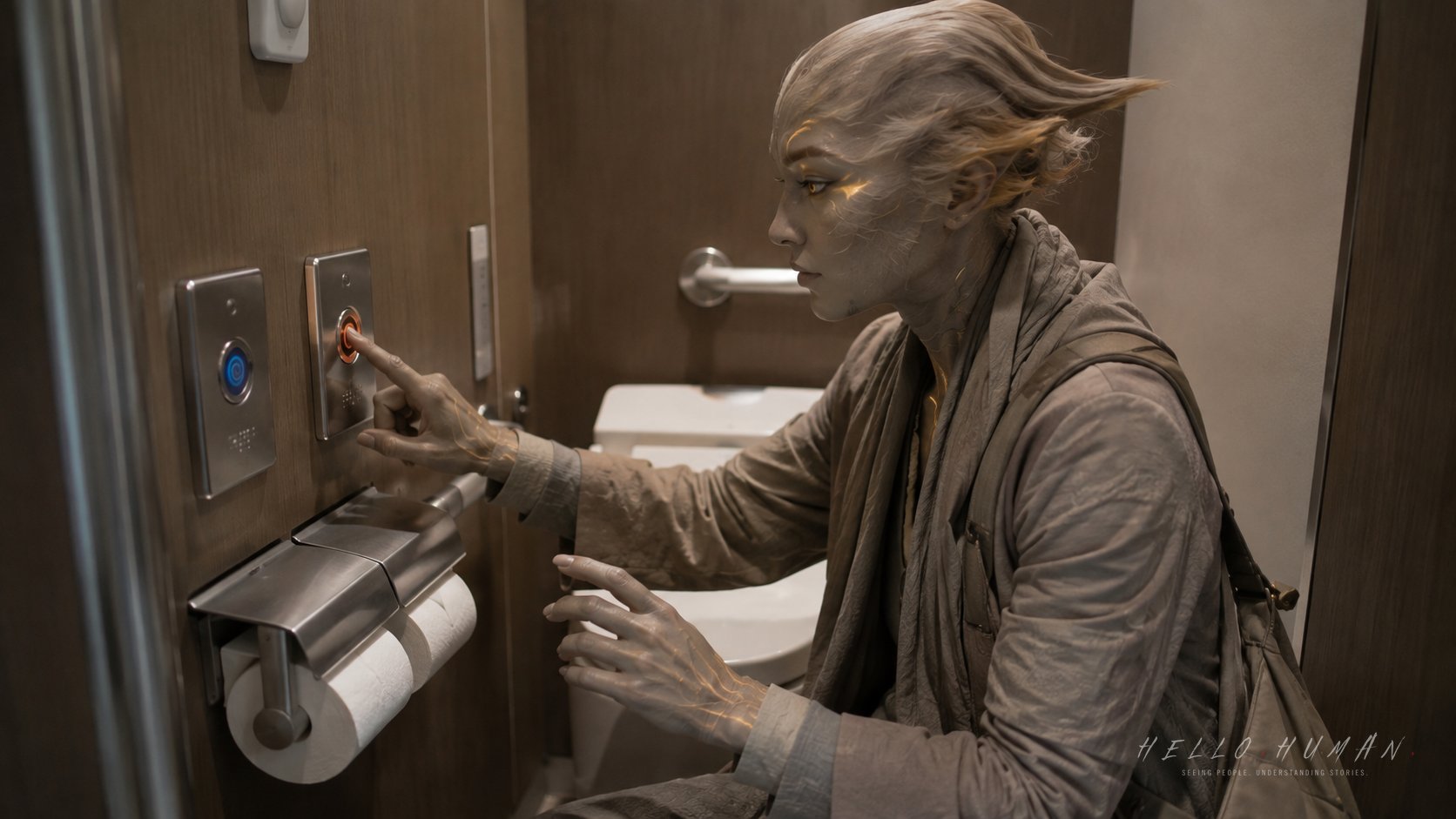
Inside a public toilet stall in a Tokyo public or visitor facility using JIS S 0026-style controls, the traveler reaches toward the buttons beside the toilet-paper holder.
The Cat-eyed walker chooses one quickly and presses. The intended flush does not happen; the finger has landed on the emergency call button instead.
Observation 01The Moment Something Changed

For a moment, the traveler leaves the finger where it is. The flush button and emergency call button are both beside the toilet-paper holder, close enough to be read as one small field of controls when someone is acting by habit rather than checking first.
The visitor’s careful hand pulls back a few centimeters. Smoke-taupe fingers hover in front of the buttons, no longer moving automatically. The catlike eye setting turns toward the control area with a concentration that was missing a second earlier.
Nothing about the mistake is large. There is no dramatic gesture, no frantic search, and no second wrong action. It is simply the wrong button pressed while trying to flush, followed by a pause when the expected result does not come.
That pause matters because this is not an arbitrary collection of controls. The Tokyo Metropolitan Government handbook states that JIS S 0026 specifies the shape, color, and placement of flush and call buttons in public toilet stalls. The same handbook explains that standardized placement helps prevent mistaken button presses.
The traveler has encountered the exact distinction the standard is meant to make easier to recognize. The problem is not that the two buttons have the same purpose. The problem is that the visitor acted before identifying which nearby control was the flush button.
The visible cue is the pair of different controls beside the toilet-paper holder: a flush button and an emergency call button.
The nearby social shift is small, with people outside the stall pausing rather than turning the moment into a confrontation.
The traveler begins to understand that proximity is not enough information; the individual control has to be identified before it is pressed.
Observation 02The Reactions No One Explained
Outside the stall, one nearby person pauses in place for a beat. No voice rises toward the door. The movement simply stops and then waits.
A second person slows rather than passing immediately. Their attention shifts briefly toward the occupied stall, but they do not approach or call through the door.
A third nearby person gives the stall a little more space. The adjustment is slight: a change in position, a moment of hesitation, then stillness. Three reactions appear before anyone has said what the traveler did wrong.
None of those reactions needs to become a story larger than the mistake. The Raw Brief gives a lightly busy setting and nearby people pausing subtly without correcting directly. That is enough to make the social change visible: normal movement acquires a moment of uncertainty while the traveler remains inside with the wrong button just pressed.
The Cat-eyed walker notices the change indirectly. Their head angles toward the controls again. The soft cheek line stays composed, but the narrow-space posture becomes more deliberate, and the warm gold at the eye edge contracts into a small, body-bound glint of concentration.
Now the two buttons are no longer perceived as one general patch of hardware near the toilet paper. The traveler studies them as separate controls. One is for flushing. The other is the emergency call button. The earlier movement of the hand has made that distinction suddenly important.
The misunderstanding is mechanical and visual before it is social. The visitor did not miss a hidden custom or an unwritten ritual. They failed to identify the correct control in a standardized arrangement whose shape, color, and placement are specifically addressed by JIS S 0026.
The first reactions are visible as a pause, a slowed movement, and a small increase in distance outside the stall.
No nearby person needs to correct the traveler directly for the interruption in ordinary movement to become noticeable.
The traveler starts separating the flush button from the emergency call button instead of treating nearby controls as interchangeable.
Observation 03What the Traveler Finally Understood
The traveler corrects the mistake physically before forming any larger conclusion. The hand retreats from the buttons. The eyes compare the controls. Only after that pause does a finger move toward the identified flush button.
The sequence is simple, but it is different from the first attempt. Before, location alone guided the hand: a button beside the toilet-paper holder looked like the likely choice. Now the traveler uses the distinctions built into the control arrangement rather than guessing from nearness.
This is where the Tokyo handbook gives the scene its practical meaning. JIS S 0026 specifies shape, color, and placement for flush and call buttons in public toilet stalls, and standardized placement is intended to help prevent mistaken button presses. The arrangement is therefore something to read, not merely a cluster to act on quickly.
The Cat-eyed walker does not need to memorize an elaborate procedure. The relevant adjustment is much smaller: identify the flush control before pressing a nearby button. That single pause keeps the emergency call button from becoming the accidental substitute for the function the traveler actually wants.
The traveler looks once more at the area beside the toilet-paper holder. What seemed confusing at first now has a clearer structure because the controls are being treated individually. The body relaxes slightly; balanced posture returns, and the careful fingers stop hovering from one possible choice to another.
The social meaning stays modest as well. Nearby people did not need to turn the incident into a public correction. Their small pauses were enough to mark that something unusual had happened. Once the traveler slows down and distinguishes the buttons, the moment returns to the scale it always had: one mistaken press in one public toilet stall.
That restraint is important to the case. The useful thing to carry away is not anxiety about every unfamiliar restroom control in Japan. It is a more precise habit for this particular kind of standardized layout: when the flush button and emergency call button sit near each other beside the toilet-paper holder, identify the flush control before touching a nearby button.
The physical correction comes first: the traveler withdraws the hand, compares the controls, and then selects the flush button deliberately.
The nearby pauses remain brief and proportionate to a single mistaken press rather than becoming a larger public scene.
The traveler understands that the standardized differences in shape, color, and placement are there to help distinguish the flush and call functions.
Practical Takeaway
In a public toilet stall in a Tokyo public or visitor facility using JIS S 0026-style controls, identify the flush button before pressing a nearby control beside the toilet-paper holder. Do not rely on proximity alone when the emergency call button is nearby.
The distinction matters because JIS S 0026 specifies the shape, color, and placement of flush and call buttons, and the Tokyo Metropolitan Government handbook says standardized placement helps prevent mistaken button presses. Taking a moment to read that arrangement uses the standard as intended.
Pay attention when you encounter this flush-and-call control layout and your hand is about to move by habit. A short visual check before pressing is enough to avoid activating the emergency call button while trying to flush.
More Observations
A realistic editorial still inside a public toilet stall in a Tokyo public or visitor facility using JIS S 0026-style controls. Oblique hands-and-object framing keeps the entire scene within the stall: the flush button and emergency call button sit beside the toilet-paper holder, and the traveler has just pressed the emergency call button while trying to flush, then withdrawn one hand to compare the two controls. The Cat-eyed walker is a refined feline-eyed humanoid in a smoke-taupe-gold palette, with a structurally catlike eye setting and soft cheek geometry, absorbed ear-root flow through the skull and neck, careful narrow-jointed fingers, and balanced narrow-space posture. A muted-gold body-bound glow traces the eye edge. The tension is contained in the traveler’s hesitation and the mistaken hand placement. Not a normal human with decorative cat ears. Documentary editorial photography, realistic indoor light, no readable text, logos, phone UI, anime, fantasy illustration, portrait, or hero shot.
[/IMAGE_PROMPT_BLOCK]