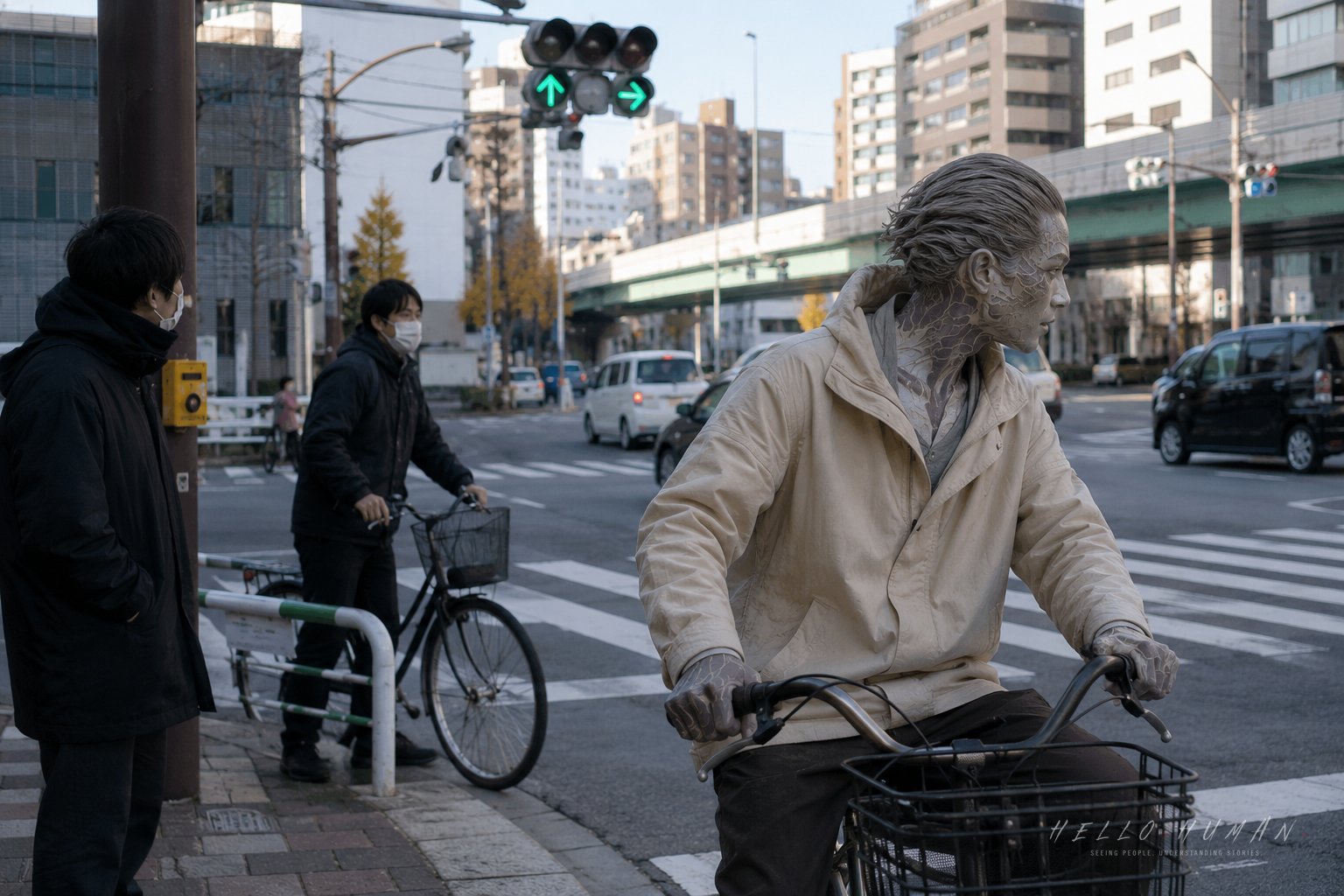
At a signalized street intersection in Tokyo, separate green arrows appear for straight-ahead and right-turn vehicle movement.
The Ink-vein resident sees the right-turn arrow, angles the bicycle toward it, and begins riding directly right through the intersection.
Observation 01The Moment Something Changed

The mistake begins with an interpretation that feels visually simple. The vehicle traffic signal shows a right-turn green arrow, and the traveler wants to turn right. The bicycle follows the direction of the arrow as though the signal were giving the same movement instruction to every road user beneath it.
The Ink-vein resident leans gently into the turn. Fine-line fingers hold the handlebars close and steady, and the bicycle leaves the straight-through path before the traveler has crossed the intersection first. The movement is small and confident rather than reckless-looking, which makes the misunderstanding easy to miss until the path itself becomes clear.
That path is the problem. According to the Tokyo Metropolitan Police Department, a cyclist turning right at an intersection with green directional arrows must not follow the right-turn green arrow. The cyclist instead follows a green light or straight-ahead green arrow, crosses straight through, changes direction, and then proceeds according to the signal faced.
The traveler has treated a directional signal for motor-vehicle movement as direct permission for the bicycle to make the same right turn. The arrow is visible. The bicycle’s required movement is different.
The visible cue is the vehicle traffic signal displaying separate straight-ahead and right-turn green arrows.
The nearby shift begins when the bicycle angles directly right instead of continuing straight across first.
The traveler has not yet understood that the right-turn arrow does not authorize the bicycle to copy the same direct turn.
Observation 02The Reactions No One Explained
One nearby person pauses at the edge of their own movement and watches the bicycle’s angle for a moment. Another slows slightly rather than stepping or moving forward immediately. A third turns their gaze from the signal toward the cyclist’s path, then holds position.
The reactions remain narrow and local. No one needs to shout an explanation across the intersection, and no crowd forms around the mistake. The bicycle is simply moving in a way that does not match the two-stage right-turn path required for the cyclist.
The Ink-vein resident notices the hesitation around the movement only after the turn has begun. The rider’s posture becomes less fluid. Deep ink undertones along the neck seem to settle, and the many fine lines of the fingers tighten around the grips as attention shifts from the arrow itself to the path being taken.
What had looked like a straightforward directional instruction now becomes more complicated. The right-turn arrow still points right. The traveler still wants to go right. But the bicycle is not supposed to make that right turn directly through the intersection.
The social signal comes from the mismatch in movement rather than from anyone delivering a rule. The surrounding pauses make the traveler reconsider the assumption that a right-turn arrow automatically means “turn right now” for a cyclist.
The distinction is specific. The Tokyo Metropolitan Police Department states that the cyclist must not follow the right-turn green arrow. Instead, the cyclist follows the green light or straight-ahead green arrow across first, changes direction, and then moves according to the signal now faced.
The first reactions are a paused movement, a slight slowdown, and a gaze shifting from the signal toward the bicycle’s unexpected path.
No nearby person needs to correct the traveler directly for the directional mismatch to become visible.
The traveler begins to separate the motor-vehicle right-turn arrow from the bicycle’s required two-stage right turn.
Observation 03What the Traveler Finally Understood
The traveler corrects the movement physically first. Instead of continuing to treat the right-turn green arrow as a direct bicycle path, the rider reorients toward the straight-through movement that should come first.
The practical sequence is not a different destination. It is a different way of reaching the same right-hand direction. The cyclist follows the green light or straight-ahead green arrow and crosses straight through the intersection before changing direction.
Only after that first crossing does the second stage begin. The bicycle turns to face the new direction, and the traveler then proceeds according to the signal now in front of them. The right turn is completed as two separate movements rather than one direct sweep through the intersection.
For the Ink-vein resident, the realization is visible in posture. The shoulders settle, the handlebars straighten, and the fine-line fingers return to a lighter grip. The rider stops reading the arrow as a universal instruction and starts reading the intersection as a sequence.
This is the part that makes the case distinctly Japanese rather than a generic misunderstanding about arrows. The Tokyo Metropolitan Police Department gives a specific rule for cyclists at intersections with green directional arrows: do not follow the right-turn green arrow for a direct right turn. Cross straight through under the green or straight-ahead signal, change direction, and then obey the signal faced.
The traveler does not need to infer anything beyond that sourced rule. There is no need to invent a hidden courtesy or an extra social custom. The visible mistake is enough: the bicycle copied the motor-vehicle right-turn movement when the cyclist should have completed the turn in two stages.
The nearby hesitation now makes sense in proportion to the mistake. People were not reacting to the traveler as an outsider. They were responding to a bicycle taking an unexpected direct right-turn path through an intersection where the cyclist’s movement should have gone straight first.
Once the rider understands the sequence, the green arrows become easier to interpret without becoming simpler. The right-turn arrow still matters for the vehicles it directs. For the cyclist trying to turn right, however, it is not permission to make the same direct turn.
The physical correction is to straighten the bicycle’s path and cross straight through first under the green or straight-ahead signal.
The nearby reactions stay brief because the central mistake is one directional misread, not a larger confrontation.
The traveler understands that a cyclist completes the right turn in two stages and then proceeds according to the signal faced.
Practical Takeaway
When turning right by bicycle at a Tokyo intersection with directional green arrows, do not follow the right-turn green arrow directly. Follow the green light or straight-ahead green arrow across first, change direction, and then proceed according to the signal you face.
This matters because the Tokyo Metropolitan Police Department specifically distinguishes the cyclist’s movement from the direct right-turn movement indicated by the vehicle arrow. The cyclist reaches the right turn through a two-stage sequence instead.
Pay particular attention when a vehicle traffic signal displays separate straight-ahead and right-turn green arrows. If you are cycling and want to turn right, the right-turn arrow is not permission to ride directly right through the intersection.
More Observations
A realistic editorial still at a signalized street intersection in Tokyo displaying directional green arrows. The vehicle traffic signal shows separate straight-ahead and right-turn green arrows while an Ink-vein resident on a bicycle has just angled directly right, visibly beginning the mistaken turn instead of crossing straight through first for a two-stage right turn. Two nearby Japanese road users pause subtly and watch the unexpected bicycle path without confrontation. The traveler is a refined Ink-vein resident in a deep-ink and warm-paper palette, with continuous ink-vein structure through the neck, soft ink cheek undertones, fine-line fingers gripping the handlebars, and a calm humanoid silhouette. A low silver body-bound sheen follows the throat transition. Soft high-collar everyday wear sits below the ink-vein neck structure without obscuring it. Not a tattoo-only human. Documentary editorial photography, realistic daylight, no readable text, logos, phone UI, anime, fantasy illustration, portrait, or hero shot.
[/IMAGE_PROMPT_BLOCK]