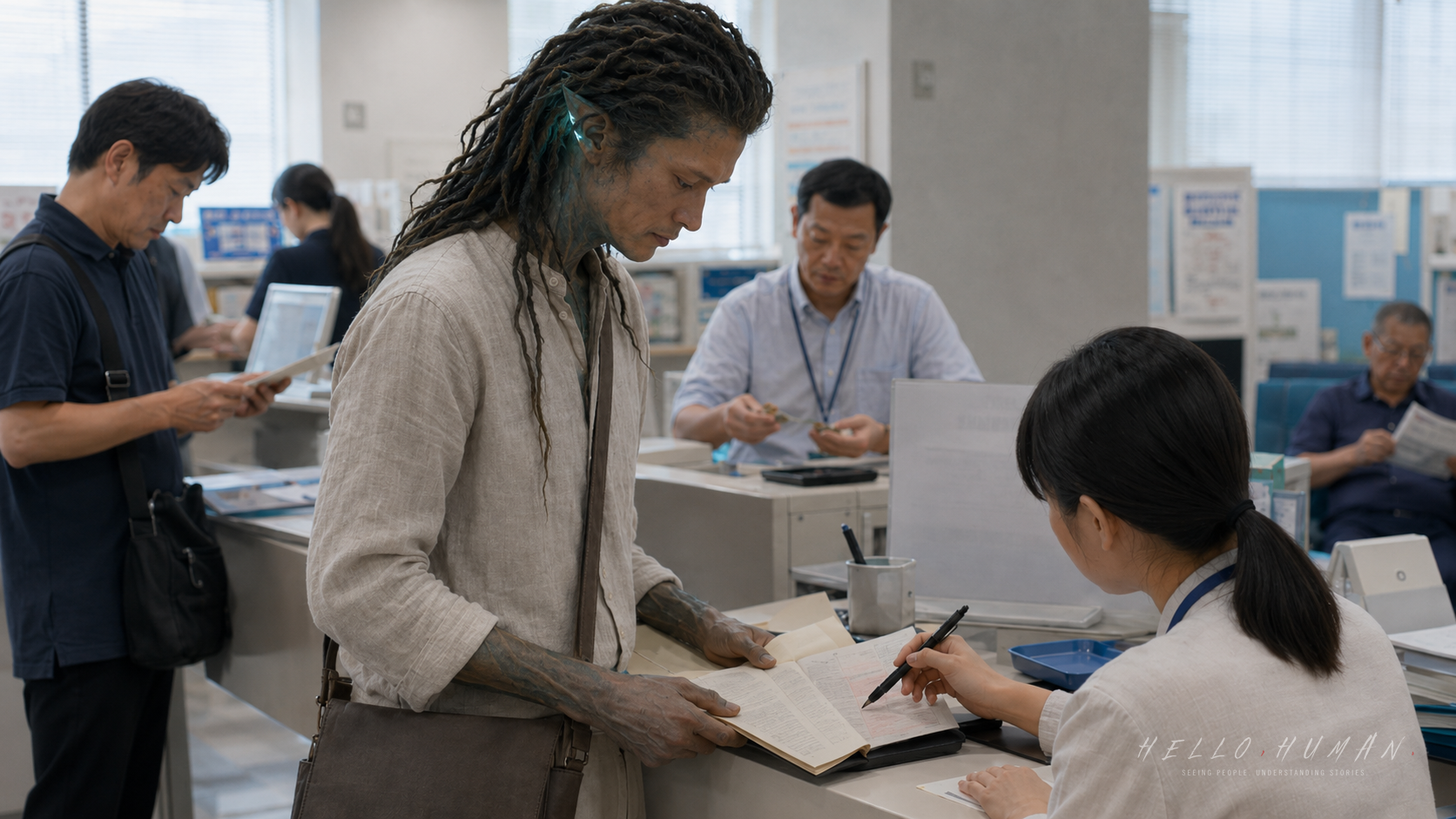
The city tax office lobby in Kyoto held its afternoon heat in the chairs, the counter glass, and the thin folders pressed against people’s knees.
Sava stood at the service counter with a payment notice open between both hands, then folded it carefully back into his folder as if saving it for another day.
Observation 01The Moment Something Changed


Sava was a kelp-haired drifter, humanlike in posture, with dark green strands rooted neatly from his scalp and salt-dark tendons visible at the sides of his neck. In the heat, the ends of his hair clung closer to his collar, and a faint sea-glass glow lived only at the edge of his left ear.
His clothes were ordinary and travel-worn: a loose linen shirt cut to sit comfortably around his neck tendons, soft trousers, flat shoes, and a document pouch worn crossbody without catching in his hair. He looked composed, slightly damp from the heat, and ready to be cooperative.
The notice on the counter had pale boxes, official numbers, and a due date printed without anger. No one had called him. No one had visited his lodging. No urgent red voice had followed him through the city.
So Sava nodded to the clerk, folded the paper along its original crease, and slid it back into the folder. His fingers smoothed the cover twice, a tidy gesture that said, to him, “I understand. I will handle this later.”
The clerk’s pen stopped above the counter. She looked at the folder, then at Sava’s face, then at the place where the due date had just disappeared.
The visible cue was the paper leaving the counter before the deadline had been treated as active.
The Japanese reaction was a pause, not a correction: the clerk held her pen still and let the folded folder become noticeable.
Sava first understood only that his neat gesture had not made the matter feel finished to anyone else.
Observation 02The Reactions No One Explained
The clerk did not raise her voice. She brought the pen down once and tapped the due date through the folder cover, exactly where the paper lay beneath it. The sound was small, dry, and final.
Behind Sava, the next person in line lowered their eyes to their own notice. Their thumb moved over the printed date as if checking that it was still there. They did not look at Sava directly.
A second clerk at the neighboring counter paused while counting coins into a tray. Her hand waited above the stack. Then she resumed more slowly, her voice dropping when she spoke to the elderly man in front of her.
A woman sitting in the lobby adjusted the papers on her lap. She turned one notice so the date faced upward, then folded her hands over it. Her shoulders angled away from the counter, giving Sava privacy without making the moment invisible.
Sava’s kelp strands drew close against his cheek. He had believed the quietness of the paperwork meant flexibility. In his mind, a deadline that truly mattered would arrive with pressure, insistence, or someone telling him not to wait.
The visible cue spread from one folder to several notices: dates were checked, touched, and held in view.
The Japanese reactions stayed indirect: a pen tap, lowered eyes, a paused hand, softened voices, and papers quietly repositioned.
Sava began to understand that the calm tone of the office was not the same as a loose deadline.
Observation 03What the Traveler Finally Understood
Sava did not explain himself immediately. He pulled the folder back toward him, opened it, and placed the notice flat on the counter again with the due date visible.
The clerk’s shoulders eased by a small amount. She turned the paper slightly, not toward herself but toward Sava, and pointed with the pen. This time she did not tap. She waited for his eyes to stay on the date.
Sava took out his small calendar and placed it beside the notice. The amber-green edge of his ear brightened faintly, then settled. He wrote the date down, then wrote the payment location beneath it, making the next step visible instead of storing it away in intention.
The clerk slid a payment slip forward. Her voice remained even. She explained where he could pay, what would happen if he waited, and which window could answer questions before the due date passed. Nothing in her tone sounded dramatic, but nothing in the paper sounded optional anymore.
When Sava stepped away from the counter, the next person moved forward at once. Their notice was already open. The office rhythm returned, not because anyone had been scolded, but because the quiet date had been given its proper weight.
The visible correction came first: Sava reopened the notice, kept the due date exposed, and wrote down the payment step.
The Japanese response softened through small movement: the clerk stopped tapping, the line resumed, and the next notice arrived already open.
Sava finally understood that in this setting, paperwork can be gentle in language and strict in consequence at the same time.
Practical Takeaway
When a Japanese tax, health insurance, pension, residence, or city office notice shows a due date, treat the date as concrete even if the wording feels calm. Keep the paper open, confirm what must be paid or submitted, and ask where to complete the step before putting it away.
The social meaning is that quiet procedure does not always come with repeated pressure. A clerk may not chase you, warn you loudly, or dramatize the deadline, but the system still expects you to notice the date and act before someone else must repair the delay.
Pay attention when a clerk taps a date, waits after you fold a paper, turns a notice back toward you, or when other people in line quietly check their own documents. Those are often the room’s way of saying the printed date is not just a reminder.