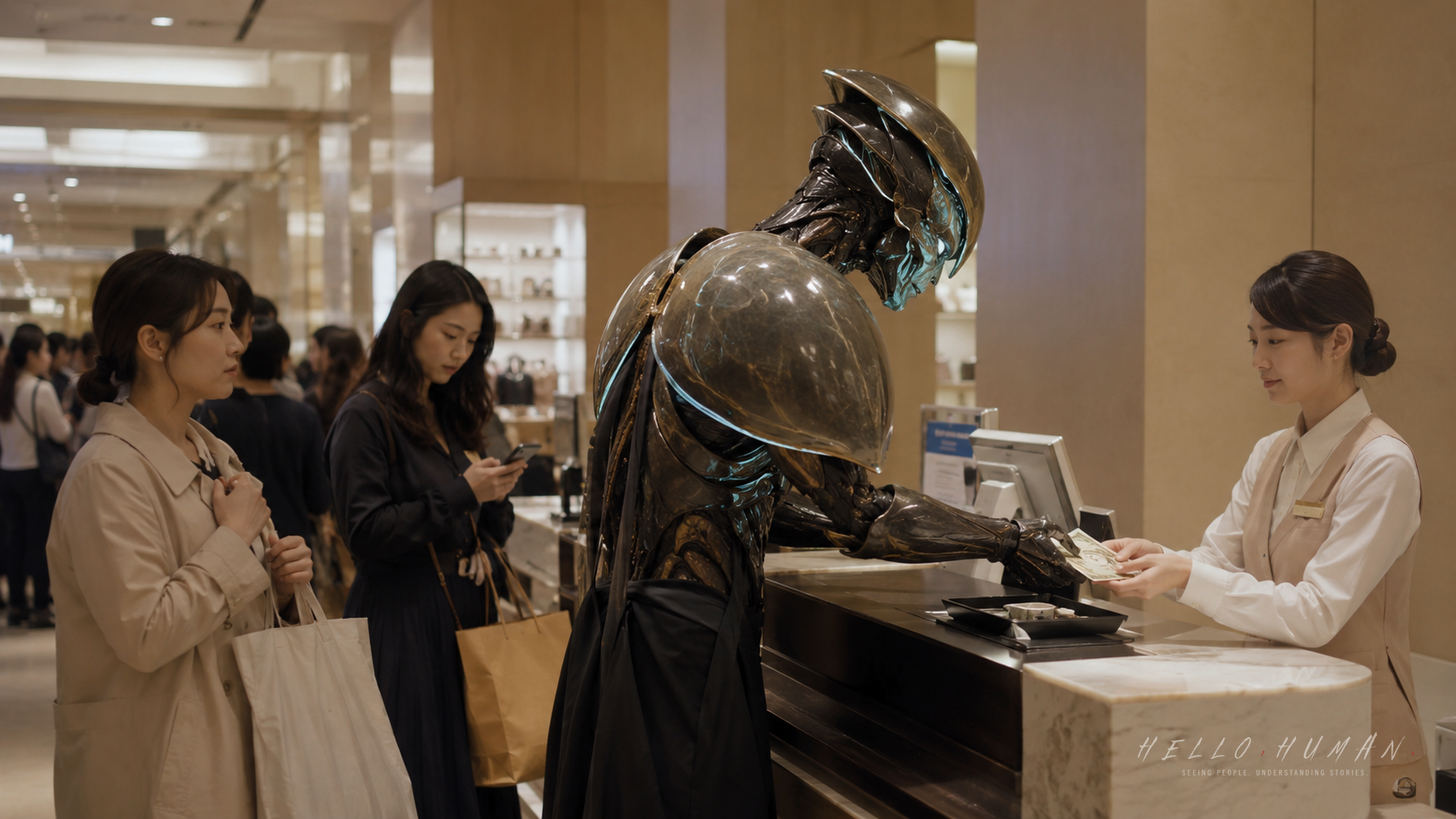
The small silver tray sat between the register and the customer side of the department store counter in Yokohama, polished enough to catch the ceiling lights.
Oren saw the clerk’s open hand first, not the tray below it, and his dark chitin wrist moved forward with the folded yen.
Observation 01The Moment Something Changed


The counter was narrow, with a gift-wrap sample on one side and a payment tray placed directly in front of the register. A small indicator beside the tray showed where customers were expected to put money, but Oren’s shell-like shoulder plate leaned over the edge of the counter and covered it from the line behind him.
Oren was a beetle-shelled tourist, not tall, but broad in a way that made ordinary counters feel smaller. His collarbone curved like smooth lacquered armor, and the segmented plates at his shoulders caught the store lights in small, hard flashes.
He had watched the customer before him hand over a loyalty card. He had seen the clerk bow slightly and extend her hand. So when his total appeared on the register screen, he counted the bills carefully, aligned their corners with two chitin-dark fingers, and placed them directly into the clerk’s palm.
The clerk accepted the money, but only after a tiny delay. Her hand lowered a few centimeters, then returned to the counter. Her smile stayed in place, softer than before, and her eyes moved once to the empty tray.
The line did not complain. It only changed shape. The woman behind Oren drew her shopping bag closer to her knees, and the man behind her tilted his head just enough to look past Oren’s shoulder toward the tray he had not used.
The first reaction was not verbal correction. It was a pause in the clerk’s rhythm.
The empty tray became the center of attention without anyone pointing at it.
Oren’s body also hid the clue, so the mistake became harder for him to read.
Observation 02The Reactions No One Explained
The clerk placed the bills on the register side, counted them, and set the change on the tray with both hands. She did not place the coins into Oren’s palm. She arranged them on the dish, receipt beneath, coins above, the way the counter expected the exchange to happen.
Oren extended his marked, jointed fingers again, waiting in the air. The clerk’s gaze lowered to the tray, then returned to his face. She kept smiling, but her shoulders remained still, as if waiting for him to notice the object between them.
Behind him, the woman with the shopping bag shifted half a step to the left. Not away from Oren exactly, but away from his covered corner of the counter. Her eyes moved to the tray, then to the clerk, then down to the handle of her bag.
The man behind her pretended to check his phone. His thumb did not move. When another register opened farther down the counter, he glanced that way but stayed in place, preserving the line while giving the moment more space.
A second clerk, folding tissue into a paper bag, slowed her hands. She did not interrupt. She simply placed the finished bag a little farther from the payment area, leaving a cleaner open space around the tray.
Oren’s shell edges caught the light again, sharper now. A small reflex passed through his shoulder plates. They lifted, then tucked closer to his body, as if his frame had finally sensed that he was occupying more of the counter than he meant to.
The staff answered the mistake by using the tray correctly on their side.
Customers nearby looked at the object, not directly at Oren.
The social message traveled through placement, spacing, and repeated hesitation.
Observation 03What the Traveler Finally Understood
Oren looked down at the tray. The coins waited there in a small, deliberate pile. The receipt was turned toward him, easy to lift. Nothing about it looked decorative now.
He drew his hand back. Then, slowly, he shifted his shoulder away from the counter edge. The covered indicator became visible again to the people behind him, a small counter marker that had been hidden under the curve of his shell.
His fingers changed shape when he understood something. The hard outer joints folded inward first, then the softer inner tips followed. He picked up the receipt and coins from the tray instead of reaching for the clerk’s hand.
The clerk’s smile relaxed by a fraction. She gave the shopping bag with both hands, and Oren received it with both of his, lowering his head in a careful bow that was slightly too angular but clearly meant.
Before stepping away, he placed his next small item, a postcard sleeve he had almost forgotten, on the customer side of the counter and looked at the tray. The clerk nodded once, not as a lesson, but as permission to continue.
The line returned to its ordinary rhythm. The woman behind him stepped forward and placed her card on the tray before the clerk even asked. Oren saw it happen. His shoulder plates stayed folded close as he moved away from the register.
Oren’s correction was physical first: he uncovered the marker, folded inward, and used the tray.
The clerk did not need to explain once the object’s role became visible.
In this kind of Japanese cash register scene, the tray protects the rhythm between customer and staff.
Practical Takeaway
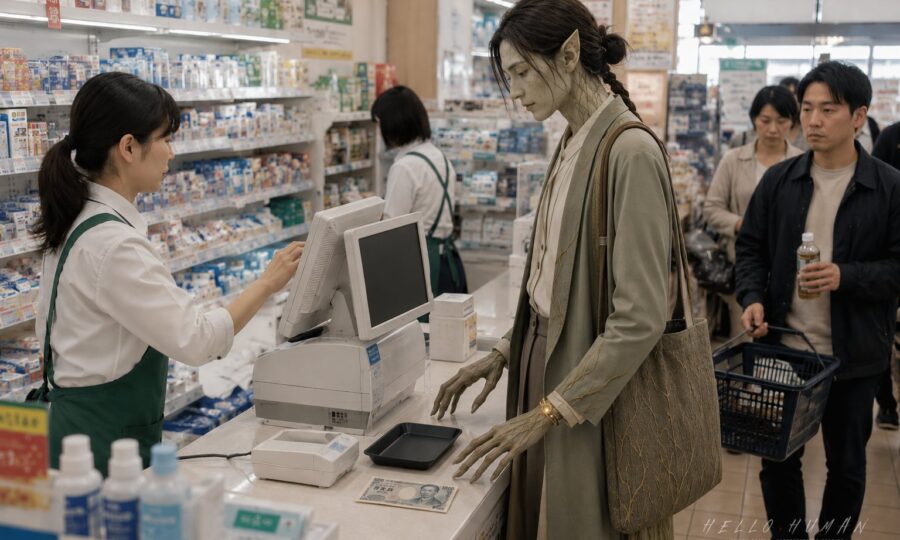
At a cash register in Japan, look for the payment tray before handing over cash, coins, cards, coupons, or receipts. Place the item on the tray unless the staff clearly reaches in a way that invites direct handoff.
The tray creates a neutral exchange space. It helps the clerk count money, return change, avoid fumbling, and keep the service rhythm smooth without making the interaction too personal or rushed.
Pay special attention at department stores, convenience stores, bakeries, pharmacies, station shops, and service counters. If people behind you keep glancing at the counter surface, the object you are missing may already be in front of you.