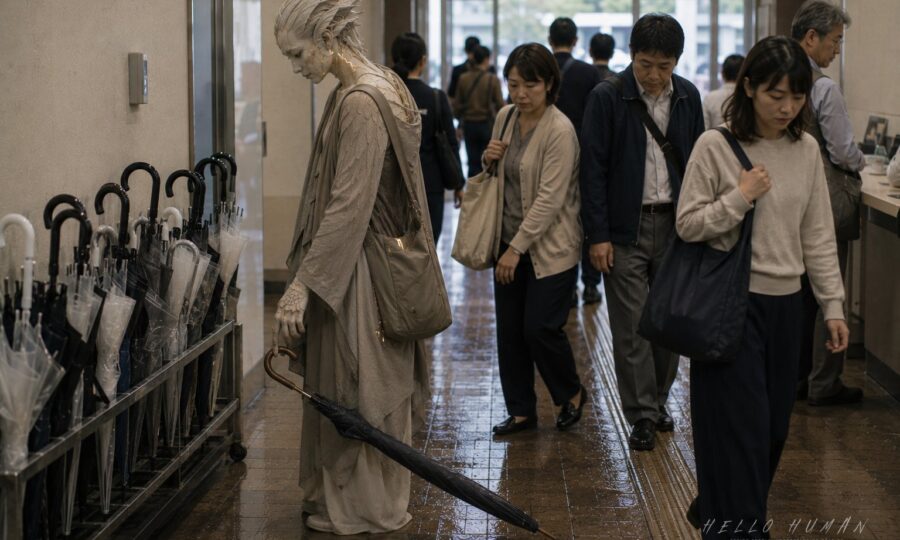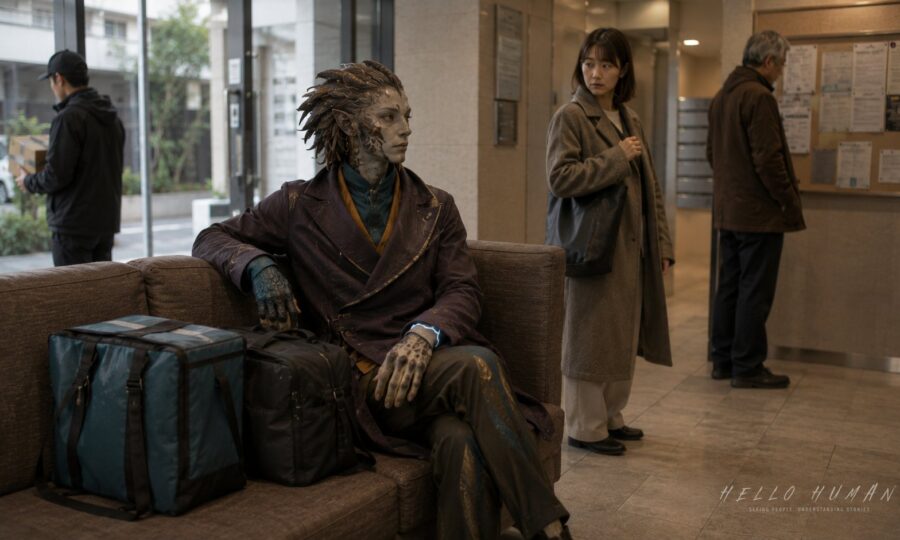
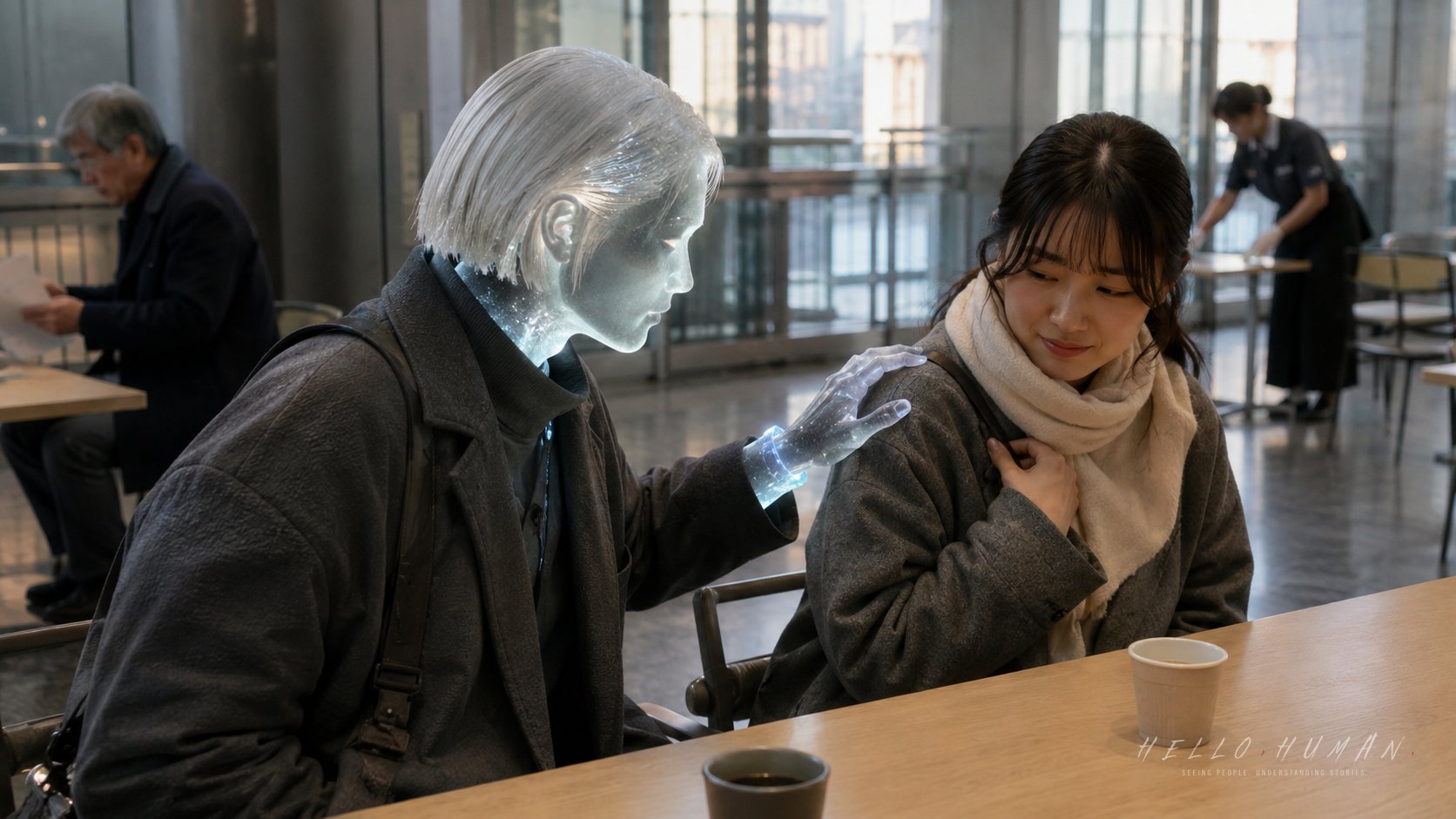
The shared table in the Kyoto public seating area was nearly empty, its pale wooden surface broken only by two cups, a folded scarf, and the cold light of a midwinter morning.
Naya sat across from a woman she had just met through a mutual volunteer group, her frosted hands resting carefully beside her cup as their first conversation found a gentle rhythm.
Observation 01The Moment Something Changed

The conversation had been going well. The woman, Morita, had smiled at Naya’s careful Japanese and said her name slowly so Naya could repeat it. Naya’s opaque glass face brightened with slight internal depth, as if the morning light had found a second window inside her.
Morita made a small joke about both of them arriving too early. Naya laughed, relieved. Her white-blue wrist seams glowed softly under the indoor station lighting, and one frosted hand crossed the narrow corner of the table.
She touched Morita’s shoulder lightly, only for a moment.
The touch was gentle. It was not a grab, not a shove, not a claim. But it landed before the first meeting had built that kind of closeness, and the space between them changed as clearly as if one of the cups had been moved to the wrong side.
Morita’s smile stayed in place. Her shoulder, however, moved back by a few centimeters. Her hand went to the strap of her bag, not to leave yet, but to create a small border around herself.
The visible cue was a brief hand on a new acquaintance’s shoulder during a first introduction, placed inside a relationship that had not yet made room for touch.
The Japanese reaction did not begin with words; it appeared in the shoulder withdrawing, the bag strap being held, and the smile becoming thinner.
Naya first understood that the mood had cooled, but not yet that her friendly gesture had crossed the body boundary before the conversation was ready.
Observation 02The Reactions No One Explained
Morita looked down at her cup and gave a small laugh of her own, shorter than before. She said, “Sou desu ne,” in a soft voice, but did not add a new story after it.
Her chair angled a little away from the table’s corner. The movement was slight enough to look like comfort, yet precise enough to place her shoulder outside the path of Naya’s hand.
At the next table, an older man who had been arranging papers paused, then turned one sheet over more slowly. He did not stare, but his eyes passed once over the empty space between the two women before returning to his documents.
A staff member wiping the far end of the counter lowered her cloth, noticed the changed posture, and resumed wiping in a quieter rhythm. The room did not become dramatic. It simply made itself careful.
Morita answered Naya’s next question with fewer words. “Maybe,” she said, still smiling. “It depends.” Her voice was friendly enough that Naya almost treated it as permission to continue as before.
Then Naya saw the arrangement: the smile remained, but the shoulder had stayed away. The words did not accuse, but the body had already refused. Her frosted fingers tightened around the edge of her cup, and the refraction inside her wrists sharpened under the morning light.
The visible cue was not one large rejection, but a set of small boundaries: shorter replies, an angled chair, lowered eyes, and a shoulder kept out of reach.
The Japanese people nearby treated the moment indirectly, allowing Morita’s posture and silence to carry what direct correction would make heavier.
Naya began to notice that polite words at a first meeting may keep the room comfortable while the real answer appears through distance.
Observation 03What the Traveler Finally Understood
Naya moved her hand first. She brought it back to her own side of the shared table and placed both frosted palms around her cup, where they could be seen but would not cross the boundary again.
She leaned back by a small measure, leaving more air between her coat sleeve and Morita’s shoulder. Her layered winter jacket had been cut to leave her translucent wrist seams uncovered, and the soft white-blue glow inside them dimmed as her hands became still.
“Sorry,” Naya said quietly, not making the word large. She bowed her head once, then let the conversation rest instead of filling the pause with explanation.
Morita’s shoulders lowered. She adjusted her scarf, then returned both hands to the table. Her next smile was still reserved, but it was no longer guarded in the same way.
Naya understood the mistake only after she stopped trying to prove friendliness. In this first meeting conversation, warmth did not need to become touch. A laugh, a nod, careful listening, and a respectful distance could say enough without asking the other person’s body to accept a closeness they had not chosen.
The correction was physical first: Naya withdrew her hand, settled it around her own cup, and gave Morita’s shoulder a clear margin of space.
The Japanese reaction softened when the boundary was restored without forcing Morita to name the discomfort directly.
Naya understood that at a first introduction, politeness may protect both people by keeping refusal small, indirect, and recoverable.
Practical Takeaway
At a first meeting in Japan, keep friendly gestures mostly within your own space. Smile, nod, laugh softly, bow, or use your voice to show warmth, but avoid touching someone’s shoulder, arm, back, or hand unless the relationship clearly allows it.
This matters socially because light touch can feel more intimate than the words around it. When people have just met, keeping physical distance lets the other person stay comfortable without having to refuse you directly.
Pay attention when a smile remains but the body moves away, when answers become shorter, when eyes drop, or when a bag, scarf, cup, or chair begins to create a quiet border. Those small changes often say that the conversation needs more space.