The local train slid through Osaka in the pale blue of a midwinter morning, windows fogged at the edges and coats pressed sleeve to sleeve near the door.
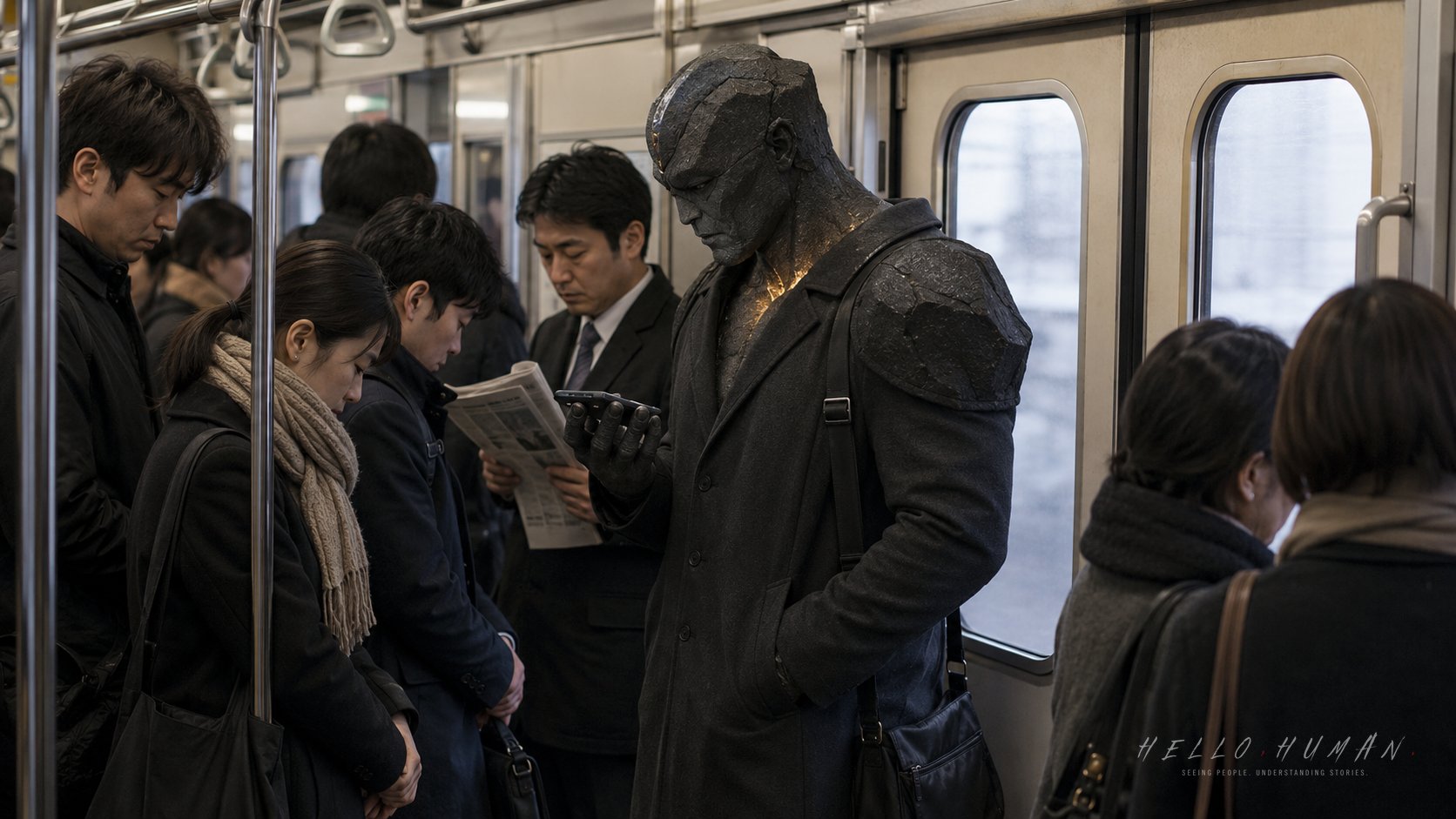
Selo stood with one dark stone hand around a hanging strap, phone cupped carefully below his chest, while the car held the soft silence of commuters saving their voices for later.
Observation 01The Moment Something Changed


The first voice message was brief. A friend’s voice came from Selo’s phone, bright and close, asking about the platform number at another station. It lasted only a few seconds, but it filled the space around the door more sharply than its length suggested.
Selo tilted the phone toward the mineral grain of his neck, trying to catch the last word. His basalt shoulders were broad but rounded, fitted under a charcoal travel coat cut with extra seams so the fabric settled around his stone structure instead of pulling against it.
He did not notice the first shift. A woman in a beige scarf stopped moving her thumb over her screen. A man with a black briefcase lowered his gaze from the window to the phone in Selo’s hand. Someone near the door inhaled, then made the breath smaller.
Selo replayed the message.
This time the voice sounded larger. It bounced off the metal door, the glass, the winter coats, the plastic hand straps. The tiny amber light along Selo’s collarbone line caught on his basalt grain, a natural flicker that appeared whenever he searched for a social pattern too late.
The visible cue was not a large gesture, but a phone speaker held open in a packed train car where other sounds had stayed private.
The Japanese reaction began as a tightening around the sound: paused hands, lowered eyes, and shoulders angled away from the phone.
Selo first understood only that the car had changed, not yet that his small replay had become the loudest object in the space.
Observation 02The Reactions No One Explained
The woman in the beige scarf put her phone down into her lap and looked at the floor between her shoes. She did not look angry. Her face simply made itself unavailable.
A high school student near the pole turned one ear slightly away, then shifted his backpack forward against his chest. The movement was small enough to be ordinary, but it made a narrow wall between his body and the sound.
An older office worker standing beside Selo lifted his newspaper by one fold, then lowered it again without reading. His hand had paused at the edge of a page, as if waiting for the air to become quiet enough to continue.
Near the connecting door, two commuters who had been murmuring to each other let their voices fall to nothing. One glanced toward Selo’s phone, not at Selo’s face, and then back to the advertisement panel above the windows without reading it.
Selo felt the silence gather around his fingers. He had heard no objection. No one had said stop, no one had pointed at a rule, no one had even stepped away far enough to make the problem obvious. In his own city, a short practical message in a crowded vehicle might have been a shared inconvenience, over and gone.
Here, the message had not ended when the audio stopped. It remained in the way people held their shoulders.
The visible cue became the aftermath of sound: faces turning neutral, hands pausing, bags shifting, and conversations dissolving around one phone.
The Japanese commuters responded indirectly because the disruption was already public; making a second public disturbance by correcting it aloud would add another layer of discomfort.
Selo began to see that quiet was not empty space in the Train Car, but a shared surface everyone was helping keep smooth.
Observation 03What the Traveler Finally Understood
Selo’s dark knuckles softened around the phone. He lowered the screen, thumbed the volume down to nothing, and pressed the device flat against his coat instead of holding it outward into the car.
Then he moved one foot a little closer to the door seam, not blocking it, just making his own body smaller inside the crowded line of standing passengers. The basalt grain at his neck caught a thin band of winter light from the window, then dimmed as his posture settled.
He did not apologize aloud. A spoken apology would have pulled more attention back to the mistake. Instead, he gave a slight bow from the shoulders to the space in front of him, the kind of quiet physical acknowledgment that did not demand a reply.
The woman in the beige scarf resumed moving her thumb. The student loosened his backpack by a few centimeters. The office worker found his place on the newspaper page again. No one rewarded Selo with a smile, but the car’s rhythm returned.
Only then did the meaning become clear to him. In a crowded local train car in Japan, a phone speaker does not become acceptable because the message is useful or short. The issue is not only volume. It is that private sound asks strangers to receive it, react to it, and carry it for a moment inside a space where everyone is trying not to impose.
The correction was physical before it was intellectual: the phone lowered, the volume disappeared, and Selo’s posture withdrew the sound from the shared air.
The Japanese reactions eased without ceremony, showing that the goal was not punishment but restoration of the train car’s quiet rhythm.
Selo understood that silence on public transport can be an active courtesy, held together by people who choose not to make their private lives audible.
Practical Takeaway
On a train or bus in Japan, keep phone sound private. Use earphones, read the transcript, lower the volume completely, or wait until you step off before playing a voice message, even if it lasts only a few seconds.
This matters socially because a crowded commute is already full of unavoidable closeness. Quiet helps people share a narrow space without asking strangers to join their call, message, video, game, or notification.
Pay attention when the car is silent, when people are standing close near the doors, when conversations are already low, or when a small sound makes hands pause and eyes drop. Those are signs that the space is asking you to make your sound smaller.