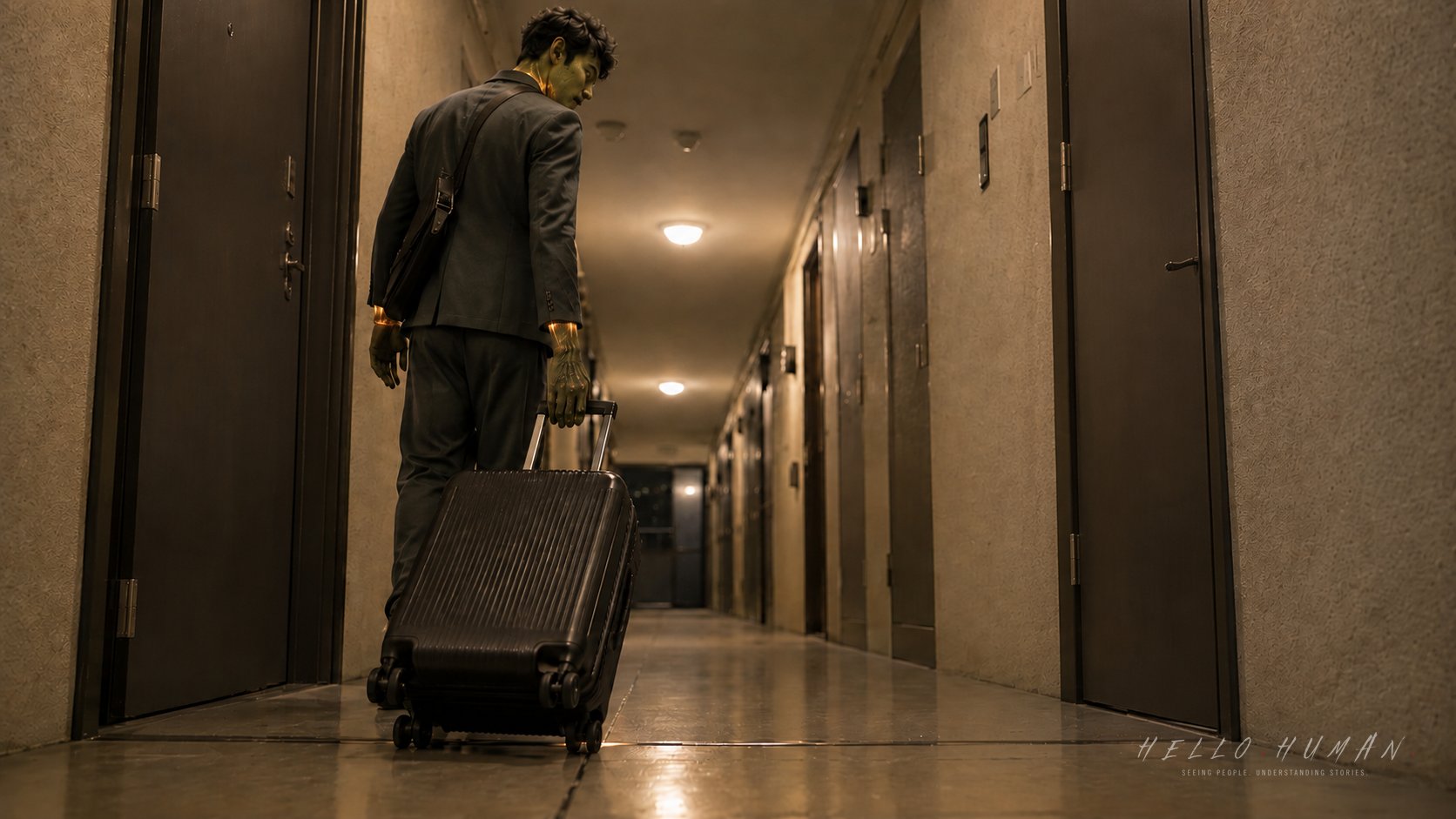
The apartment corridor held the day’s heat like a narrow box, even after midnight in Osaka.
Under the low ceiling light, one suitcase wheel touched the floor, then the next, and the sound ran ahead of the traveler.
Observation 01The Moment Something Changed

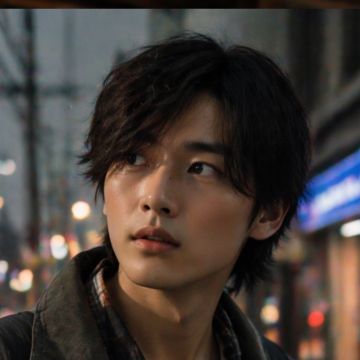
Noma stepped out of the elevator with one hand around the suitcase handle and the other holding a folded access card. His root-like shoulders moved smoothly under a loose travel jacket, the fabric cut wider at the upper back so the branching line did not pull.
The corridor was empty. A row of apartment doors faced him in the humid light, each with a small threshold, each closed into its own sleeping room. The air conditioner units outside hummed faintly somewhere below, but inside the hallway the silence had a flat surface.
Noma saw the distance to his borrowed apartment and chose speed. It seemed polite to pass through quickly, to spend less time in the shared space, to get the suitcase inside before anyone had to notice him.
The wheels answered the choice. They clicked over a floor seam, rattled across a slight dip, then sharpened into a hard rolling line that traveled down the corridor before him.
His long twig-joint fingers tightened around the handle. The amber seams near his wrists, usually warm and steady, dimmed as the sound came back from the walls.
The visible cue was the suitcase moving fast across the apartment corridor, wheels striking seams and making the late-night hallway feel louder.
The Japanese reaction began behind closed doors, not with a spoken complaint, but with small sounds and stillness around the corridor.
Noma first understood only that his hurry had not made him smaller in the space.
Observation 02The Reactions No One Explained
From one apartment, a door chain gave a small metal click. No door opened. The sound was only a thin adjustment from inside, but it landed in the gap between two rolls of the suitcase.
A peephole near the next door darkened for a moment, then returned to its ordinary shine. Noma did not see a face. He saw only the brief loss of light, like the corridor blinking once.
Behind another threshold, slippers stopped. The soft indoor steps had been moving toward a kitchen or bathroom, then paused until the suitcase wheels passed the door.
Farther down the hall, a resident’s hand appeared just enough to pull in a hanging laundry pole from the balcony side entrance. The movement was practical and silent. The person did not look toward Noma, but the timing made the hallway feel aware of him.
Noma reached his door and held the suitcase upright. In the sudden quiet after the wheels stopped, the corridor seemed to gather itself again. He could hear the low buzz of the light fixture, the small breath of the elevator behind him, and his own hand still wrapped too tightly around the handle.
The visible cue repeated through the corridor: the sound stopped, and every small indoor sound became noticeable.
Japanese residents reacted indirectly through a door chain, a darkened peephole, paused slippers, and movements made without direct eye contact.
Noma began to read the silence as shared space, not emptiness.
Observation 03What the Traveler Finally Understood
Noma did not knock on any door. He did not call out an apology into the hallway, where more sound would have made the mistake larger.
First, he changed his hands. He bent slightly, placed his twig-joint fingers under the suitcase side handle, and lifted the front wheels clear of the floor. The bark-warm depth of his cheek lowered toward the luggage, and the leaf-vein texture along his neck tightened with concentration.
He moved the last few steps differently. One wheel touched down only when it had to. The suitcase no longer ran ahead of him; it followed, slow and dampened, while his soft-soled shoes took most of the weight.
At his door, he eased the suitcase over the threshold instead of pulling it across the metal strip. The amber sap seams at his wrists warmed again, a small body-bound glow half-hidden by sleeves made to open around the joints.
The practical meaning arrived after the physical correction. In a late-night apartment corridor in Japan, speed is not always the quieter choice. A shared hallway may look empty, but it is attached to sleeping rooms, thin thresholds, and people listening without wanting to confront anyone.
The visible correction was clear: Noma slowed the suitcase, lifted the front wheels, and softened the threshold crossing.
The Japanese reaction was the return of ordinary quiet, with no door opening and no further sign from the residents.
Noma understood that in shared housing, considerate movement is measured by sound, not by how quickly one disappears.
Practical Takeaway
When moving through an apartment corridor late at night in Japan, slow down before the luggage becomes loud. Lift the front wheels if you can, guide the suitcase by hand over seams or thresholds, and avoid letting it rattle across the floor at speed.
This matters because apartment hallways are shared spaces attached directly to private rooms. Even ordinary sounds can feel sharp after midnight, and residents may respond through silence, paused movement, or small door-side signals rather than direct complaint.
Pay attention when arriving late, leaving early, using elevators near apartments, crossing metal door strips, or moving luggage during hot nights when people may be awake behind closed doors. An empty corridor is still a place people are sharing.