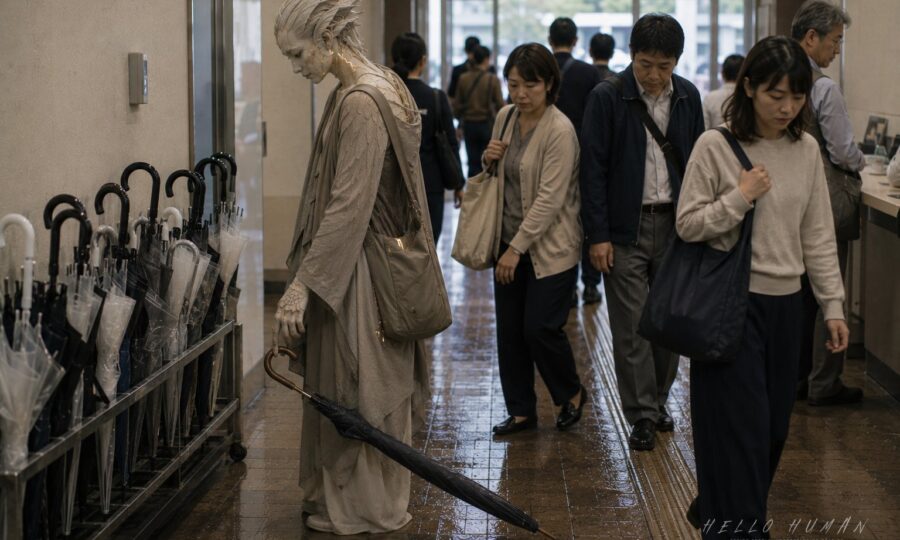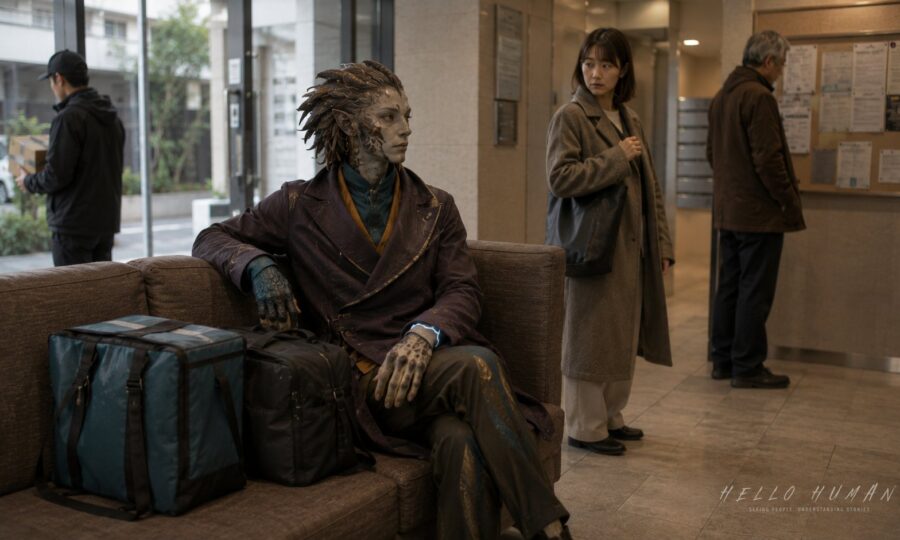
The first drops of typhoon rain tapped the plastic collection net behind the apartment building in Osaka. Under the weak light, the garbage station looked already asleep.
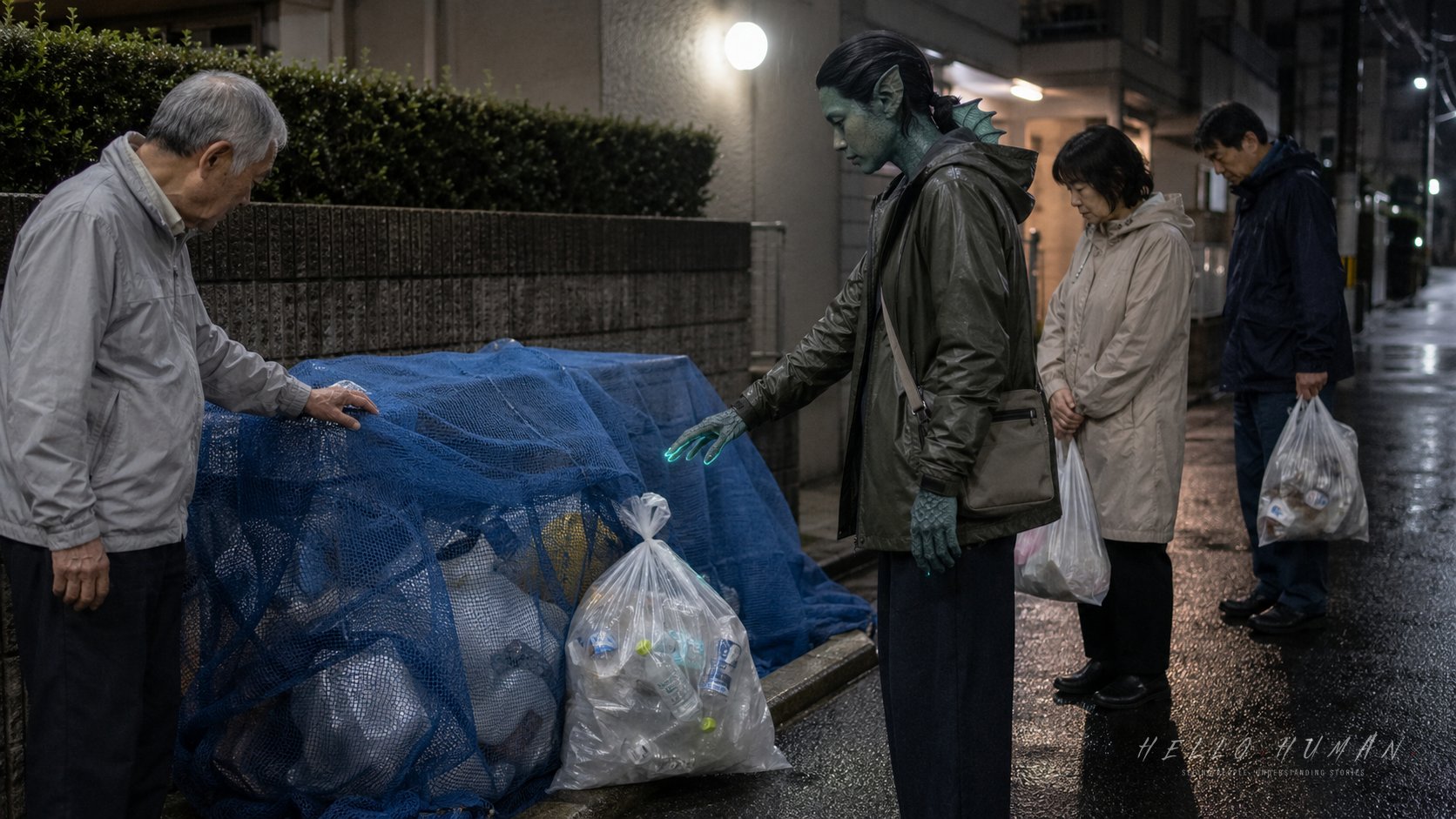
Sera held a tied bag of glass bottles with long scale-pad fingers, the pads darkening slightly as their hand hovered over the net. There was no separate container in sight.
Observation 01The Moment Something Changed


Sera had read the apartment notice beside the entrance, but the wording seemed to divide trash by day more than by place. Burnable trash had the large blue net. Bottles had a smaller line on the schedule, but no matching box stood nearby.
The street was quiet. A bicycle cover snapped once in the rising wind, and a shutter across the narrow lane trembled with the approaching typhoon. Sera lowered the bottle bag beside the burnable trash net, not inside it, as if careful distance could solve the uncertainty.
The bottles clicked softly together. Sera smoothed the knot, drew their fitted rain jacket sleeve back over the wrist joint, and glanced toward the apartment stairs. The small dorsal fin at the back of their neck lay flat in the damp air.
Then the first shift happened without a word. An elderly man coming down with a small burnable bag slowed one step before the net. His hand stopped above the mesh, and his eyes moved to Sera’s bottle bag, then to the printed collection notice, then back to the bottles.
He placed his own bag under the net carefully. He did not move Sera’s bag. He only pulled the edge of the net a little straighter, leaving the bottle bag outside its line.
The visible cue was small: one tied bottle bag resting beside the burnable trash net before the correct place or day was clear.
The Japanese reaction began with a pause, not a correction; the neighbor’s eyes measured the bag against the net and the notice.
Sera first understood only that the placement had changed the air around the garbage station.
Observation 02The Reactions No One Explained
A woman in a navy raincoat arrived next, carrying two small kitchen bags. She bent toward the net, noticed the bottle bag, and lifted her elbow closer to her body so she would not brush it. Her gaze rested on the bottles for only a second before she looked down at her own hands.
She tucked her trash under the net, then checked the corner of the collection area where crates sometimes appeared on bottle day. Finding nothing, she pressed her lips together and stepped back into the apartment entrance without speaking.
A younger resident came out barefoot in sandals, holding an umbrella before opening it. He saw the bottle bag from the side, paused under the eaves, and shifted his burnable bag from his right hand to his left. That tiny change let him place his bag farther from Sera’s, as though keeping the categories from touching.
From an upstairs balcony, a sliding door opened and closed. Someone looked down briefly, not at Sera’s face, but at the bottle bag beside the net. The attention was quiet enough to deny, yet specific enough to feel.
Sera stood near the bicycle rack, pretending to adjust the strap of their small shoulder bag. The strap had been widened to sit between their upright shoulders and avoid the small fin at the neck, but their fingers kept returning to it. The scale pads darkened again where they pressed the fabric.
No one sounded angry. That was what made the scene harder to read. In Sera’s home city, a mistake in shared disposal would bring a direct note, a lifted hand, or a sharp word. Here, the correction stayed outside the mouth and gathered around the object.
The bottle bag had become the sentence. The neighbors were reading it, stepping around it, separating their own bags from it, and letting Sera see the gap without forcing a conversation in the rain.
The visible cue repeated through spacing: each resident kept their own trash slightly away from the bottle bag.
The Japanese reactions stayed indirect through paused hands, lowered eyes, small sidesteps, and quick checks toward the missing bottle container.
Sera began to sense that neatness alone was not the same as belonging to the shared system.
Observation 03What the Traveler Finally Understood
Sera moved before they fully had the words. They stepped out from the bicycle rack, bowed slightly toward the nearest resident without asking for a public explanation, and picked up the bottle bag by its knot.
The bottles clicked again, louder this time because the street had gone still between gusts. Sera lifted the bag away from the burnable trash net and held it close to their side. Their long fingers curled under the plastic without tearing it, the soft scale pads dark against the clear bag.
The elderly man, still near the stairs, gave the smallest nod. It was not praise. It was more like the scene returning to its proper shape.
Sera carried the bag back upstairs and placed it inside their entryway, beside their folded umbrella. Only then did the notice make more sense. The bottle day was not simply a future pickup time. It also meant the correct container or exact setup might appear only at the right time.
The shared garbage station was not an empty corner for anything tidy. It was a rotating agreement. Nets, crates, days, and materials appeared in relation to one another, and the neighbors protected that rhythm by not adding confusion early.
In Japan, especially in apartment common areas, the most important signal can be how others avoid touching a mistake. They may not want to embarrass the person who made it, but they also do not absorb the mistake into the shared space. The object remains visible until its owner understands.
The next morning, rain streaked the stairwell windows. Sera checked the notice again, then waited. On the proper morning, a low crate appeared near the garbage station, separate from the burnable net. Sera placed the bottle bag there with both hands and stepped back before anyone had to pause.
The visible correction was physical first: Sera picked up the bottle bag and removed it from the burnable trash area.
The Japanese response softened only after the object left the wrong place, shown by a small nod and the restored movement of the space.
Sera understood that the right disposal action depends on timing, material, and the exact shared setup, not only on being quiet and tidy.
Practical Takeaway
At an apartment garbage station in Japan, do not place bottles, cans, plastics, or other sorted items beside the burnable trash net just because no separate container is visible. Keep the item in your room until the correct collection day and setup are clear, or ask the building manager or a neighbor privately.
This matters because the garbage station is a shared responsibility, not just a pickup point. A misplaced bag can make other residents uncertain about whether the category, day, or location has changed, and they may avoid correcting it directly to prevent embarrassment.
Pay attention when people pause at the net, look between your bag and a notice, separate their own trash from yours, or leave an object untouched. Those quiet reactions often mean the item is not where the shared system expects it to be.