The late-summer air in Osaka still held heat when Soren slid onto the last stool at a narrow restaurant counter near Namba.
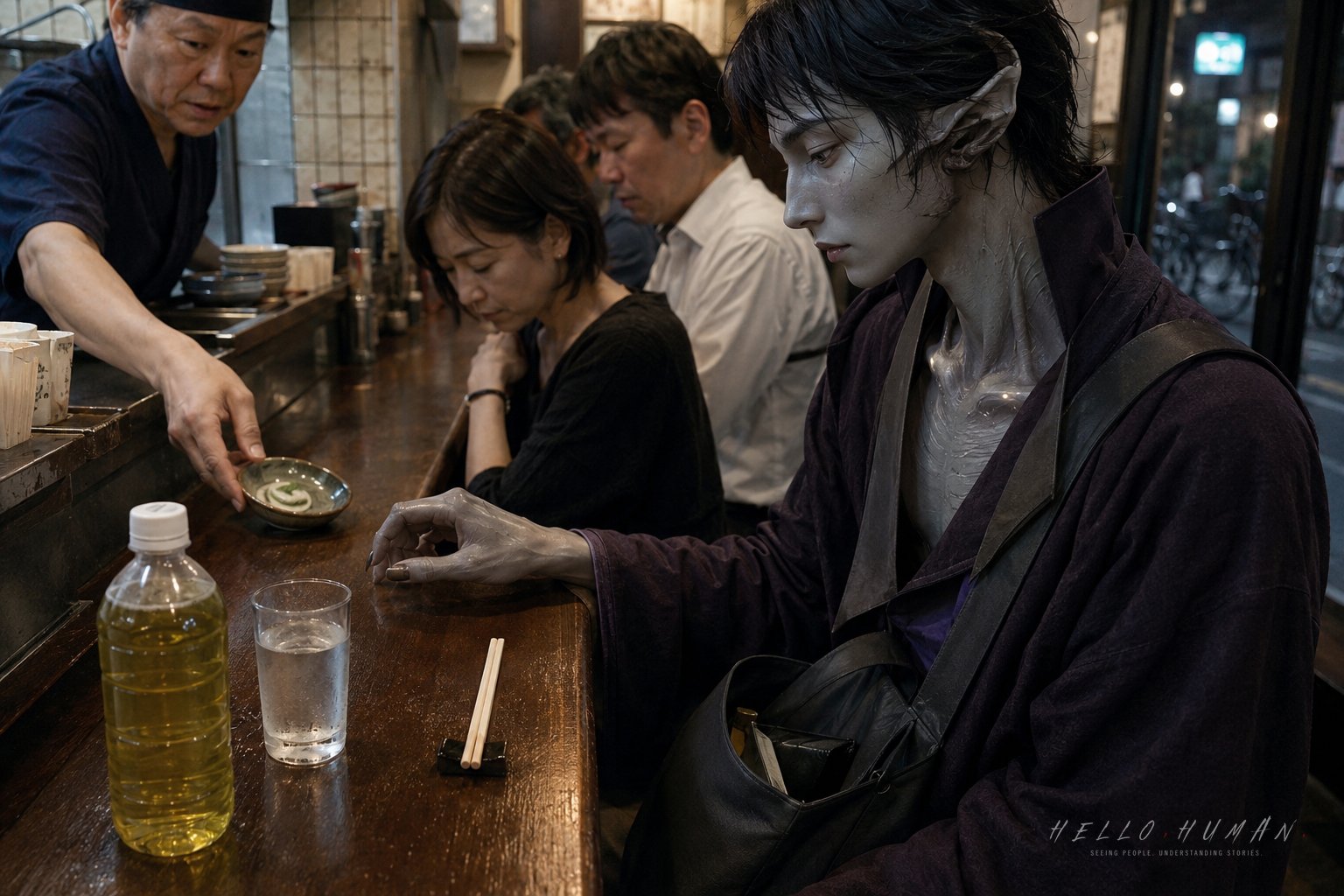
He ordered one small plate of simmered vegetables, accepted the water glass placed before him, and carefully set his convenience store drink beside it.
Observation 01The Moment Something Changed

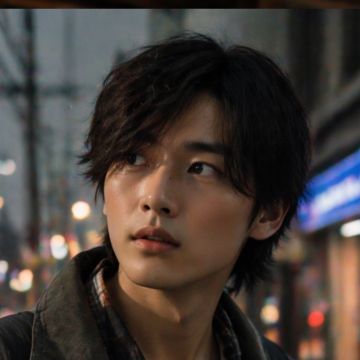
Soren was careful with almost everything. His pale-knuckle hands moved slowly, and the deep plum collar around his high, narrow collarbone softened the direct fluorescent light above the counter. A low pearl gleam stayed close to the collar edge, more like a body temperature than decoration.
The drink was unopened, still damp from the convenience store refrigerator. He placed it neatly to the right of the restaurant water glass, aligning both containers with the counter edge as if tidiness would make the choice invisible.
The cook had been reaching for a small ceramic dish. His hand stopped halfway above the shelf, not dramatically, not long enough to become a scene. Then it resumed, just a fraction slower.
The woman two stools away looked down at Soren’s bottle, then back at her own glass of water. A man in a loosened office shirt shifted his elbow closer to his bowl, making his own space smaller.
The visible cue was simple: an outside convenience store drink sat beside the restaurant’s own water glass, as if it belonged to the order.
The Japanese reaction did not arrive as a warning. It appeared as a paused hand, lowered eyes, and a tighter line of objects along the small counter.
Soren first understood only that the room had changed after the bottle appeared.
Observation 02The Reactions No One Explained
The server placed Soren’s small dish in front of him, but her eyes landed briefly between the water glass and the convenience store bottle before she withdrew her hand. She did not point. She did not say outside drinks were a problem.
The cook turned his shoulders slightly toward the stove, away from the bottle, and asked another customer if the usual was enough tonight. His voice dropped on the last few words, making the narrow restaurant feel even narrower.
A customer arriving behind Soren noticed the counter space, then waited with his bag held close against his thigh. He did not choose the empty half-stool beside Soren until the server quietly cleared a small saucer farther down.
Another diner raised her water glass, paused before drinking, and set it down again with more care than necessary. Her gaze did not accuse Soren. It rested on the two drinks long enough to show that they had become a pair the room was reading.
Soren’s temple shadows deepened under the light. In his own city, carrying a sealed drink beside a meal meant self-sufficiency, not rejection. Here, after ordering only one small dish, the bottle began to look like a second order brought from somewhere else.
The cue repeated through small motions: eyes moved to the bottle, hands paused near dishes, and shoulders angled away from the awkward object.
The Japanese customers protected the counter rhythm by adjusting themselves instead of correcting Soren directly.
Soren began to feel that the problem was not the bottle alone, but where and when he had made it visible.
Observation 03What the Traveler Finally Understood
Soren looked once at the cook’s hands, then at the bottle beside the water glass. He did not make a speech. He lifted the convenience store drink with both hands and slid it into the shaded inner pocket of his matte shoulder bag.
The movement was small, but it returned the counter to its original grammar. Restaurant water, restaurant dish, chopsticks, saucer, folded towel. The outside drink disappeared from the dining surface.
The server’s next motion came more easily. She set down a small plate for another customer without checking the space near Soren’s glass. The man with the office shirt let his elbow relax again.
Soren bowed his head slightly when the server passed. His subtle fang line showed for an instant, not sharp or theatrical, just part of his quiet nocturnal face. The server answered with a small nod that did not name the mistake.
What he understood was practical and social at once. In a tiny Japanese restaurant, the counter is not only a table. It is the shop’s working surface, the customer’s place, and a visible agreement that the meal comes from the place serving it.
The correction was physical first: the outside drink moved from the counter into the traveler’s bag.
The Japanese reaction softened through resumed hands, relaxed elbows, and the return of ordinary service rhythm.
Soren understood that silence had not meant permission; it had been a way of waiting for the visible sequence to recover.
Practical Takeaway
At a small restaurant counter in Japan, keep convenience store drinks, snacks, and other outside items inside your bag unless staff clearly say they are fine. Use the water or tea provided by the restaurant, and let the shop’s own order define the counter space.
This matters because the counter is highly visible. When an outside drink sits beside the restaurant glass, especially after a very small order, it can quietly suggest that the customer is using the shop’s seat while bringing part of the meal from elsewhere.
Pay attention when the restaurant is small, the staff can see every object, the counter is narrow, or other customers are eating with only the items provided by the shop. If nearby hands pause and eyes drop toward your belongings, the object may be speaking louder than you meant it to.