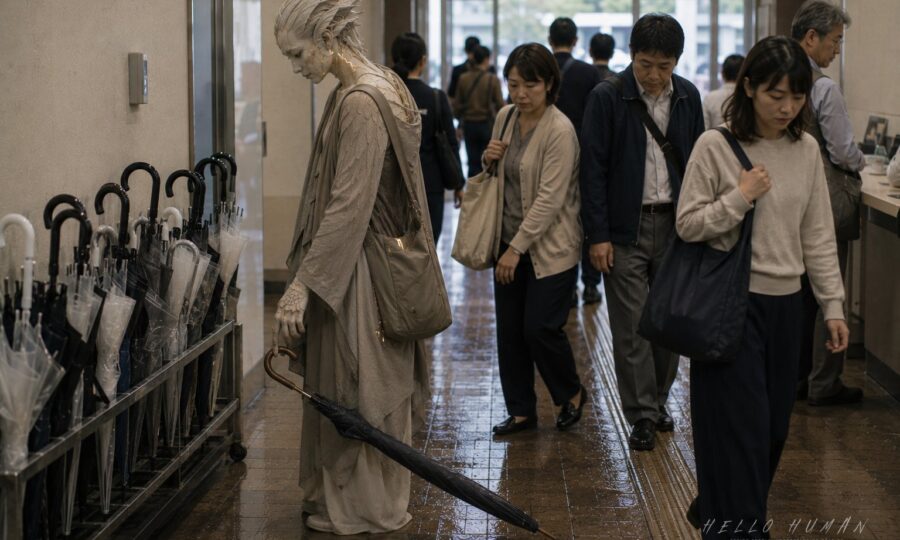
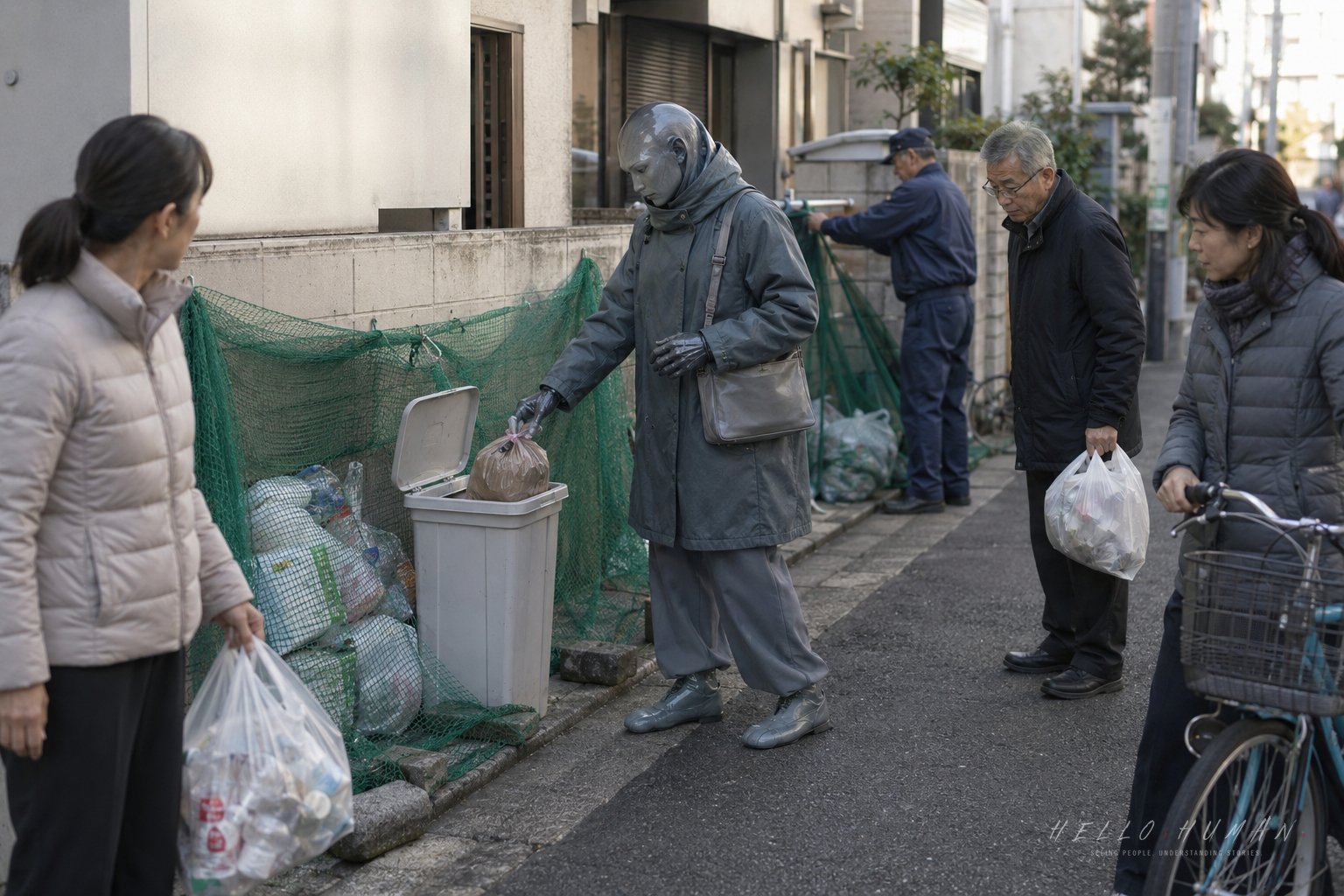
The morning collection net lay over the apartment garbage station like a blue-green lid, weighted at the corners by two small stones.
On the narrow Osaka street, neighbors moved with quiet purpose, placing bags down and stepping away before the commute thickened.
Observation 01The Moment Something Changed


Reka arrived carrying one small household lunch bag from the apartment kitchen. It was tied tightly, light enough to swing from two rounded fingertips, and faintly squared by a folded lunch wrapper inside.
The glass-core guest moved carefully in the early morning crowd. Their body held a soft continuous curve from shoulder to neck, clothed in a matte waterproof jacket with an opaque layered collar and cuff edging that helped their sea-glass gray form stay stable in public air.
At their side hung a sealed soft pouch with rounded pressure-free contact panels. A tiny sea-glass sheen had gathered at one pouch seam, while a small blue-green glow rested inside the throat, visible through the opaque gel depth of their cheeks.
Under the collection net, several larger bags were already arranged. Beside the net stood a tiny station bin with drink bottles inside, its opening clean and easy to understand at a glance.
Reka chose the tidiest option. They lifted the small lid, placed the household lunch bag into the bottle bin, and pressed it gently down so it would not fall out.
A neighbor approaching with a clear bottle bag slowed before reaching the net. Her hand changed direction in midair. She looked at the tied lunch bag inside the bottle bin, then at the burnable trash gathered under the collection net, then at Reka’s hand leaving the lid.
The visible cue was precise: a household lunch bag sat inside a tiny bin that other residents were using only for drink bottles.
The Japanese reaction came through a delayed hand, a held glance, and a neighbor’s attention moving between the bin, the net, and Reka’s fingers.
Reka first understood only that the placement, though tidy, had changed the rhythm of the garbage station.
Observation 02The Reactions No One Explained
The neighbor with the bottle bag did not remove Reka’s bag. She placed her bottles on the ground for a moment, flattened the mouth of her own bag, and waited with her shoulders angled slightly away.
An older resident came out from the apartment entrance holding two burnable trash bags. He paused at the net, looked once at the small bottle bin, and set his bags farther from it than the others.
A woman locking her bicycle lowered her gaze toward the tied lunch bag and then toward Reka’s soft pouch. Her expression did not harden. She simply adjusted her bike basket and gave the garbage station a little more space.
The building manager arrived with a clipboard tucked under one arm. His hand reached for the collection net, stopped, and then smoothed one corner instead. He did not point at the mistake. He made the correct area look more obvious.
Reka stood beside the narrow street with their rounded fingertips close together. In their own shared housing, residue mattered mostly by size and smell. A sealed small bag placed neatly in a small bin would have meant consideration.
Here, the neatness did not solve the category. The bottle bin was not simply available space. It was part of a local sorting pattern that the residents were quietly maintaining before the collection truck came.
The visible cue became clearer because other residents treated the bottle bin and the net as different systems, not as extra containers beside each other.
The Japanese reactions stayed indirect: waiting with a bottle bag, placing burnable trash farther away, lowering eyes, and smoothing the net instead of correcting the visitor.
Reka began to understand that small trash in Japan could still be the wrong trash when the material category did not match the place.
Observation 03What the Traveler Finally Understood
Reka looked again at the bottle bin. The drink bottles inside were bare, rinsed, and pointed in different directions, but all belonged to the same category. Their tied lunch bag was the only soft, opaque shape among them.
They opened the small lid with two careful fingertips and lifted the bag out. The inner blue-green glow at their throat drew closer, a small body-bound tightening that came when people looked away rather than naming discomfort.
Reka stepped back to the collection net. They did not rush. They raised the weighted edge, placed the lunch bag with the other household trash, and lowered the net flat again so the corner lay as it had before.
The neighbor with the bottle bag moved immediately after that. She dropped her bottles into the tiny bin, folded her empty bag, and gave the briefest nod without making the correction into a conversation.
The building manager’s clipboard shifted under his arm. The older resident adjusted one stone on the net, then walked toward the station. The bicycle lock clicked, and the street returned to its early-morning motion.
Only then did the meaning settle for Reka. The issue had not been whether the lunch bag was small, closed, or placed neatly. The issue was that the garbage station was a shared schedule, a shared sorting system, and a shared promise that each resident would leave the next person’s task intact.
The visible correction was simple: the lunch bag came out of the bottle bin and went under the collection net with the household trash.
The Japanese response shifted through motion returning: bottles dropped into the bin, the net was adjusted, and the narrow street resumed its ordinary flow.
Reka understood that at a residential garbage station, the right place is not the closest empty space but the correct local category.
Practical Takeaway
At an apartment garbage station in Japan, do not use a small bottle bin or nearby container for household trash just because your bag is small. Match the item to the local category, and when unsure, keep it with you until you can confirm the correct collection place or day.
This matters socially because garbage stations are shared by residents and handled on a local schedule. A misplaced bag can create extra work for neighbors, the building manager, or the collection crew, even when the bag is tied neatly and does not look messy.
Pay attention when people pause at a collection net, look between one container and another, or adjust the area without speaking. In Japan, those small movements often mean the category is wrong before anyone says so directly.