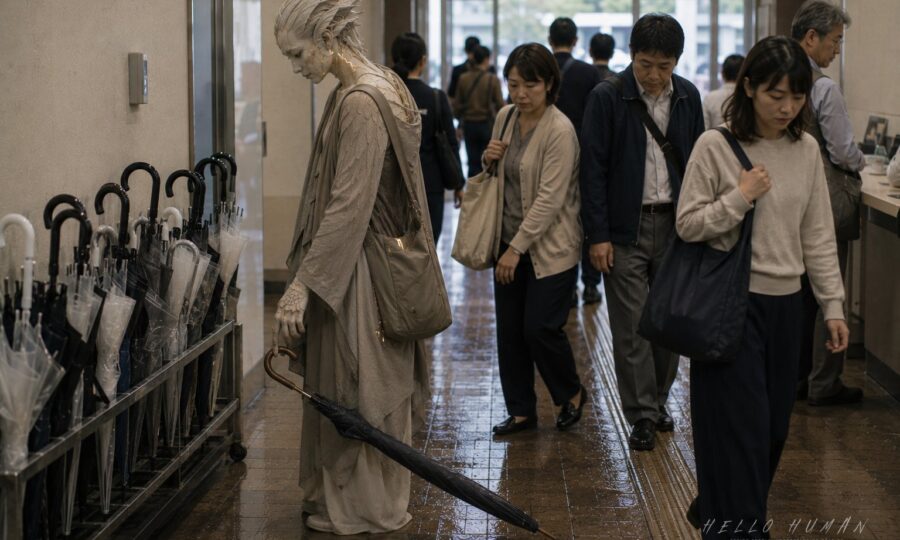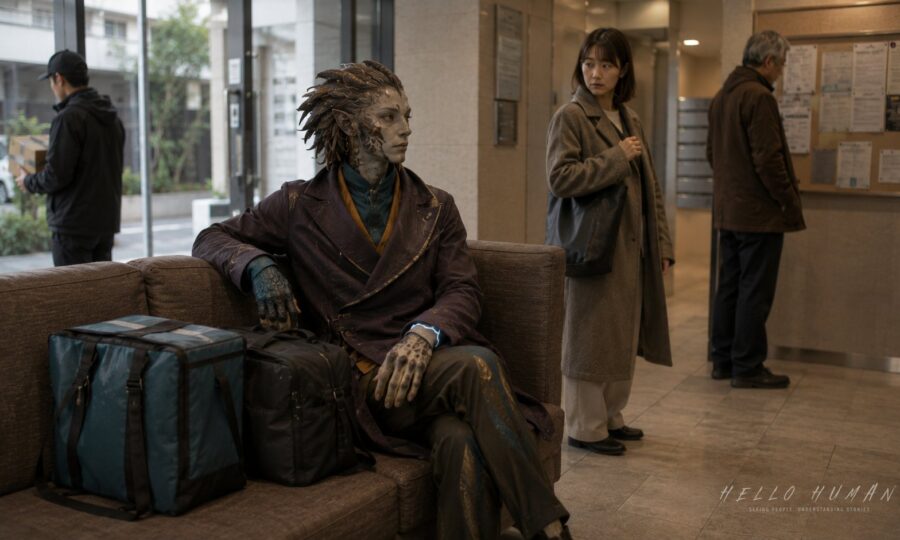
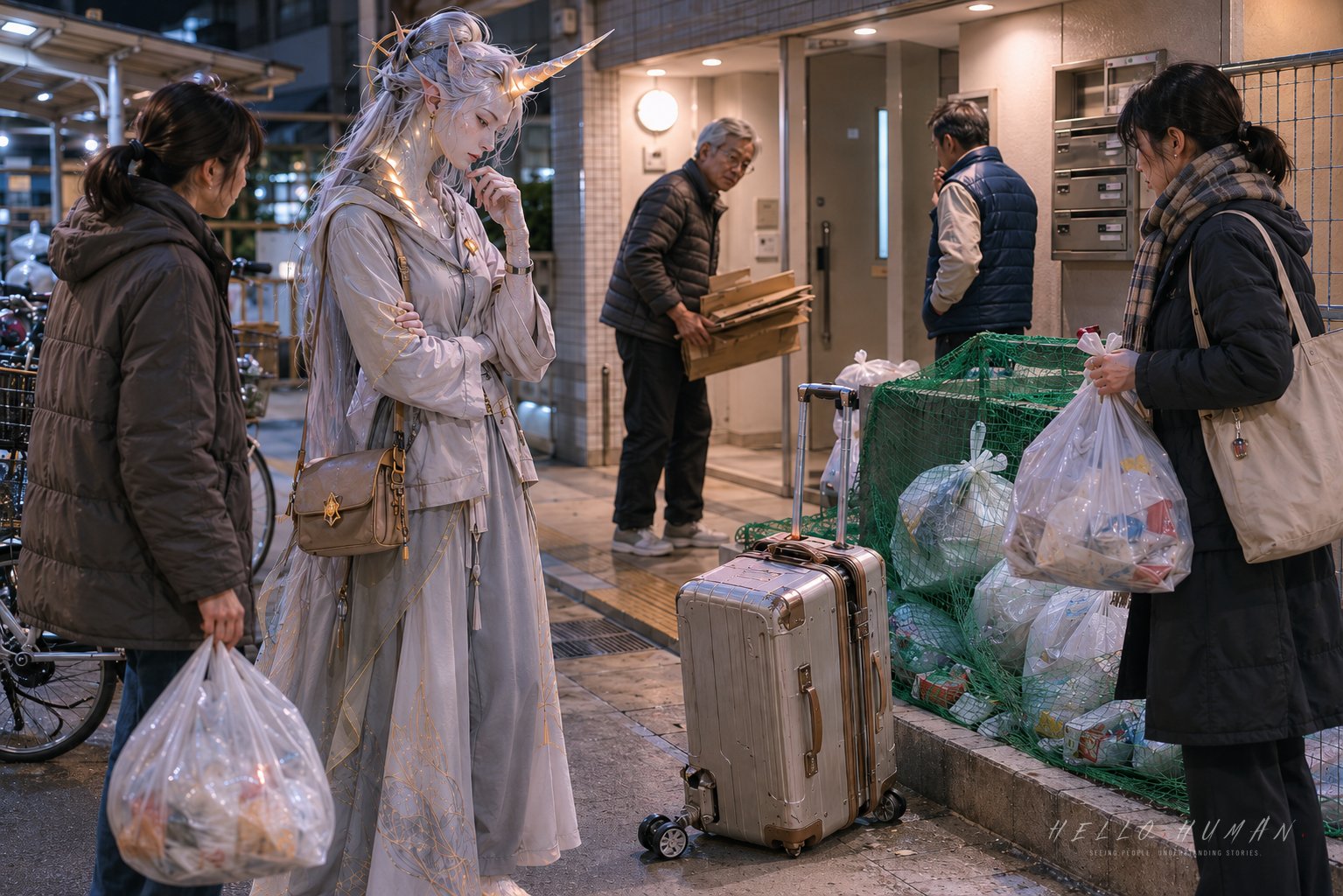
The broken suitcase arrived at the apartment garbage station just after the last trains began to thin out. One wheel hung loose, and the handle stayed half-raised like it had given up before the year ended.
Ena set it beside the collection net, close to the bags already gathered for the morning, then stepped back with a careful, graceful stillness. The silver-gray line of her long neck caught the corridor light, and the faint gold under her skin brightened only near her eyes.
Observation 01The Moment Something Changed


The apartment common area in Osaka was not large. A bicycle rack sat on one side, mailboxes on the other, and the garbage station occupied the small corner under a green net and a low roof.
Ena had moved into the short-stay apartment ten days earlier. The suitcase had cracked during the trip, and in her room it took up the space between the futon and the kitchenette. To her, the answer felt simple: place it where discarded things gathered.
She did not push it under the net. It was too large, and she did not want to crush the smaller bags. So she leaned it politely beside the trash area, wheels turned inward, handle lowered as far as it would go.
A resident coming back with a convenience-store bag slowed at the entrance. His hand paused on the mailbox key. His eyes moved from the suitcase to the net, then to the small calendar clipped near the wall, and then away.
Ena noticed the pause, but not the meaning. No one had said no. No one had pointed. The suitcase stayed there, neat, quiet, and very wrong.
The visible cue was not messiness but category: the suitcase was too large to belong with ordinary apartment trash.
The Japanese reaction began with a pause, a look toward the collection area, and a decision not to speak across the shared space.
Ena first understood only that the object had made people slow down, not yet why it mattered.
Observation 02The Reactions No One Explained
A woman in a dark coat came down with two tied bags. She stopped before the net, looked at the suitcase, and placed her bags farther back than usual, leaving a careful gap around the broken handle.
An older man arrived with flattened cardboard tucked under one arm. He glanced once at the suitcase wheel, once at the wall calendar, and held the cardboard against his side while he waited for the woman to finish. His shoulders angled slightly away from Ena.
Near the elevator, a student lowered his voice during a phone call. He did not mention the suitcase. He only shifted his backpack to the other shoulder and stepped around the corner with less space than before.
Then the building manager appeared in a quilted vest, carrying a small broom and a folded paper notice. He did not ask who had left it. He crouched, checked the suitcase tag, pressed his lips together, and set the notice on the wall near the collection area with a strip of tape.
Ena stood by the mailboxes, one hand resting against the strap of her slim satchel. The glare-softening fastener gave a restrained gold glint. Her integrated forehead horn remained still inside the clean hood opening, but the light near its base dimmed as she understood that silence was not permission.
The suitcase stayed in one place, but everyone else adjusted around it: bags moved, shoulders turned, voices lowered, and hands paused.
No resident made the mistake public; the pressure traveled through small corrections instead of direct complaint.
Ena began to read the space as shared responsibility, not as an empty corner for anything unwanted.
Observation 03What the Traveler Finally Understood
Ena moved before speaking. She bent with controlled, careful hands, lifted the cracked suitcase by its side grip, and brought it back away from the collection net.
The building manager looked up but did not step toward her. His face softened only a little. He pointed with two fingers, not at Ena, but at the notice on the wall and then toward the apartment entrance, where residents usually checked building information.
Ena bowed once. The motion was small because of her long neck and the horn integrated into her forehead structure. Her pearl-gray collar sat below the horn base without pressing it, and the pale gold undertone at her throat brightened for a second, then settled.
She carried the suitcase back to her room, though it crowded the doorway again. Later, she would ask the building contact how to arrange collection and where to put the item on the right day. The correction began with removing the residue from the shared place.
In that apartment common area, the issue was not only cleanliness. A bulky item left without schedule turns private inconvenience into a shared task. Someone must wonder who will arrange it, who will move it, and whether the collection area will quietly become everyone’s problem.
The physical correction was simple: Ena removed the broken suitcase from the garbage station before trying to explain herself.
The Japanese response stayed indirect because the goal was to restore the shared rhythm without embarrassing one person in the common area.
The traveler finally understood that a neat-looking object can still leave social residue when it transfers responsibility to others.
Practical Takeaway
In a Japanese apartment or guest housing space, do not leave broken suitcases, furniture, appliances, or other bulky items beside the normal trash area unless the building has clearly arranged that exact collection. Keep the item in your room and ask the manager, host, or building contact about the local bulky-trash process.
This matters because shared trash areas are not just disposal points. They are maintained by timing, sorting, collection rules, and the quiet labor of residents who expect each person to finish their own part before the item enters the common space.
Pay attention when people pause near an item, look toward a posted schedule, place their own trash farther away, or quietly reset the area. In Japan, those small movements often mean the object is not simply inconvenient; it has fallen outside the shared order.