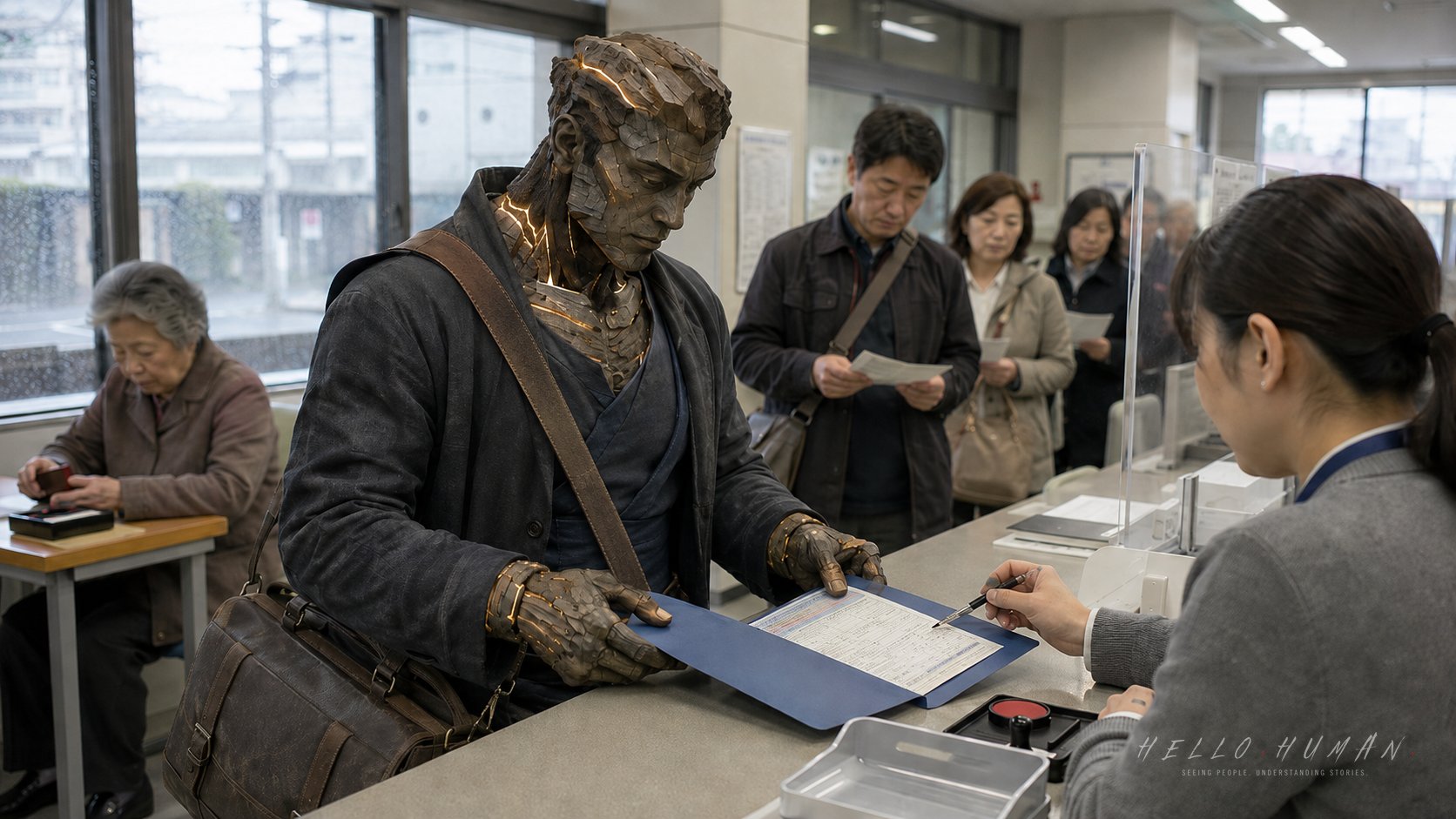
The rain had stopped over Osaka, leaving the pavement outside the ward office dark and glossy. Inside, umbrellas clicked shut near the entrance, and the reception line moved in small, careful steps.
At the city tax office service counter, Orun rested a warm clay-colored hand on a blue document folder. The payment notice inside still held the shape of the envelope it had arrived in.
Observation 01The Moment Something Changed


Orun was a stone-jointed resident, broad at the collarbone, with layered planes around his jaw and throat. His document sling crossed low beneath the heavy collarbone slab, padded wide with soft leather panels so the strap did not bite into his mineral frame.
The clerk had drawn a small circle around the printed due date. She did not raise her voice. She placed the notice flat between them and pointed with the capped end of her pen.
Orun looked at the date, then at his folder. In his home city, a quiet notice was a reminder, and a deadline arrived with a formal summons. Here, the paper looked calm enough to sleep inside the folder for another few days.
He folded the notice once along its existing crease and slid it back behind his residence card copy and insurance booklet. The ochre seams at his segmented wrists gave a faint sheen where the broad cuff openings pressed softly against them.
The clerk’s hand stopped before reaching for the next form. Her pen hovered above the counter. Behind Orun, the next person in line shifted their envelope from one hand to the other.
The visible cue was not dramatic: a notice with a due date went back into a folder instead of staying on the counter as an urgent object.
The Japanese reaction began with a pause, a pen held still, and a line that became more silent rather than louder.
Orun first sensed that the paper had changed weight in the room, even though no one called it dangerous or wrong.
Observation 02The Reactions No One Explained
The clerk lowered her gaze to the folder edge, then back to the notice corner still visible inside it. She tapped the counter once, not hard, exactly where the paper had been a moment before.
A man behind Orun angled his shoulders away from the line, making space without stepping out of it. He looked down at his own notice and pressed it flatter against his chest.
An older woman at the writing table paused with her stamp case open. Her hand did not move toward the ink pad until she saw whether the clerk would call another number or continue with Orun.
The second clerk at the neighboring counter softened her voice while explaining something to a resident. Her eyes flicked once toward Orun’s folder, then returned to the receipt in front of her.
Only after these small movements did Orun feel his mineral veins warm under the silence. The warmth was not embarrassment exactly. It was his body recognizing pressure before his thoughts found the shape of it.
The visible cue was the folder: once closed, it made the payment notice look postponed, even though the clerk had just marked the due date.
The Japanese reactions stayed indirect through gaze, spacing, softer voices, and hands that paused mid-task.
Orun began to understand that the quietness was not permission to delay; it was the office giving him room to correct himself.
Observation 03What the Traveler Finally Understood
Orun did not make a speech. He set both heavy hands on the counter, opened the folder, and pulled the notice back out with careful stone fingers.
He flattened it in front of the clerk so the due date faced upward. The movement was slow, but it was physical first: paper returned to the shared space, deadline visible, conversation reopened.
The clerk’s shoulders eased by a fraction. She pointed again to the date, then to the payment slip below it, and said in a low, steady voice that paying today would keep the procedure simple.
Orun nodded. His wide padded document sling shifted slightly below the collarbone slab, distributing the weight as he reached for his wallet pouch. The faint ochre sheen at the compressed seams dimmed as the line behind him began to breathe again.
What he understood was not that Japanese paperwork was loud. It was the opposite. In a public office, a calm printed deadline can carry all the urgency by itself, and the people around it may protect the mood of the room while still showing that time has become narrow.
The visible correction was simple: the notice came back out of the folder and stayed open on the counter.
The Japanese response changed through small releases, with shoulders easing, hands moving again, and the clerk’s explanation continuing in the same quiet tone.
Orun learned to read the paper, the date, and the paused counter rhythm as one signal rather than waiting for someone to sound urgent.
Practical Takeaway
At a Japanese public office, keep payment notices, tax slips, and health insurance papers visible when a clerk points to a due date. Ask what needs to be done today before putting the notice away.
This matters socially because the office may not dramatize urgency. A calm tone, a circled date, and a waiting pen can mean the deadline is already active, and delaying the gesture can hold up the counter flow.
Pay attention when a clerk taps a date, repeats a payment amount, pauses before taking the next form, or looks toward a line behind you. Those small signals often carry the message before anyone says it directly.