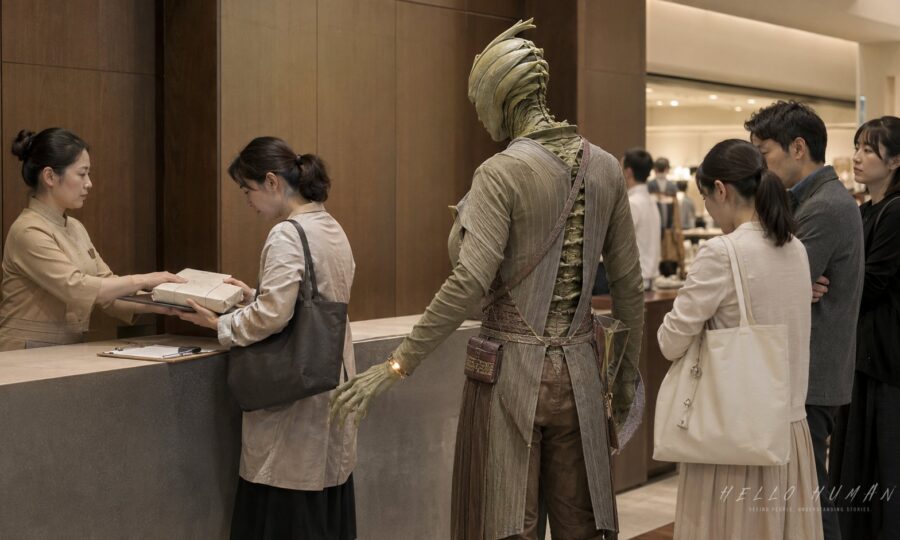
The afternoon heat sat against the Tokyo ward office windows like a second pane of glass. Inside, the waiting area stayed quiet except for number calls, paper trays sliding, and the soft click of pens against clipboards.
Elian stood at the counter with a residence card, a completed address form, and a folded lease copy. The new apartment name was written carefully now, but the move-in date near the top of the form was several weeks old.
Observation 01The Moment Something Changed


Elian had not meant to delay anything. The building name had appeared one way on the real estate message, another way on the mailbox label, and a shorter version on a delivery notice. He thought it would be better to wait until he could write it perfectly.
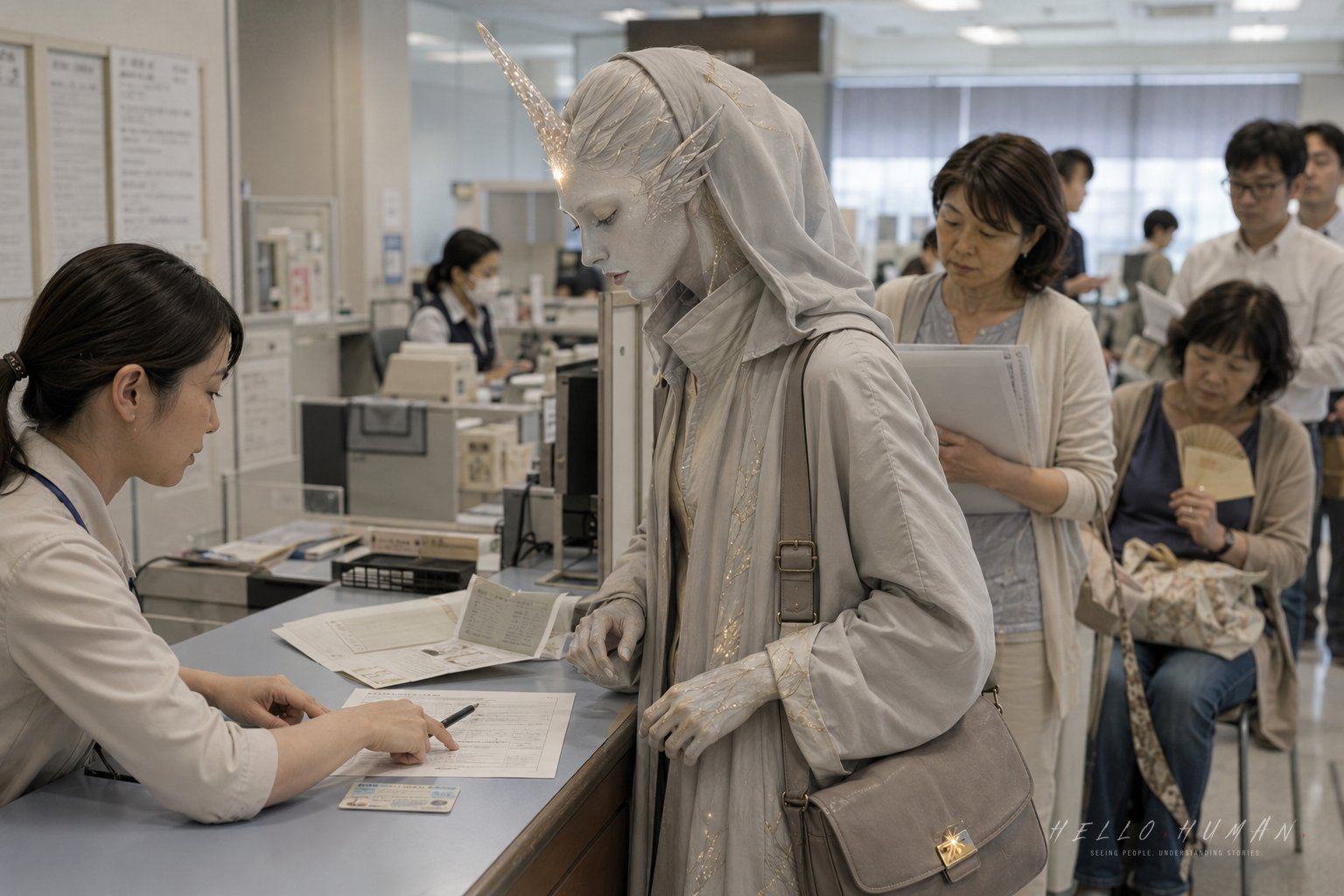
He was a Horn-crowned traveler, still and careful by nature. A single clean horn rose from the structure of his forehead, not like an ornament, but like part of the same calm line that continued down his long neck. His pearl-gray hood opened neatly around the horn base, and the soft collar below it kept clear of the sensitive skin there.
The clerk took the form with both hands. Her eyes moved down the address, the apartment name, the room number, and then stopped at the date. She looked once at the residence card, then back at the date.
Elian waited with refined still hands folded near his slim satchel. A restrained gold glint appeared at the satchel closure when his attention sharpened, then faded. He thought the clerk was checking spelling.
She did not frown. She did not say he had done something wrong. She only turned the form slightly toward herself, checked the date again, and lowered her voice before asking when he had actually moved.
The visible cue was a completed address form arriving at the counter with a move-in date several weeks behind the afternoon it was being submitted.
The Japanese reaction began with a second look, a quieter voice, and the clerk’s careful attention to the date instead of the apartment name.
Elian first understood the pause as a spelling check, not as a signal that the timing itself had become the problem.
Observation 02The Reactions No One Explained
The man at the next counter paused while sliding a document from a clear folder. His hand stayed flat on the plastic sleeve, and his eyes lowered toward his own form as if the date line there had suddenly become important.
A woman in the waiting chairs stopped fanning herself with an envelope. She looked toward the number screen, then toward the counter where Elian stood, then returned her gaze to the papers in her lap without letting it become a stare.
The clerk behind Elian’s clerk leaned slightly closer, not enough to interrupt. She glanced at the form, then at a small notice near the counter, and looked away again before the movement could become a public correction.
Elian’s clerk brought out another sheet. She placed it beside his form with the edges aligned, slowly enough for him to notice that this was no longer a simple copy-and-stamp moment. Her finger rested near the move-in date, not on it.
“This date,” she said softly. Then she paused, choosing the next words with care. “It is already several weeks?”
Elian’s calm eye setting did not change much, but the pale gold undertones at his brow brightened where his attention turned. He felt, at last, that the room was not asking whether the apartment name was correct. It was asking why the office was learning about the move only now.
The visible cue repeated through nearby bodies: paused folders, lowered eyes, a stopped envelope fan, and a second clerk checking the notice without stepping into the conversation.
The Japanese reactions avoided blame, but they made the timing visible by treating the date as the object everyone carefully moved around.
Elian began to understand that accuracy had not canceled urgency; the delay had become part of the procedure he brought to the counter.
Observation 03What the Traveler Finally Understood
Elian’s first correction was physical. He unfolded the lease copy fully, placed it flat beside the form, and moved his phone away from the counter so the clerk had clear space to compare the documents. His hands settled, open and still.
Then he bowed slightly. “I waited for the apartment name,” he said. “I understand now.”
The clerk nodded once, not in approval exactly, but in acknowledgment. She marked the form, brought another document forward, and explained the next step in a voice that stayed low enough for only the counter to hear.
Elian wrote the added information slowly. The clean hood opening stayed aligned below his horn, and his soft collar did not brush the counter as he leaned forward. The slim satchel rested against his side, its glare-softening fastener turned inward, no longer catching the overhead light.
The waiting area resumed its ordinary rhythm. A number was called. The man at the next counter slid his document forward. The woman with the envelope began fanning herself again, smaller than before.
Elian understood the shape of the mistake after the paper moved on. In a Japanese public office, waiting for perfect certainty can look responsible from inside the problem, but the office also needs time to remain continuous. The address could be corrected; the missing weeks could not be made invisible.
The physical correction came first: Elian cleared the counter, unfolded the lease, stopped explaining the apartment name, and let the clerk handle the late date directly.
The Japanese response eased when the paperwork could move again, quietly and in sequence, without turning the delay into a public lesson.
Elian finally understood that administrative timing is part of the information, not a detail to solve after everything else feels perfect.
Practical Takeaway
When your address changes in Japan, go to the ward office promptly even if one detail, such as the apartment building name, still feels uncertain. Bring the lease, residence card, and any address documents you have, and let the counter help confirm the wording.
This matters socially because the date is not only a private memory of when you moved. At a public office, it connects records, notifications, residence information, and the sequence other staff need to process without confusion.
Pay attention when a clerk checks the same date twice, lowers their voice, brings out an extra form, or points to a notice instead of openly correcting you. Those quiet movements often mean the procedure is now about timing, not just spelling.