The cold afternoon had made the clinic windows pale around the edges. Coats hung over knees, masks softened faces, and the waiting room held the small sounds of paper forms, slippers, and a wall clock.
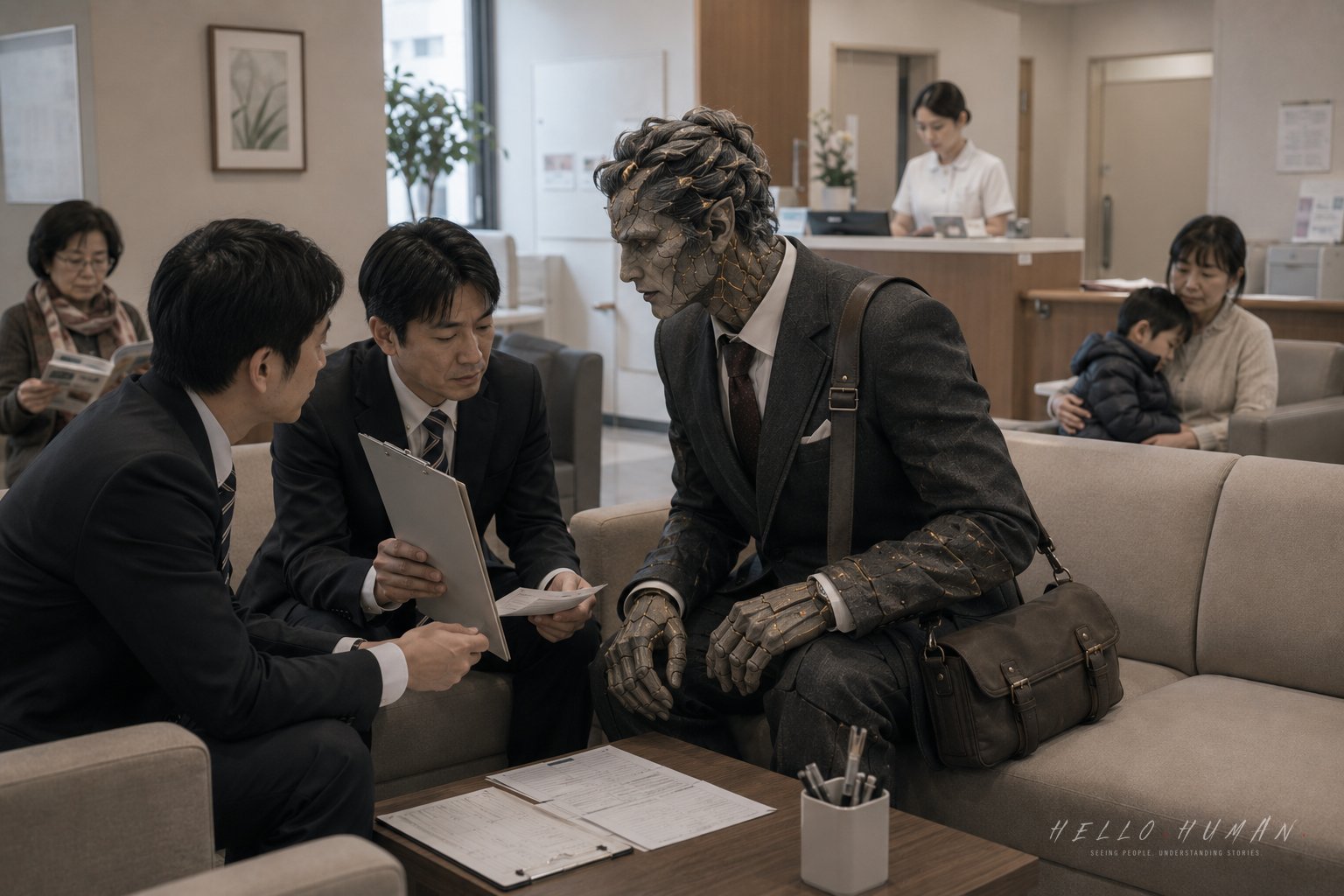
Daro sat near two new colleagues on a row of vinyl chairs. His document sling rested below his broad collarbone slab, and the first meeting conversation had begun in the careful space between their knees and the low table.
Observation 01The Moment Something Changed


Daro was trying to be easy to understand. The two Japanese colleagues had met him at the clinic entrance for a work-related health check, and their first conversation moved through names, forms, and the order of the afternoon.
He was a Stone-jointed resident, a calm heavy humanoid with warm clay jaw planes layered around the throat. His segmented stone wrists emerged from broad cuff openings, and reinforced shoulder seams softened the weight of his posture against the chair back.
One colleague answered his question with a quiet “hai,” then lowered her gaze to the form in her lap. The other gave a small nod and looked toward the reception counter. Daro read the softness as uncertainty.
He leaned closer, bringing his broad collarbone slab forward over the low table. Then he repeated the question more clearly, each word rounded and slow, his voice carrying past the two colleagues into the row behind them.
The wall clock seemed louder after that. A child stopped swinging one shoe. A patient holding a prescription envelope looked down at the envelope’s corner, and Daro’s dark mineral veins warmed faintly along his neck seams.
The visible cue was Daro moving his heavy posture forward and raising the clarity of his voice in a room already organized around low sound.
The Japanese reaction began indirectly: the nearby movement stopped, gazes lowered, and the two colleagues answered with smaller bodies instead of louder words.
Daro first understood the quiet as confusion, not as a signal that the conversation needed to remain narrow.
Observation 02The Reactions No One Explained
The colleague nearest him shifted her clipboard higher against her chest. She did not move away sharply, but her shoulder angled toward the aisle, making a thin boundary where the conversation had come too close.
The second colleague placed one finger lightly on the form and nodded twice, smaller than before. His eyes moved toward the reception desk, then back to Daro’s mouth, then down again, as if trying to keep the answer from expanding.
Across the waiting room, an older man turned one page of a magazine without reading it. The page stayed lifted for a moment, shielding his face from the direction of Daro’s voice.
A nurse stepped out from behind the reception counter with a file in her hand. She paused at the threshold, lowered her voice before calling the next name, and waited until the room’s sound settled again.
The child’s mother placed a hand lightly on the child’s knee. The shoe stopped swinging. No one stared at Daro, but several people had changed their bodies around the sound he had made.
Daro felt the room’s quiet press against his words after they were already spoken. His calm heavy fingers tightened once around the edge of his document sling, and a faint ochre sheen appeared at the compressed seam under the strap.
The visible cue repeated through the room: a clipboard rose, shoulders angled away, a magazine page lifted, a nurse waited, and a parent stilled a child’s movement.
The Japanese reactions avoided direct correction, but they made the sound boundary visible through posture, timing, and lowered activity.
Daro began to understand that speaking more clearly had not solved confusion; it had widened a private conversation into shared clinic space.
Observation 03What the Traveler Finally Understood
Daro’s first correction was not verbal. He eased his weight back into his own chair, letting the reinforced shoulder seams take the pressure again. His segmented wrists lowered toward his lap, and the space between his knees and the low table reopened.
Then he reduced his voice to the size of the two people beside him. “Sorry,” he said, almost under the wall clock. “I understand.”
The nearest colleague’s shoulders softened. She turned the clipboard slightly so he could see the form without needing to lean in. The second colleague answered with the same quiet “hai,” but this time Daro let the word stay small.
The nurse called another name. The older man lowered his magazine page. The child’s shoe moved once, then rested. Nothing dramatic changed, which made the repair feel complete.
Daro noticed that the clinic waiting room was not silent because people were unsure. It was quiet because many separate concerns were sharing one room: names, symptoms, forms, family worries, and private appointments. A first meeting conversation had to fit inside that shared quiet.
His mistake had come from kindness turned too strong. In Japan, especially in a waiting room, a softer reply may not be a request for more volume. It may be an invitation to bring the conversation closer to the room’s existing level.
The physical correction came first: Daro leaned back, lowered his wrists, and returned his voice to the narrow space between the three seats.
The Japanese response eased through ordinary motion resuming, with the nurse calling names and nearby patients returning to their own papers.
Daro finally understood that personal space can be made of sound as much as distance, especially where people are waiting for private reasons.
Practical Takeaway
In a clinic waiting room in Japan, keep first-meeting conversations low and contained. If someone answers quietly, match their volume and distance before leaning closer or repeating yourself more clearly.
This matters socially because waiting rooms hold many private situations at once. A louder voice or closer posture can make other people’s quiet feel exposed, even when the intention is only to be helpful.
Pay attention when the room’s sound level drops, shoulders angle away, eyes lower, or nearby hands pause over forms and bags. Those small reactions can mean your conversation has grown beyond the space it was meant to occupy.