The early morning train in Tokyo carried the New Year period softly. Coats were darker than the advertisements, paper shopping bags rested against ankles, and the windows showed a pale city not fully awake.
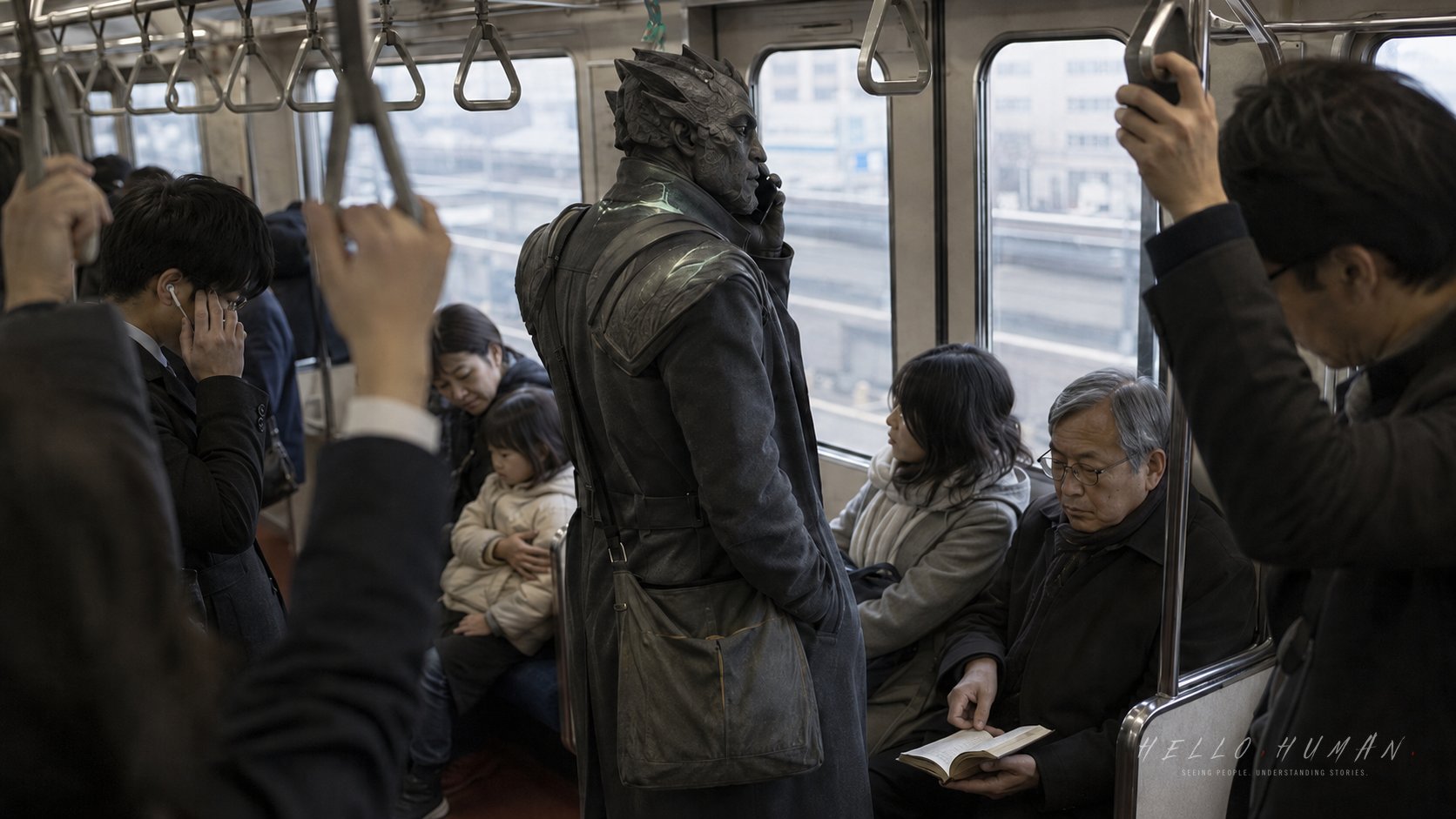
Orven stood beside the priority-seat strap area with one hand on the overhead rail. His broad low-routed satchel strap passed below the folded stone-wing contour of his back, and his phone began to vibrate inside his coat.
Observation 01The Moment Something Changed


Orven looked at the screen and saw a name from the lodging desk. He had checked out early, left one document behind, and the message felt urgent enough to become a voice call before he had time to think.
He was a Slate-wing traveler, humanlike but shaped by old mineral logic. Folded stone-wing shoulders stayed close to his back under weatherproof slate canvas with padded shoulder panels, and short carved neck ridges showed above his collar. His blunt stone fingertips held the phone carefully, without sharp motion.
He answered in a low voice. Not a loud voice. Not a careless one. Just audible enough that the words crossed the space between the hanging straps and the seated passengers below them.
“Yes, I can return,” he said, turning slightly toward the door glass. His weathered slate brow planes lowered with concentration, and a faint greenish warmth touched the rain-worn seams near his shoulder.
The passenger seated nearest the priority-seat sign did not look up fully. She shifted her bag from her lap to her knees and turned her face toward the window, even though the window showed only the dim reflection of the train car.
The visible cue was a phone held to the ear in the priority-seat strap area, with a low voice still traveling through the quiet car.
The Japanese reaction began without complaint: a seated passenger turned away, the nearby strap-holders became still, and the car’s small sounds thinned around the call.
Orven first understood his lowered voice as a correction, not yet realizing that the voice call itself was the mistake.
Observation 02The Reactions No One Explained
A man standing across from Orven adjusted his grip on the strap. He did not stare at the phone. His eyes moved once toward Orven’s hand, then down to the floor between their shoes.
An older passenger seated under the priority-seat marker closed her book with one finger left inside it. She kept the book on her lap and leaned a fraction toward the empty space beside her, making her posture smaller.
A student with earbuds in looked up, removed one earbud halfway, then put it back without meeting Orven’s eyes. The motion was brief, but it made the call feel louder than it had been a moment before.
Near the door, a parent touched a child’s sleeve before the child could ask a question aloud. The child’s mouth closed. The parent’s gaze moved toward the phone, then toward the priority seats, then away.
No one told Orven to stop. The train did not stop. The announcement above the door continued in its usual rhythm, and the wheels kept their steady sound under the floor. That ordinary movement made the silence around his voice harder to read.
Orven answered another question from the caller, softer this time. “Yes, next station,” he said. But the softer words still required everyone near him to know that he was solving a private problem in a shared car.
The visible cue repeated through small reactions: a strap grip changed, a book closed, an earbud shifted, and a parent stopped a child’s voice before it joined the call.
The Japanese reactions avoided direct embarrassment, but they showed that the sound boundary near the priority seats had been disturbed.
Orven began to understand that being quiet was not the same as being unobtrusive when a phone conversation remained audible.
Observation 03What the Traveler Finally Understood
Orven looked at the priority-seat area again, not as a place where he happened to stand, but as a place where the train asked for extra care. Bags were held close. Knees stayed aligned. Voices, when they appeared at all, were smaller than the rhythm of the wheels.
His first correction was physical. He lowered the phone from his ear, covered the microphone with one blunt fingertip, and stepped closer to the door without pressing into the people beside it.
“I will text,” he said into the phone, very softly, and ended the call before the reply could continue. The screen turned inward against his coat. His folded stone-wing shoulders settled under the padded panels, and the rain-dark seam edge near his shoulder lost its faint brightness.
The man across from him loosened his grip on the strap. The older passenger opened her book again. The parent’s hand left the child’s sleeve. No one smiled at Orven, but the car returned to its earlier size.
At the next station, he stepped onto the platform side of the doorway and wrote the message with both hands close to his chest. The answer took longer than the call would have, but it belonged to him alone.
Only then did the meaning become clear. In a Japanese train car, especially near priority seats, a phone call can feel intrusive even when the caller is trying to be considerate. The problem is not only volume. It is the shape of a private voice entering a shared quiet where people cannot easily leave.
The physical correction came first: Orven lowered the phone, ended the call, turned the screen inward, and moved the conversation into text.
The Japanese response eased through ordinary motion resuming, with books, straps, and small family gestures returning to their previous rhythm.
Orven finally understood that the priority-seat area asks for more than a low voice; it asks for sound that does not make nearby passengers share the call.
Practical Takeaway
On a train in Japan, avoid taking voice calls inside the car, even if you can keep your voice low. Near priority seats, lower the phone first, end the call briefly, and use text or wait until you are on the platform.
This matters socially because passengers are sharing a small space they cannot easily exit. A low but audible call still makes others carry one side of your private situation, especially around seats reserved for people who may need a calmer area.
Pay attention when nearby passengers lower their eyes, adjust straps, close books, stop small movements, or become quieter around your phone. Those reactions can mean the sound is already too present, even without a direct warning.