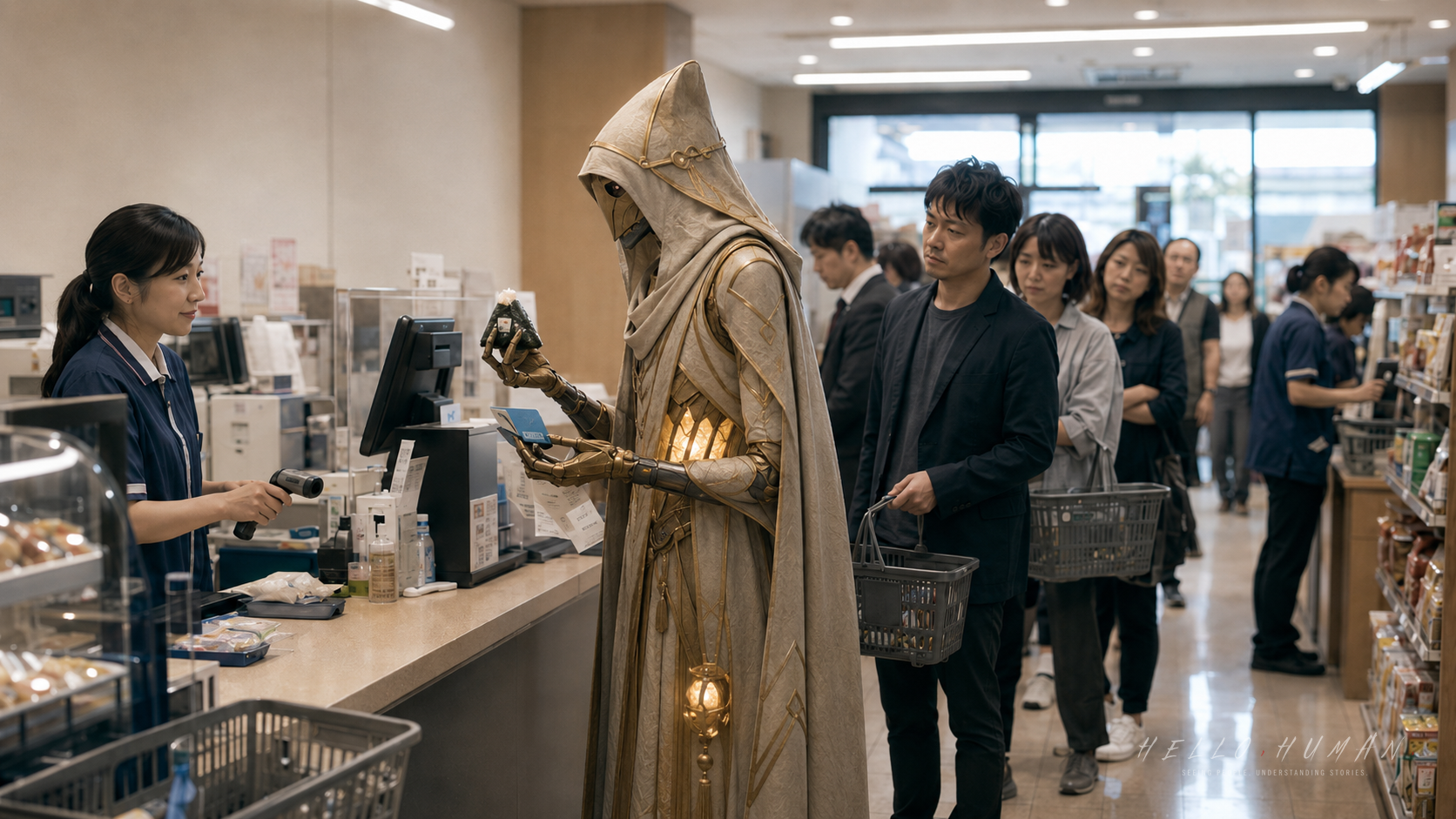
The convenience store counter in Fukuoka had two registers open, both moving quickly under the bright evening lights.
Veyra placed a rice ball, a prepaid card, and three folded receipts on the counter, then began asking questions while the line behind them reached the drink case.
Observation 01The Moment Something Changed

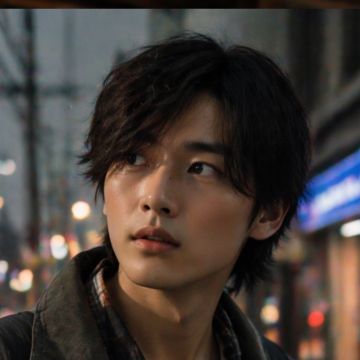
Veyra’s body held itself in a segmented thorax posture, upright and formal, with thin chitin hands folded neatly before each movement. Beneath the ribs, a small lantern organ rested close to the body, dim and warm inside its own shadow.
The cashier scanned the rice ball. Veyra pointed to the prepaid card and asked how it could be used. The cashier answered softly, one hand still near the scanner.
Then Veyra unfolded the receipts. One was for a delivery payment. One was for a concert lottery. One had a barcode faded at the edge. Veyra arranged them in a careful row, as if the counter were a consultation desk.
The cashier’s smile stayed in place, but her scanning hand stopped. Her gaze moved once toward the line, then back to Veyra. The other register beeped three times in quick succession.
Behind Veyra, a man in a work jacket shifted his bento from his left hand to his right. A student holding only a bottle of tea looked toward the second register, then lowered his eyes to the floor.
No one told Veyra to hurry. The first signal was the cashier’s stopped rhythm.
The cashier’s brief glance toward the line showed that the counter time had become shared time.
The waiting customers adjusted their hands and eyes instead of complaining aloud.
Observation 02The Reactions No One Explained
The cashier picked up the first receipt and turned it toward the barcode reader. Her voice stayed polite, but each answer became shorter. “This one is possible.” “This one needs the machine.” “This one may not read.”
The staff member at the second register called, “Next customer, please,” a little more clearly than before. The words were not aimed at Veyra, but the sound opened another path for the people behind them.
The man with the bento stepped sideways to the other register without looking annoyed. The student followed, leaving a small empty space behind Veyra that made the delay more visible.
A woman near the coffee machine checked the clock above the tobacco shelves, then checked her phone. She did not stare. She simply held her wallet ready before joining the shorter line.
The cashier placed one receipt flat on the counter and touched the self-service machine pamphlet beside the register. Her finger rested there for less than a second, suggesting the next place without saying Veyra had chosen the wrong one.
Veyra’s lantern organ brightened only within the rib shadow. It was not a burst of light, just a small contained glow, the kind that appeared when a room’s patience grew tight around them.
The cashier shortened her answers to keep the exchange moving without refusing help.
The second register created an indirect release for the line behind Veyra.
A brief touch toward the machine pamphlet suggested where longer questions belonged.
Observation 03What the Traveler Finally Understood
Veyra looked at the line, then at the cashier’s hands. The hands had never become rude. They had simply kept trying to return to motion.
The three receipts no longer looked like one request. They looked like three separate tasks placed into a moment built for quick buying.
Veyra gathered two of the receipts back into their thin chitin fingers. “This one only,” they said, touching the rice ball and the card. Their voice lowered until it fit inside the counter space.
The cashier’s shoulders eased. She scanned the card, completed the payment, and placed the receipt in the tray with a small bow. Her rhythm returned, not rushed, just smooth.
After paying, Veyra stepped away from the register and stood beside the copier and ticket machine, where there was room to unfold the papers. The lantern under their ribs dimmed to a quiet amber. When they needed help again, they waited for a lull and asked one question at a time.
Veyra understood that a convenience store counter is designed for short, efficient exchanges.
The correction came through pace, shorter answers, opened alternate lines, and gentle redirection toward another machine.
In Japan, asking for help is normal, but timing matters when the line behind you is carrying everyone’s errands.
Practical Takeaway
At a busy convenience store in Japan, keep counter questions brief when people are waiting. Handle simple payment first, then step aside to check receipts, machines, tickets, coupons, or complicated services before asking again.
This matters because convenience store counters depend on quick shared rhythm. Staff may want to help, but a long question during rush hour can quietly slow many people who are trying to buy one or two items.
Pay attention when the cashier’s answers become shorter, their hand returns toward the scanner, another register calls customers forward, or people behind you shift to a different line. Those small signals may mean your request needs a better moment.