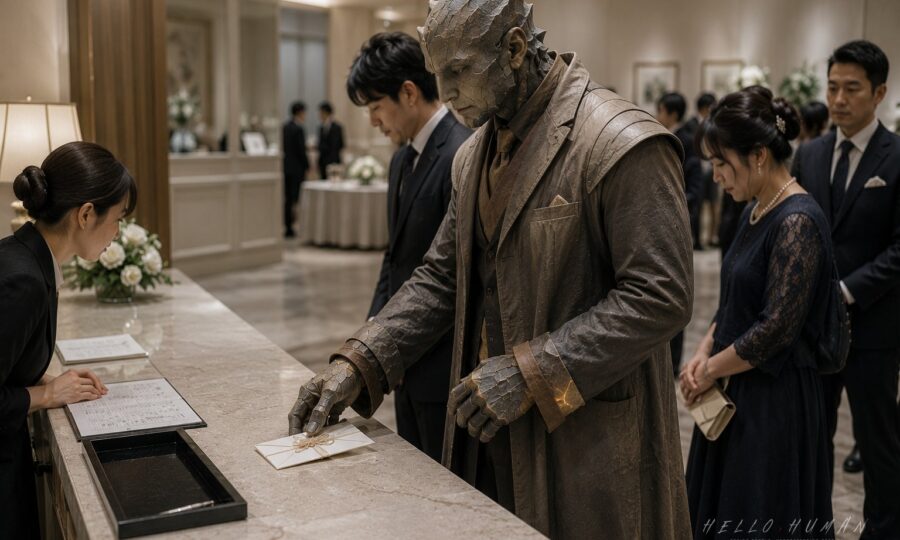
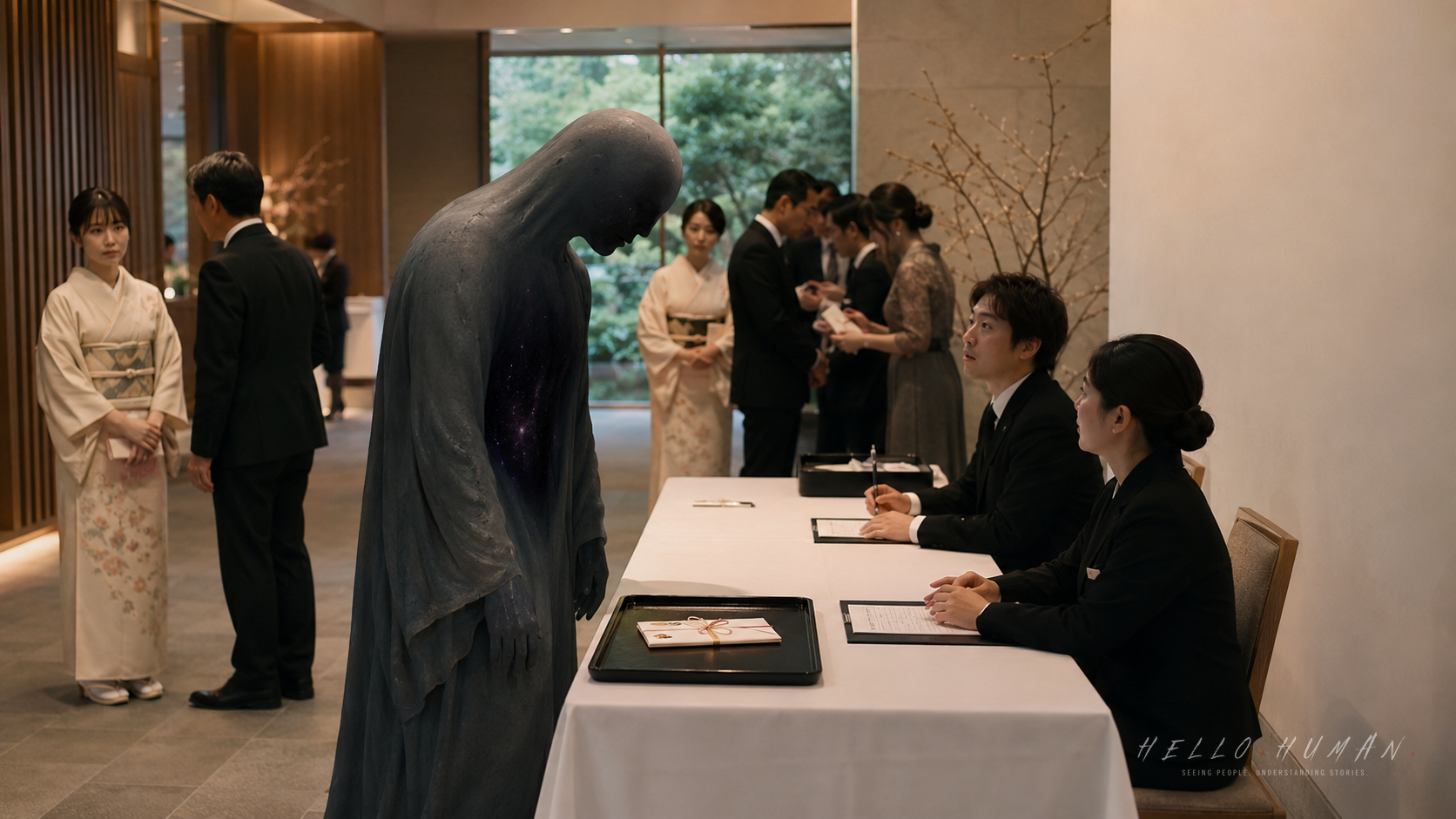
The wedding reception table in Kyoto was covered in white cloth, with guest cards arranged in neat rows and a small tray waiting beside the name list.
Yore placed the decorated money envelope on the table, tapped its edge with one dusk-toned finger, and asked if the amount should be checked now.
Observation 01The Moment Something Changed


The hotel lobby outside the banquet room held the quiet brightness of a formal afternoon. Guests arrived in dark suits, pale dresses, and careful steps. Each person paused at the table, bowed, gave a name, and presented an envelope with both hands.
Yore had watched from the line. Their body held a low twilight posture, with a soft boundary between arm and sleeve that made their outline seem unfinished at the edges. Inside the torso, a hollow dusk shadow rested beneath the ribs, narrow and still.
When their turn came, Yore bowed and set the envelope down. The mizuhiki cord shone against the paper. Then they touched the envelope again, as if confirming a purchase.
“The gift is inside,” Yore said. “Do you verify the amount before entry?”
The receptionist’s hand stopped above the guest list. Her smile remained, but it tightened at the corners. The man beside her lowered his eyes to the envelope without touching it.
No one corrected Yore directly. The first signal was a pause over the guest list.
The receptionist’s smile stayed polite, but its tension showed the question had changed the tone.
The envelope was meant to be received ceremonially, not opened or treated like a counter payment.
Observation 02The Reactions No One Explained
The receptionist placed both hands lightly on the table, not on the envelope. Her voice softened. “Thank you very much,” she said, bowing just enough to close the question without answering it.
The man beside her moved the tray a little closer to Yore. The motion suggested where the envelope should rest, not what should be said about it.
A guest waiting behind Yore looked down at their own envelope and adjusted the cloth wrapping around it. They held it with the front facing outward, already prepared to offer it without comment.
Another staff member stepped toward the line and greeted the next arriving guest in a slightly brighter voice. The sound drew attention away from Yore’s question and back toward the reception rhythm.
Yore noticed that no one looked into the envelope. No one weighed it, counted it, or discussed its contents. The paper, the cord, the bow, and the receiving hands carried the meaning that Yore had tried to make practical.
The hollow shadow inside Yore’s ribs narrowed. It happened only during awkward silence, a small inward dusk that made their chest appear less deep than before.
The receptionist avoided discussing money by accepting the gift with gratitude rather than explanation.
The tray was moved forward to redirect Yore toward the expected action.
Other guests modeled that the envelope should be offered quietly, with the amount left unspoken.
Observation 03What the Traveler Finally Understood
Yore looked at the tray, then at the guest envelopes already received. They were not stacked like bills or receipts. They rested in a formal order, each one carrying a name, a relationship, and a wish for the couple.
Their fingers left the envelope. Then they picked it up again, this time with both hands, turned it so the front faced the receptionist, and placed it gently on the tray.
Yore bowed. No amount was named. No proof was requested. The envelope crossed the table as a greeting and a blessing, not as a transaction to settle.
The receptionist’s shoulders eased. She accepted it with both hands and bowed back. The man beside her checked Yore’s name on the list and guided them toward the banquet room with an open palm.
As Yore stepped away, the dusk shadow beneath their ribs widened again to its ordinary shape. The room had not rejected them. It had simply asked the gift to remain wrapped in ceremony.
Yore understood that ceremonial envelopes in Japan carry social meaning beyond the money inside.
The correction came through silence, tray placement, formal thanks, and examples from other guests.
At a wedding reception, discretion helps preserve the warmth of the gift and the dignity of the occasion.
Practical Takeaway
At a Japanese wedding reception, present the money envelope formally with both hands, usually after removing it from its wrapping cloth. Face the envelope toward the receptionist, bow, and let the staff receive it without discussing or showing the amount.
This matters because the envelope is part of the ceremony. Even though money is inside, the exchange expresses congratulations, relationship, and respect, so treating it like a payment can make the moment feel too bare.
Pay attention when staff pause, thank you without answering a money-related question, move the tray closer, lower their voices, or other guests offer envelopes quietly. Those signs may mean the form of giving matters more than practical confirmation.