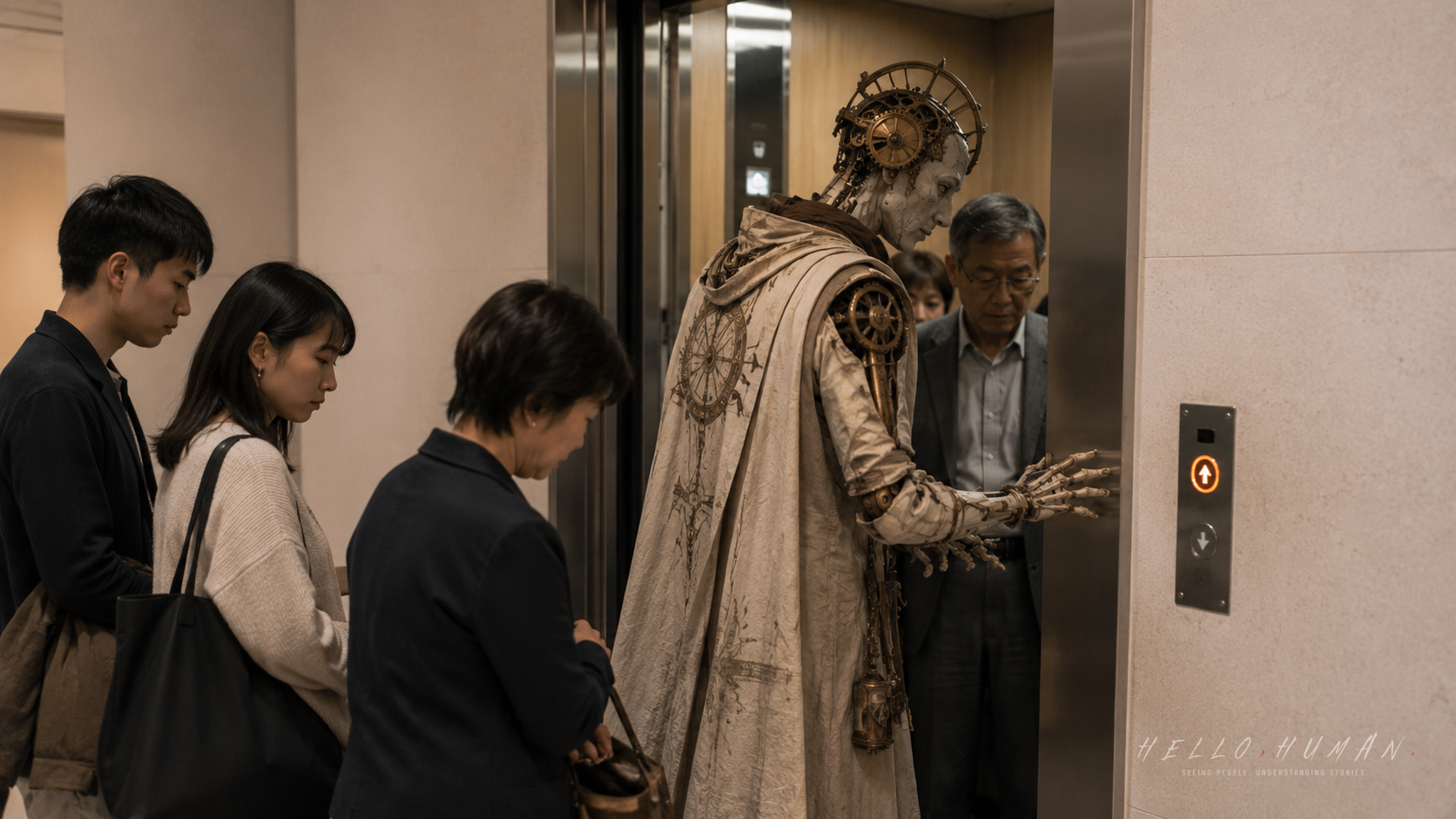
The elevator doors opened on the third floor of a community hall in Nagoya, revealing three people inside and one narrow space near the buttons.
Tovin stepped halfway in, stopped in the doorway, and lifted a clock-hand finger toward the panel without moving the rest of their body.
Observation 01The Moment Something Changed

The community hall corridor smelled faintly of paper schedules, floor wax, and rain coats drying near the umbrella stand. People had been waiting in a loose line by the elevator, quiet after a neighborhood meeting upstairs.
Tovin had a body built from measured pauses. Small gear-set joints sat inside their shoulders, not worn like decoration but turning beneath the skin with soft mechanical patience. Their fingers were long and narrow, each bone shaped like a clock hand with a tiny blunt point at the end.
When the elevator arrived, an elderly woman inside took one careful step forward to leave. Tovin stepped in at the same moment and stopped, half inside the car and half in the corridor.
The woman’s foot paused just before the door track. She did not say anything. Her eyes lowered to the narrow strip of floor between Tovin’s heel and the elevator threshold.
Behind Tovin, a man holding a folder shifted his weight back. A child beside him pressed closer to a parent’s sleeve. Inside the elevator, the person nearest the buttons kept one hand raised, waiting to press a floor that had not yet been chosen.
No one told Tovin to move. The first signal was everyone stopping at once.
The doorway became crowded because entering and exiting were trying to happen in the same place.
Lowered eyes and paused feet showed that the problem was physical before it was verbal.
Observation 02The Reactions No One Explained
The elderly woman inside the elevator angled her shoulders slightly, as if she might pass through the remaining gap. Then she decided against it. Her handbag stayed close to her ribs.
The person by the buttons looked at Tovin’s raised finger, then at the open doors. Their hand moved toward the “open” button and held there without pressing anything else.
The man with the folder gave a small half-bow to the people inside, although he was not the one blocking them. He stepped a little to the side, creating an example of where Tovin could have stood.
The parent behind Tovin whispered to the child, but not loudly enough for the words to travel. The child’s shoes turned away from the center of the doorway, copying the parent’s angle.
Tovin’s internal ticking became audible. It was usually hidden under room sounds, but the small public silence made it clear: tick, pause, tick. Their shoulder gears held still while the rest of the corridor waited around the error.
People showed the correct flow by making space to the side, not by scolding Tovin.
The person near the buttons protected the elevator doors from closing while everyone waited.
The quiet half-bow and sideways steps carried the message that exiting should happen first.
Observation 03What the Traveler Finally Understood
Tovin looked down at the door track. It was only a narrow groove in the floor, but everyone’s attention had gathered there. The threshold was not empty. It was a small crossing point with an order.
Their raised finger folded back into the hand. The shoulder gears turned once, softly, and Tovin stepped out of the doorway into the corridor.
The elderly woman exited first. She gave a small nod without looking directly into Tovin’s face. The two people behind her followed, their steps light and quick, as if the room had resumed breathing.
Only after the elevator cleared did Tovin enter again. This time they moved fully inside, turned sideways near the wall, and kept the doorway open with their body out of the path. The person near the buttons asked the floor with a glance and a small lift of the hand.
Tovin pointed to the fifth floor. The button lit. Their internal ticking faded under the hum of the elevator as the doors closed without anyone needing to squeeze, wait, or apologize aloud.
Tovin understood that an elevator doorway is a shared passage, not a place to stop and decide.
The correction came through paused exits, side steps, and people quietly preserving the door space.
In Japanese shared spaces, smooth movement often depends on clearing thresholds before handling details.
Practical Takeaway
When an elevator opens in Japan, stand to the side and let people exit before entering. Once inside, move fully away from the doorway before checking buttons, bags, phones, or directions.
This matters because elevator doors are tight shared thresholds. A small pause in the doorway can block people from leaving, slow the line behind you, and create awkward pressure without anyone wanting to correct you directly.
Pay attention when people pause at the door, lower their eyes to the floor track, shift sideways, hold the open button, or wait in silence. Those reactions may mean the doorway needs to be cleared first.