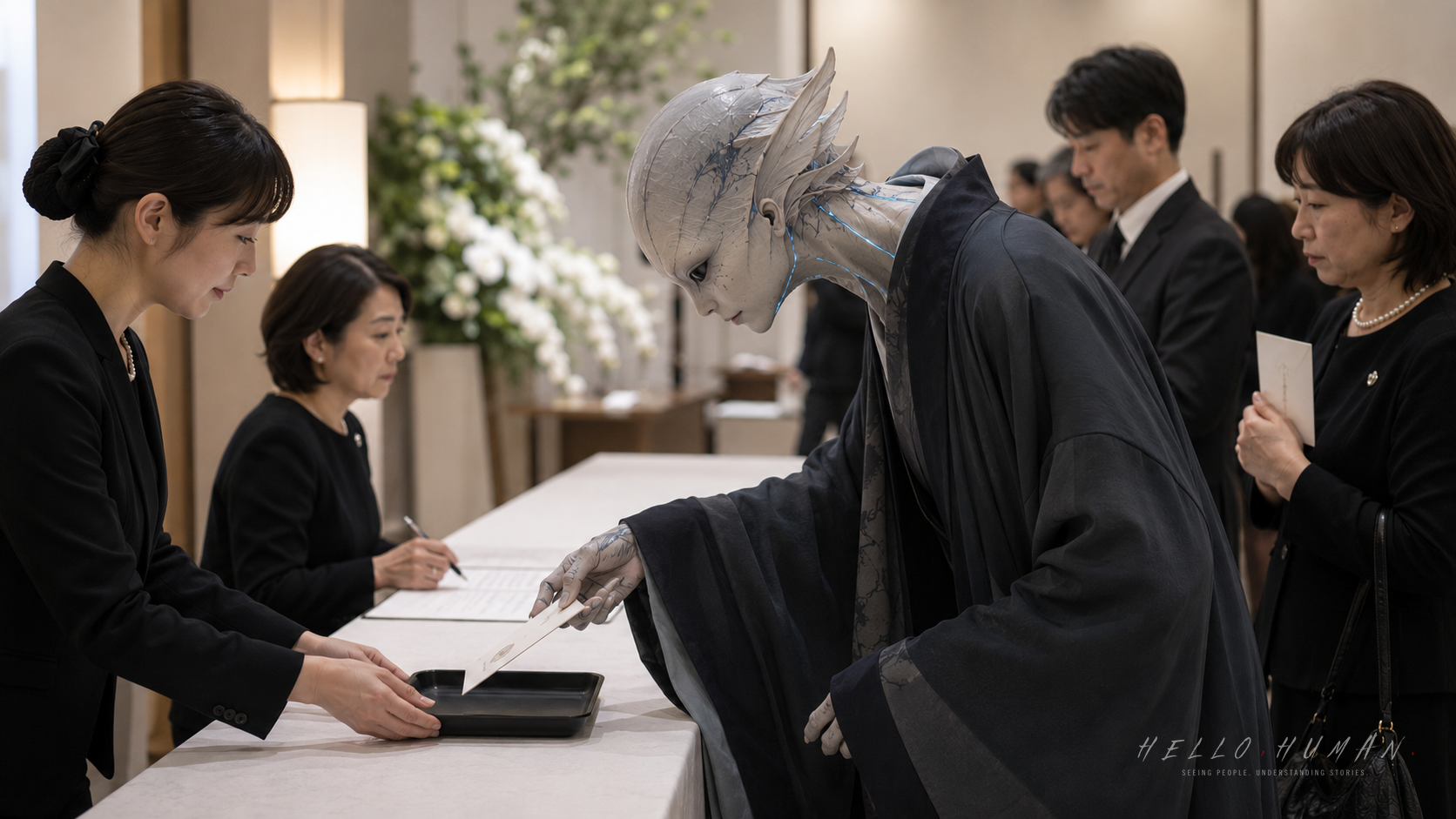
The condolence tray was black, shallow, and almost empty except for the quiet weight everyone gave it.
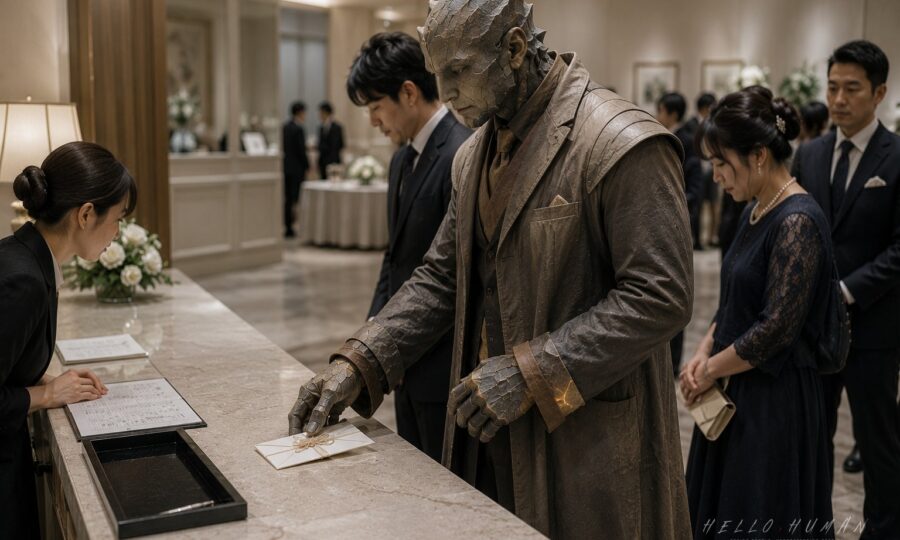
Neme stepped to the funeral reception table, held his envelope with both hands, and bowed until one long sleeve slid across the tray’s edge.
Observation 01The Moment Something Changed

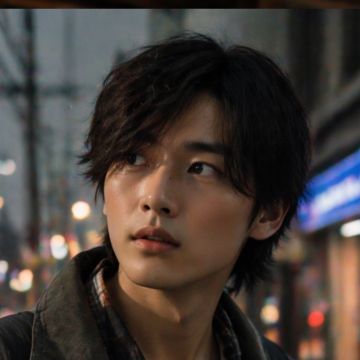
The funeral hall sat on a side street in Osaka, quiet behind a row of small flower stands and dark suits. Inside, the air had the flat softness of carpet, low voices, and shoes that had slowed down before crossing the entrance.
Neme was an ink-eyed pilgrim, not tall, but made of angles that seemed folded rather than grown. His eyes were dark without shine. Brushstroke veins moved faintly under his brown-gray skin, and the folds over his knuckles looked dry enough to crease like paper.
He had watched the Japanese guests ahead of him. Each person approached the reception table, offered a condolence envelope, exchanged a restrained bow, and moved aside. No one lingered. No one made the grief larger than the room allowed.
When Neme’s turn came, he tried to make his bow smaller in sound and deeper in feeling. His shoulders folded. His head lowered. His wrists extended the envelope forward.
But his home world used distance as coldness. To show sincerity, one drew near. So Neme bowed too close to the table, and his long dark sleeve slid over the corner of the condolence tray.
The mistake was not the bow itself, but how close it brought Neme’s body and sleeve to the reception objects.
The tray became partly covered at the exact moment it needed to remain open.
The first sign was stillness around the attendants’ hands.
Observation 02The Reactions No One Explained
The attendant nearest him lowered her eyes to the tray, then raised them only as far as Neme’s hands. Her fingers stayed folded on the table. She did not pull the tray away.
The second attendant, holding a small record sheet, paused with the pen just above the paper. The pen did not touch down. Its tip hovered as if the form itself had become too loud.
Behind Neme, a man in a black suit shifted half a step backward. The woman beside him pressed her envelope closer to her chest, turning it slightly so the edge no longer pointed toward the blocked tray.
Someone near the wall gave a low whisper, then stopped before the sentence became clear. A chair leg made a small sound and then silence covered it.
Neme remained bowed for one breath too long. His sleeve rested across the tray, and the corner of his envelope nearly touched the attendant’s side of the table. His ink-dark eyes narrowed in the direction of the silence.
He had expected grief to make a room heavy. This was different. The weight was not sadness alone. It was a line he had crossed without stepping over anything marked on the floor.
The attendant gave the smallest bow in return, shallow and careful. Her gaze moved once from Neme’s sleeve to the open space beside the tray.
The Japanese reactions stayed indirect: paused hands, lowered eyes, and guests holding their envelopes back.
No one wanted to correct a mourner’s sincerity at a funeral reception.
The repeated gaze toward the tray showed that the object, not Neme himself, needed space.
Observation 03What the Traveler Finally Understood
Neme lifted his head slowly. The ink near his pupils gathered inward, darkening like wet brush marks returning to a point.
He saw the sleeve across the tray. He saw the attendant’s hands waiting. He saw the man behind him holding an envelope that had nowhere calm to go next.
His correction was physical before it was verbal. He drew his sleeve back against his wrist, slid one foot away from the table, and brought the envelope closer to his own chest before offering it again with both hands.
The attendant accepted it with a quiet bow. The pen touched the record sheet. The tray was visible again, and the guests behind him resumed their small forward movement.
Neme stepped aside without turning his back too quickly. At the end of the table, he stood with his arms folded close, letting the sleeve hang straight down. His bow to the next attendant was shallower, with air left between his body and the table.
He understood then that distance at the reception was not emotional absence. It was a way of keeping the shared ceremony usable for the next person, the next envelope, and the family’s grief passing through many careful hands.
The correction was simple: withdraw the sleeve, step back, and offer the envelope within the table’s clear space.
The reception rhythm returned as soon as the tray and handover area were open again.
Neme learned that respectful distance can carry feeling without crowding the ritual.
Practical Takeaway
At a Japanese funeral reception, approach calmly, keep a modest distance from the table, and make sure your sleeve, bag, hands, or body do not cover the condolence tray, record sheet, or space where envelopes are exchanged.
This matters because the reception area is both formal and practical. The family’s representatives, attendants, and guests all need the objects to remain clear so the ceremony can continue quietly without anyone having to correct a mourner.
Pay attention when attendants pause their hands, glance at the tray, or guests behind you stop moving forward. In a formal setting, those small pauses often show where your body or belongings need to shift.