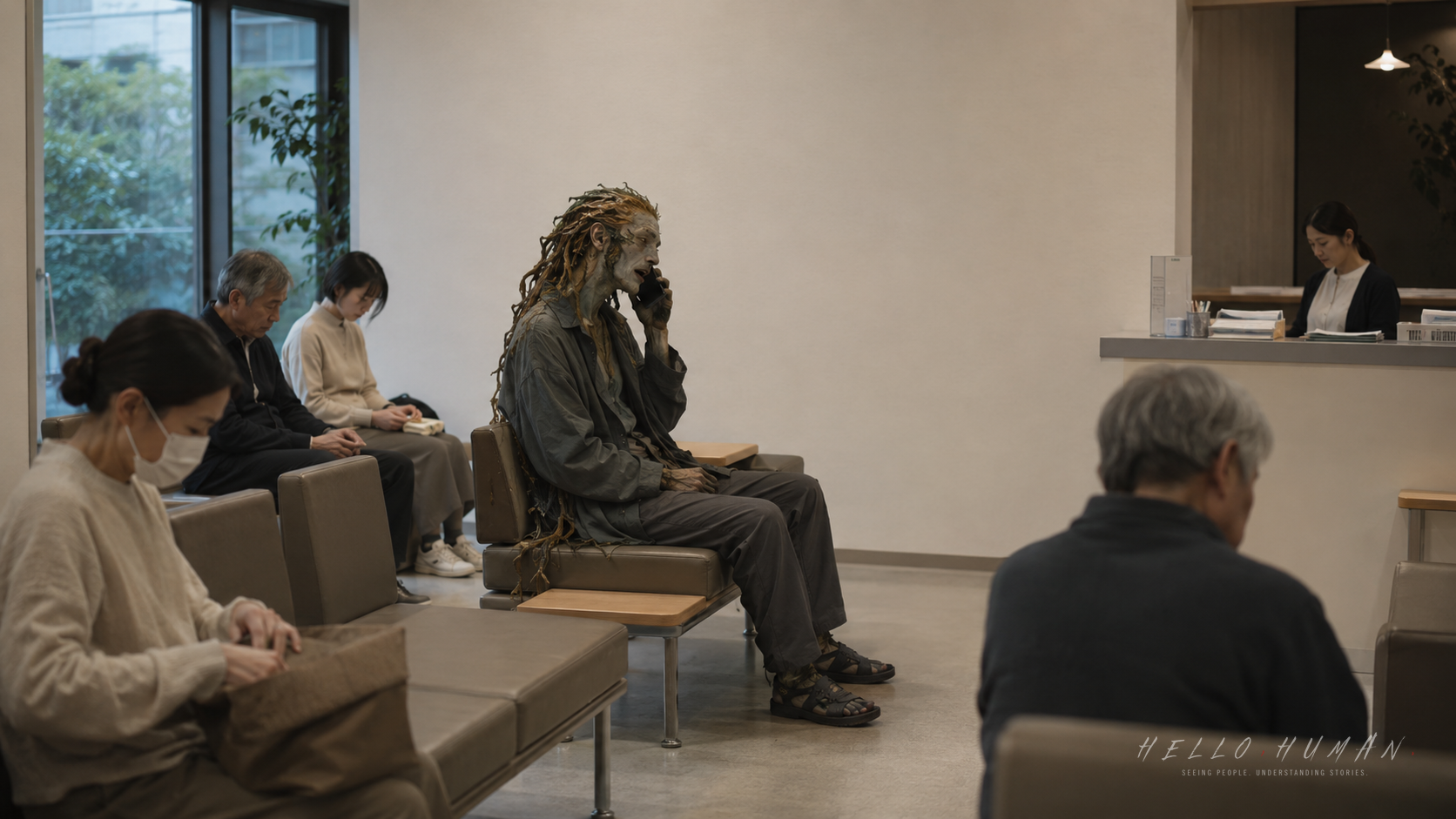
The clinic lobby in Kamakura had eight pale chairs, a shoe rack by the entrance, and a television playing with subtitles but no sound.
Marel sat near the middle row, kelp strands rooted into their scalp sliding softly against their salt-dark neck tendons as they spoke across the room.
Observation 01The Moment Something Changed


Marel had come in from the narrow street outside, still carrying the damp smell of the sea. Their body moved with a soft drifting posture, not quite walking and not quite swaying, as if the floor were a gentle current.
They had been asked to wait. The receptionist had pointed to the chairs with a small open palm, and Marel had nodded with great seriousness. Waiting, to them, meant staying visible until called.
Then their phone rang. It was not a sharp sound, only a low chime, but Marel answered in a voice that crossed the whole lobby at once.
“I am inside the healing room,” Marel said, each word broad and clear. “There are chairs. There is a silent box showing weather.”
The man by the wall stopped turning the pages of his magazine. A mother lowered her eyes to the child beside her. At the reception counter, the woman in pale blue paused with one hand on the keyboard.
The room did not correct Marel with words. It corrected them by becoming still.
Several people lowered their gaze at once, avoiding direct confrontation.
The receptionist’s paused hand showed that the loud voice had interrupted the shared calm.
Observation 02The Reactions No One Explained
The receptionist did not call out to Marel. She leaned slightly toward another staff member and spoke in a voice that barely moved beyond the counter. The difference in volume was sharper than any instruction.
The mother placed one finger gently against her child’s picture book. The child had not spoken, but still nodded and turned the page more slowly.
The man with the magazine shifted one chair farther away. He did it carefully, lifting his bag first, then himself, so the metal chair legs would not scrape.
An elderly woman near the entrance looked up at the sign asking visitors to turn off phone sounds, then looked back down at her hands. She did not look at Marel directly.
Marel continued speaking for another sentence. As the silence around them thickened, the kelp rooted in their scalp began to cling closer to their neck. The strands no longer floated outward. They pressed flat, sensing a room quieter than their voice.
The receptionist modeled a lower voice instead of openly scolding Marel.
Other visitors protected the atmosphere by moving carefully and avoiding noise themselves.
A glance toward a sign, followed by looking away, worked as an indirect hint without public embarrassment.
Observation 03What the Traveler Finally Understood
Marel looked at the television, still moving without sound. They looked at the receptionist’s lowered shoulders, the child’s careful page turn, the elderly woman’s folded hands.
Their voice narrowed. “I will speak later,” they said into the phone, now barely louder than the air conditioner. “This room is shared.”
They ended the call and placed the phone inside their coat. Their kelp hair loosened slightly but stayed close, as if learning the shape of the lobby.
The receptionist resumed typing. The man’s magazine page turned again. The mother’s child leaned against her sleeve and whispered something too small for anyone else to catch.
When Marel’s name was called, they stood slowly. Before walking to the examination room, they gave a small bow toward the counter. It was not dramatic. It simply returned the space they had borrowed too loudly.
Marel understood that quiet is part of the service environment in many Japanese shared spaces.
The correction came through contrast: soft voices, careful movement, and people making themselves less noticeable.
In a clinic lobby, keeping volume low helps protect privacy, fatigue, and worry that may not be visible.
Practical Takeaway
In a Japanese waiting room, clinic lobby, elevator area, or similar shared indoor space, keep phone calls brief and quiet, or step outside before speaking. Match the room’s volume rather than bringing your own into it.
This matters because people in shared spaces may be tired, anxious, unwell, or simply trying not to disturb others. A low voice helps everyone remain comfortable without forcing anyone to correct you directly.
Pay attention when people stop moving, lower their eyes, speak more softly than before, glance at a sign, or quietly increase distance. In Japan, those small changes often mean your sound has become too large for the space.