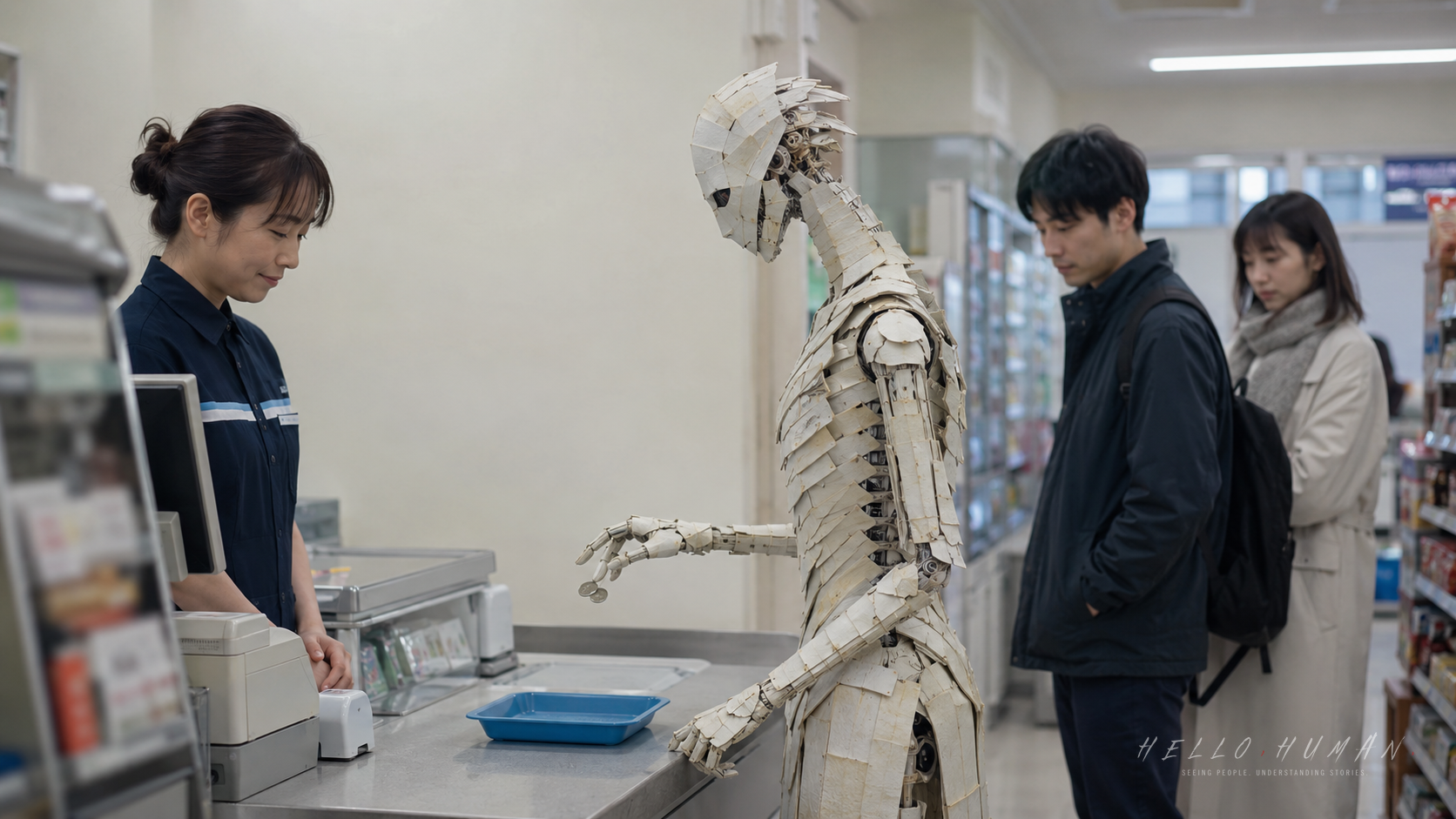
The payment tray sat between the register and the customer, shallow and blue, with a small rubber mat that kept coins from sliding.
Orin held three coins above it without lowering their hand.
Observation 01The Moment Something Changed


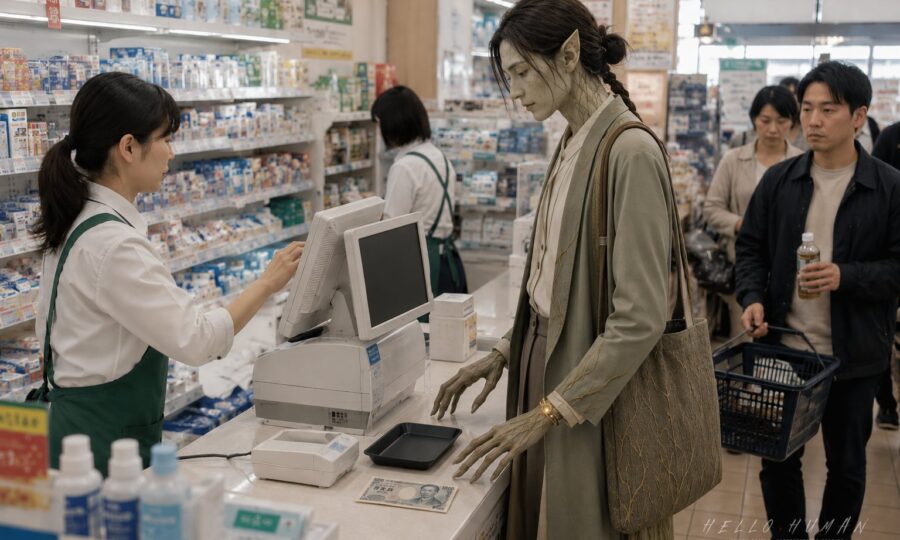
It was early evening in Hiroshima, and the convenience store line moved in soft, practiced steps. A woman bought onigiri and tea. A student tapped a card. A man placed exact change into the small tray without looking up from his phone.
Then Orin came forward, carrying a bottled coffee and a packet of rice crackers. Their body was made from thin index-card bone plates, each plate overlapping the next like an old catalog drawer compressed into a living shape. Tab-like ridges ran along both forearms.
The cashier scanned the items and turned the screen slightly. Orin counted the coins with a quiet cataloging motion, thumb to plate, plate to palm. Then they extended the coins directly toward the cashier’s hand.
The cashier’s fingers rose halfway. They stopped in the air, not touching Orin and not taking the coins. Her gaze moved from Orin’s hand to the tray, then back to the coins.
Behind Orin, the next customer shifted their basket from one hand to the other. The plastic handles clicked once. Orin’s forearm ridges lifted slightly, as if a drawer label had been pulled out of place.
The cashier did not reject the coins. She paused before accepting them directly.
Her gaze moved to the payment tray, making the object part of the conversation.
The line behind Orin stayed quiet, but the small shift in waiting made the mistake noticeable.
Observation 02The Reactions No One Explained
The cashier smiled with only her eyes. Her hand returned to the register side of the counter. She did not pull away sharply. She simply made her hand unavailable.
With her other hand, she nudged the blue tray forward by a few centimeters. The movement was light, almost like straightening the counter after a previous customer.
The student waiting behind Orin glanced at the tray, then looked down at his own card. The man near the magazine rack turned his shoulders slightly away, giving the register a little more privacy.
The cashier said the total again in a softer voice. She did not add an instruction. The tray remained centered between them, its empty surface clearer than a spoken correction.
Orin’s index-card plates made a faint dry sound along the wrists. They were used to direct exchange: record given, record received, hand to hand. But this counter had inserted a small neutral space, and everyone seemed to recognize it except them.
The cashier avoided embarrassing Orin by changing the counter arrangement instead of correcting them aloud.
Other customers reduced their attention, allowing the exchange to recover without becoming a scene.
The tray created a shared middle space where payment could move without direct hand-to-hand pressure.
Observation 03What the Traveler Finally Understood
Orin looked down at the tray as if seeing it for the first time. It was not decoration. It was not storage. It was the place where the payment could rest before becoming the cashier’s responsibility.
Their hand lowered. One coin touched the rubber mat, then another, then the last. The coins stopped moving without sound.
The cashier counted them from the tray. Her fingers moved quickly now, professional and calm. She placed the receipt and change back on the same tray, turned neatly toward Orin.
Orin picked up the receipt first, then the change. This time, their tabbed forearm ridges settled flat. The catalog inside their body had found the correct order: item, total, tray, receipt, exit.
As Orin stepped away, the next customer moved forward without hesitation. The blue tray returned to the center of the counter, ready to receive the next small offering of coins, cards, coupons, or silence.
Orin understood that the payment tray organizes the checkout flow without needing many words.
In Japanese stores, indirect service signals often appear through objects placed between people.
A smooth exchange can depend on noticing where staff expect hands, money, and receipts to go.
Practical Takeaway
At a cash register in Japan, place cash, coins, cards, coupons, or point cards on the payment tray when one is provided. After payment, take your receipt and change from the tray rather than reaching toward the cashier’s hand.
This matters because the tray creates a clear, neutral space for the exchange. It keeps the checkout flow smooth, reduces awkward contact, and helps staff handle money and receipts in a consistent order.
Pay attention when a cashier pauses, looks at the tray, moves it closer, or repeats the total without taking what you are holding out. The correction may be the tray itself, quietly waiting in front of you.