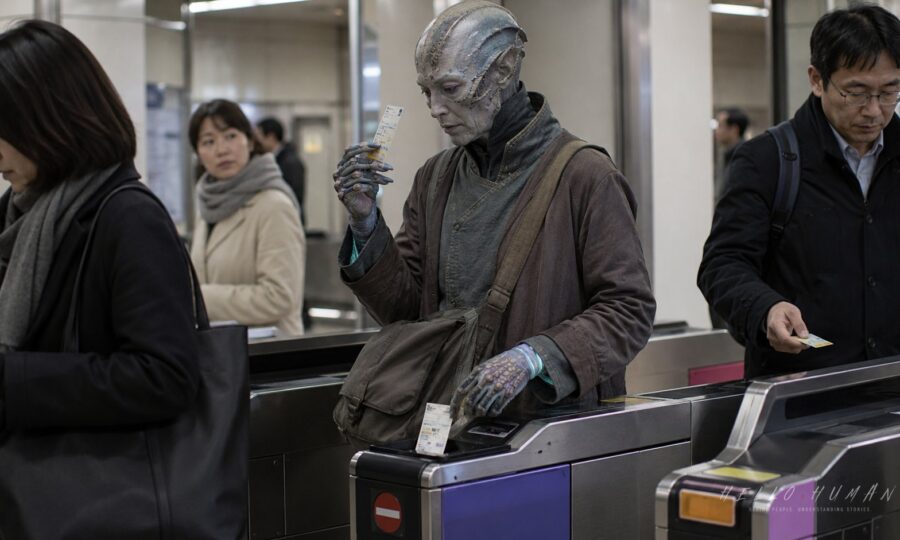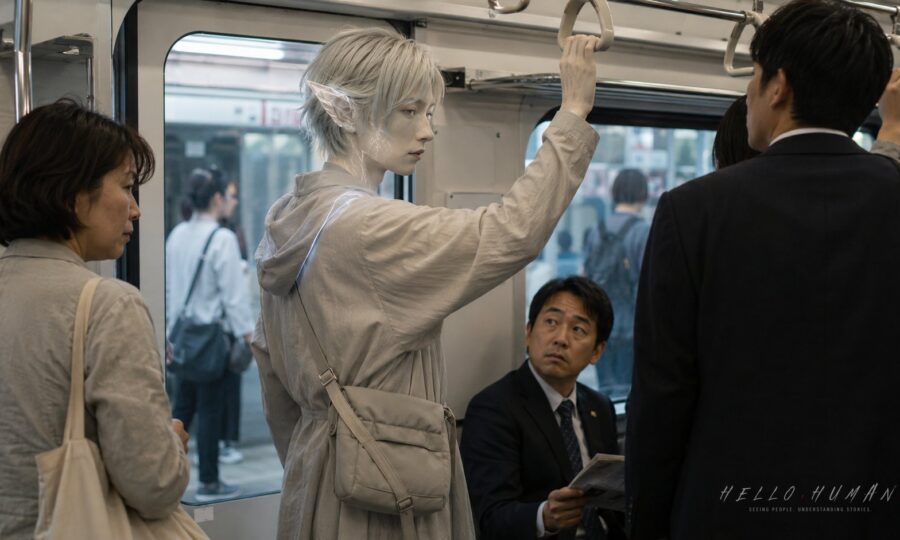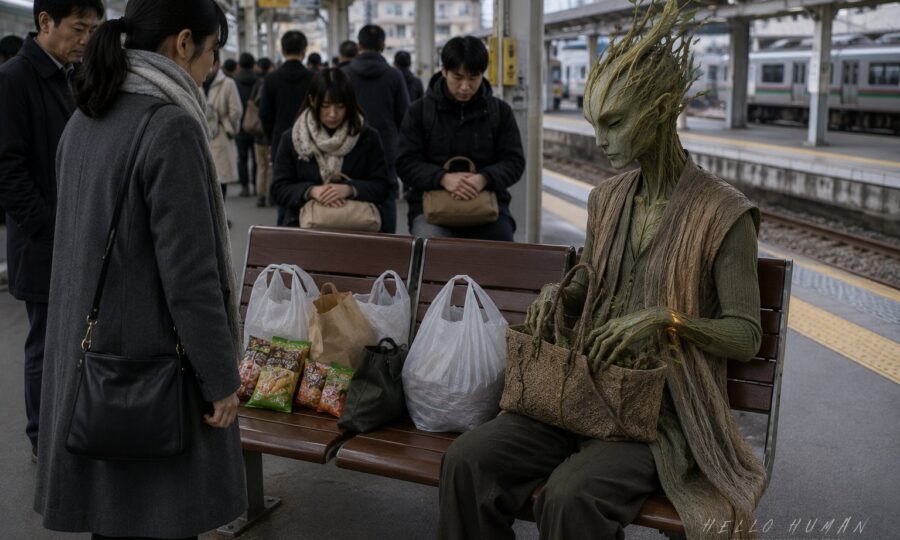
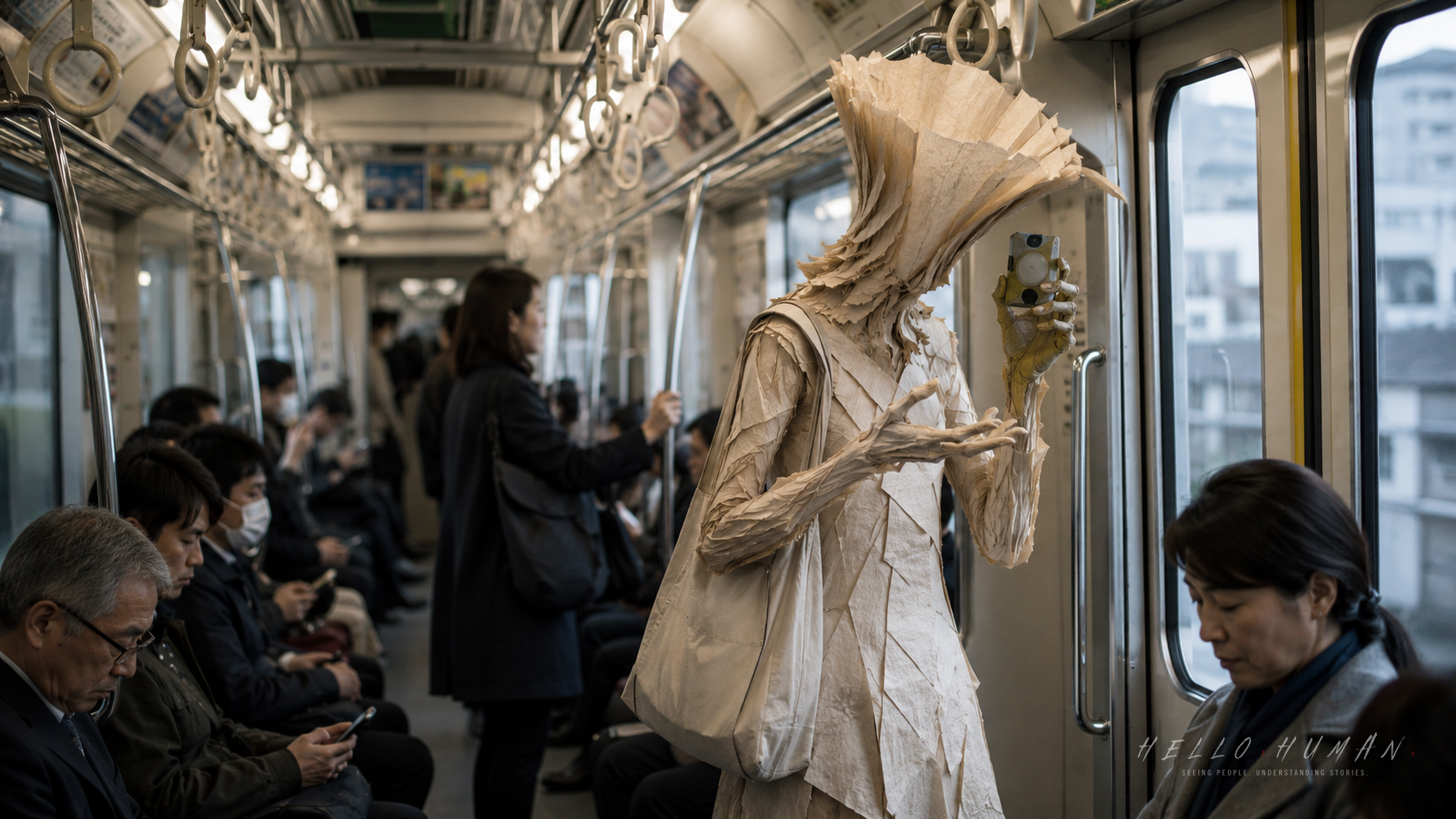
The train doors closed in Kobe with a soft chime, and the car settled into the low sound of rails, coat fabric, and phone screens being tapped without noise.
Noma stood beside the door, their washi-like skin tightening slightly under the fluorescent lights as they answered a question in a voice that reached every seat.
Observation 01The Moment Something Changed

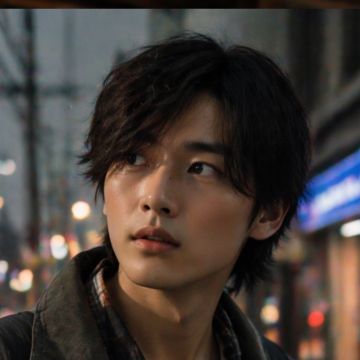
Noma had boarded with two station pamphlets and a folded transfer map held carefully between long, papery fingers. Their skin was not painted or masked. It was layered, fibrous, and faintly uneven at the edges, like handmade paper shaped into a breathing body.
The seats were mostly full. A school uniform shoulder leaned near the window. A man in a navy coat stood under the strap handles. A woman near the priority seats held her bag against her knees and looked down at her phone.
Noma turned toward a small companion device in their palm. The device clicked softly, and Noma replied at once.
“Yes, I have entered the moving room,” they said. “The humans are seated in rows. The doors make music.”
The words were not angry. They were not rude in intention. But they rose above the ordinary train silence, crossing the aisle, the straps, the advertisements, and the bowed heads of everyone trying not to become part of anyone else’s trip.
No one corrected Noma directly. The first reaction was the car becoming more still.
The loud voice stood out because the surrounding train sounds were controlled and low.
People’s attention shifted without their faces turning fully toward Noma.
Observation 02The Reactions No One Explained
The man in the navy coat lowered his phone by a few centimeters, then raised it again without unlocking it. His eyes did not meet Noma’s. They rested on the dark window behind Noma’s shoulder.
The woman near the priority seats adjusted her bag strap and turned her knees slightly inward. The movement made a little more space near the aisle, but it also made her body smaller.
A student standing near the door removed one earbud, listened for a moment, then put it back in. He looked at the floor markings instead of at Noma.
At the next station, two passengers entered and felt the shape of the car before choosing where to stand. One moved toward the far door, though there was room closer to Noma. The other held a strap and angled her face toward the window.
Noma continued speaking, but slower now. Their folded eyelids blinked with a soft paper crease. Under the fluorescent light, the fibers along their cheek and throat tightened, as if the air itself had become a little dry.
Passengers showed discomfort by reducing movement, avoiding eye contact, and choosing distance.
No one wanted to turn the train car into a public correction scene.
The quiet behavior of others became a contrast that made Noma’s volume easier to notice.
Observation 03What the Traveler Finally Understood
Noma looked around without turning their head too quickly. They noticed the sealed mouths, the lowered screens, the careful shoulders, and the way conversations, when they existed, stayed inside pairs of people.
Their companion device clicked again. Noma brought it closer to their chest, near the layered ribs beneath their paper skin.
“I will answer later,” they said, now barely louder than the train wheels. “This room is full of separate quiets.”
The device dimmed. Noma folded the transfer map smaller and placed both hands around it, keeping their elbows close. The fibers around their throat loosened, and their breathing became less audible.
At the next stop, the doors opened. People stepped out and in with the same careful rhythm as before. This time, Noma moved with the flow, silent beside the door, watching how much conversation could fit inside a glance.
Noma understood that quiet in a Japanese train car is not emptiness. It is shared privacy.
The correction came through stillness, distance, and the example of other passengers’ low volume.
On public transport, a voice can feel larger because everyone is close and few people can easily leave.
Practical Takeaway
Inside a train car in Japan, keep conversations low and avoid phone calls unless there is an urgent reason. If you need to speak, bring your voice close to the person beside you rather than letting it fill the car.
This matters because passengers are sharing a tight space while trying to preserve private time. A quiet voice helps people rest, read, commute, and avoid being pulled into someone else’s conversation.
Pay attention when nearby passengers become still, look down, angle away, move to another door, or make their own voices softer. Those small changes may mean your sound has become too large for the train car.