The clinic elevator opened with a soft chime, and everyone waiting outside made the same small calculation: who could enter without touching whom.
Rikka stepped in first, folded his narrow arms against his chest, and turned sideways so his back would take less room.
Observation 01The Moment Something Changed

The elevator was in a small medical building in Nagoya, the kind with a pharmacy on the first floor, a dental clinic above it, and a narrow lobby where people spoke softly even before they reached the reception desk.
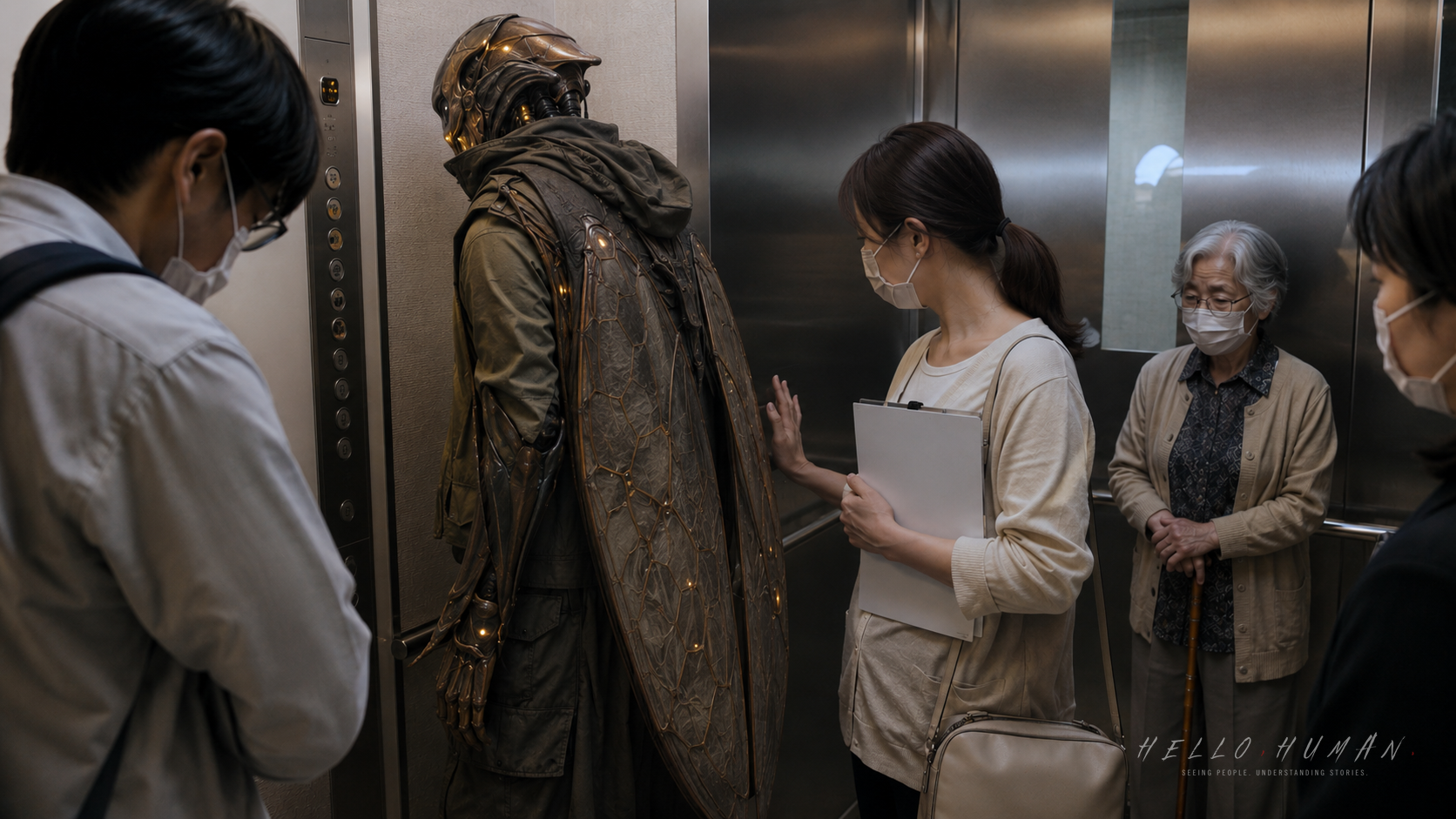
Rikka was a cicada-backed runner, built for heat and sudden distance. Dark amber plates covered his spine. A rib structure under his shirt clicked faintly when he breathed. Folded wing cases lay tight against his back, translucent at the edges but heavy where they joined the shell.
He had watched the Japanese patients wait in a loose order near the elevator door. No one crowded the entrance. No one rushed inside. When the doors opened, he copied their restraint and entered with a careful half-bow of his upper body.
Inside, he turned sideways to reduce his width. But his wing cases shifted with the turn. The outer edges slid over the elevator control panel, covering the row of buttons beside the door.
A woman holding a clinic folder stepped in after him. She lifted one hand toward the panel, stopped before touching his shell, and lowered her hand to the folder again.
Rikka’s intention was polite, but his body changed the shared layout of the elevator.
The blocked object was small: the control panel beside the door.
The first signal was a hand stopping in midair, not a spoken correction.
Observation 02The Reactions No One Explained
A man in a mask entered last and stood near the door seam. He looked at the panel, then looked down at the floor. His shoulder moved as if he might reach across, but he let the doors begin to close instead.
The woman with the folder pressed her thumb along the folder’s plastic edge. She glanced once at Rikka’s back plates, then toward the small gap between the plates and the wall. The gap was too narrow for a hand.
An elderly patient near the rear adjusted his cane and shifted closer to the corner handrail. He did not need the buttons himself. Still, he watched the panel with the steady attention of someone waiting for another person to solve a small difficulty.
The elevator did not move. No floor had been selected.
For one breath, the whole box became still. The machine waited. The passengers waited. Rikka waited with them, thinking the silence was part of the elevator’s order.
Then the masked man gave a tiny cough. Not a complaint. Barely a sound. The woman with the folder looked again at the hidden buttons, then away, as if giving Rikka one more chance to notice without being named.
Rikka’s back plates began to hum under the warm elevator light. On his home route, a stopped group meant danger ahead. Here, the danger was not ahead. It was behind him, under the edge of his own shell.
The passengers showed the problem by pausing, looking, and keeping their hands to themselves.
No one wanted to reach across Rikka’s body or touch his back plates without permission.
In a small elevator, silence can mean that a shared function is blocked.
Observation 03What the Traveler Finally Understood
Rikka turned his head slightly. One side eye, set low near the shell line, caught the reflection of the buttons in the elevator wall.
He saw the woman’s hand waiting near her folder. He saw the masked man’s body angled toward a panel he could not reach. He saw his own wing cases covering the place everyone needed and no one wanted to invade.
His correction came without words. He stepped half a pace forward, rotated his shoulders toward the back corner, and flattened the wing cases tight against his spine. The click in his ribs quieted.
The panel appeared again. The woman with the folder pressed her floor. The masked man leaned in just enough to press another button. The elderly patient relaxed his grip on the cane and faced the doors.
The elevator began moving. It felt almost too ordinary after the tension, but that was the point. The small room had returned to its usual agreement: bodies close, functions clear, no one forced to ask for access.
At the next floor, Rikka stepped out first and stood beside the wall until the others had passed. His wing cases stayed folded. This time, he watched not only how much space his body occupied, but which part of the room other people needed to use.
The useful correction was physical: step away, fold in, uncover the buttons.
The mood changed as soon as others could use the panel without crossing his body.
Rikka learned that shared space includes controls, handrails, exits, and the path to them.
Practical Takeaway
In a small Japanese elevator, avoid standing directly over the control panel unless you are ready to press buttons for others. Keep your bag, coat, shoulders, and body clear of the buttons, door edge, and handrails.
This matters because people may hesitate to ask you to move, especially in a quiet clinic, apartment building, hotel, or office elevator. They may choose silence rather than reaching across your body or interrupting the calm of the small space.
Pay attention when a hand stops before the panel, someone looks at the buttons but does not press them, or the elevator doors close without movement. The shared space may be blocked even if no one says so.