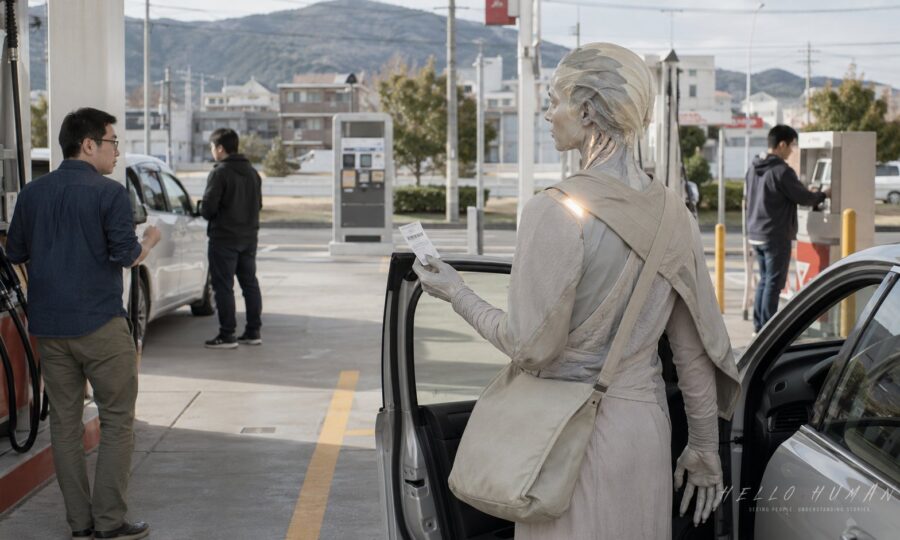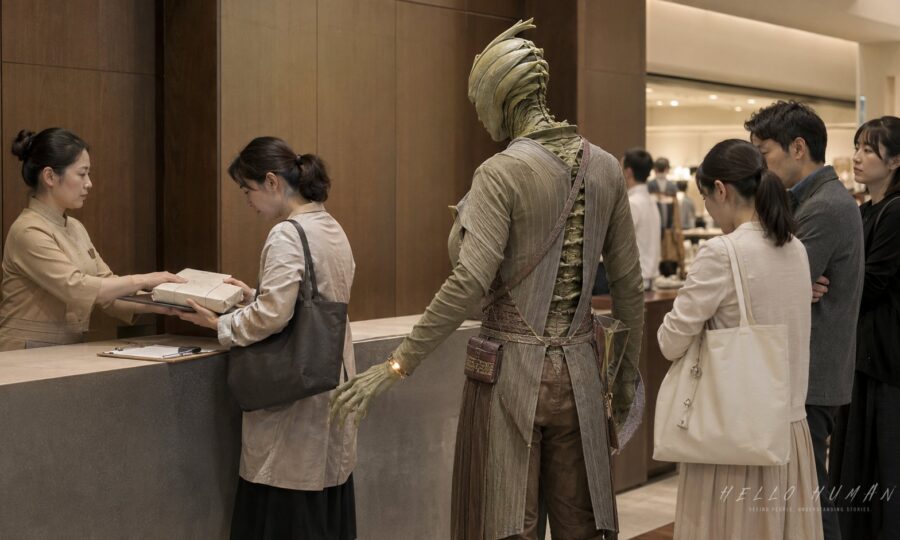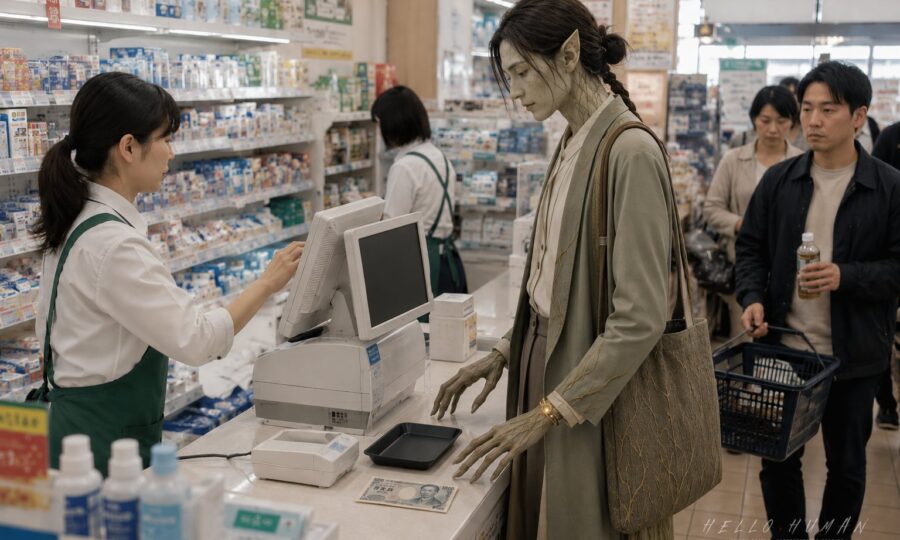
The convenience store shelf was only wide enough for one basket, one pair of hands, and a quiet decision about where to stand next.
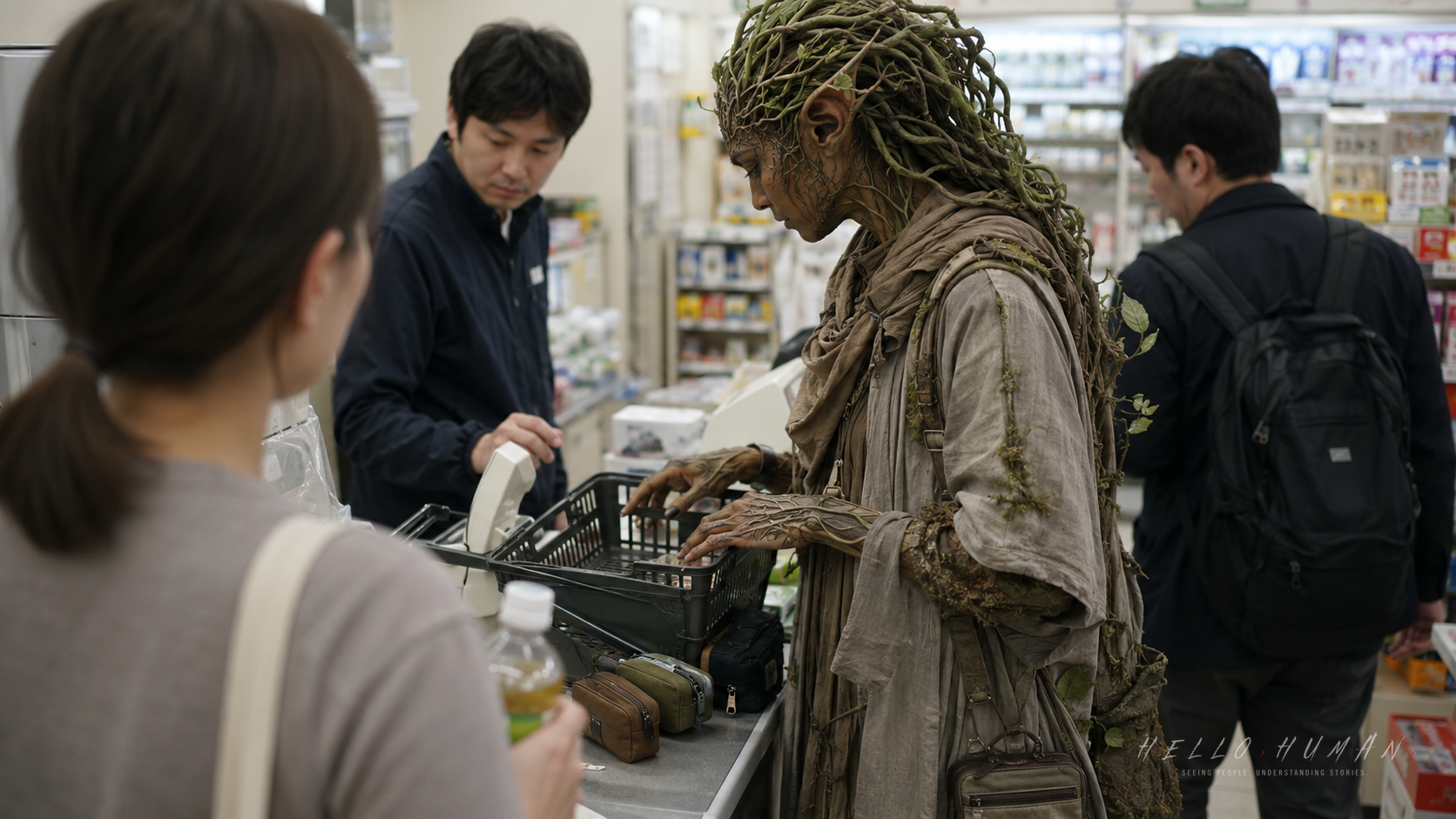
Soro placed his basket sideways across it, opened three damp travel pouches, and lowered his vine hair until the leaves brushed the edge of the counter.
Observation 01The Moment Something Changed

The lunch rush had thinned but not ended. Office workers still stepped in from the street, bought tea, rice balls, batteries, folded umbrellas, and left with the practiced rhythm of people who knew the store’s narrow paths.
Soro, a vine-haired listener from a dry-ringed moon, had paid correctly. He had used the tray. He had bowed when the clerk handed him the receipt. Nothing looked wrong until he moved half a step to the side.
At the small bagging shelf beside the cash register, he set his basket sideways instead of lengthwise. The basket covered a small floor marker near the shelf, and his soft brown vine hair drooped over the corner where the next customer would normally slide past.
Then he began sorting. One pouch for chilled things. One pouch for paper. One pouch for anything with a sharp wrapper. His long green-black fingers worked carefully, not slowly by his own sense of time, but too completely for the space.
The clerk’s hand paused above the scanner. The next customer, a woman with a single bottle of tea, shifted her weight and looked once at the open strip beside Soro’s shell-bark shoulder.
The mistake was not the payment. It happened after payment, when Soro treated the small shelf as a private packing table.
No one told him the shelf was part of the store’s flow.
The first change appeared as a pause at the register and a body angled away from the blocked path.
Observation 02The Reactions No One Explained
The woman with the tea did not step forward. She held the bottle closer to her coat and looked at the display of gum near the register, though her eyes did not seem to read anything there.
A man behind her turned his shoulders sideways, making a thin passage for another customer leaving the store. His paper bag tapped against his knee. He whispered something to the person with him, then both of them looked briefly toward the shelf.
The clerk continued scanning, but his movements became smaller. He placed the next customer’s receipt near the register instead of extending it fully across the counter, as if he did not want her to move into a space that was not clear yet.
Near the entrance, an elderly man with a cane chose the longer route around a snack display. He did not look at Soro directly. He only waited for the narrow aisle to loosen.
Soro noticed the silence first. His vine hair, rooted under the dark skin of his scalp, curled inward at the tips. On his world, quiet meant safety. In this Tokyo convenience store, the quiet had weight.
He looked down at his own careful arrangement: basket sideways, pouches open, receipt tucked under a wrist plate, one chilled drink still outside its pouch. It looked organized. Around it, everyone else had become less organized.
The Japanese customers did not correct Soro directly; they adjusted around him.
Their hesitation pointed to the blocked path more clearly than words would have.
When several people become smaller, slower, or sideways near one object, that object may be in the wrong place.
Observation 03What the Traveler Finally Understood
Soro closed two pouches without fastening them. He lifted the basket with both hands, rotated it lengthwise, and pulled it close to his body until the marker on the floor was visible again.
His shoulder plates folded inward with a faint dry click. The vine hair that had been brushing the shelf gathered against his neck, leaves pressed flat like hands trying not to touch anything.
The woman with the tea stepped forward immediately, not rushing, but with the relief of a path restored. The clerk handed her the receipt at the normal distance. The man behind her stopped standing sideways.
Soro did not finish sorting at the shelf. He slid the remaining items into one pouch, moved toward the window-side ledge, and tied the cords there, away from the register line. Only then did his breathing return to its slow leaflike pulse.
He had mistaken the end of his transaction for the end of everyone’s shared space. In that small Japanese store, the few seconds after payment still belonged to the queue, the clerk, and the next person trying to leave cleanly.
The correction happened physically first: basket turned, body folded in, path cleared.
The room relaxed without announcement because the blocked route had reopened.
Soro learned that the counter area continues to move even after his own payment is complete.
Practical Takeaway
After paying at a convenience store or small cash register in Japan, gather your items quickly, keep your basket lengthwise, and move away from the register-side shelf before doing detailed organizing.
The space beside the counter is often part of the next customer’s route, not just a place to pack. Leaving it clear helps the clerk keep the line moving and lets other customers pass without asking.
Pay attention when people pause near you, turn their shoulders sideways, glance at the shelf or floor, or choose a longer route around your belongings. Those small movements may be the room telling you where the flow is.