The station exit opened into a narrow Kyoto street, and the morning flow slipped through it like water finding the only available gap.
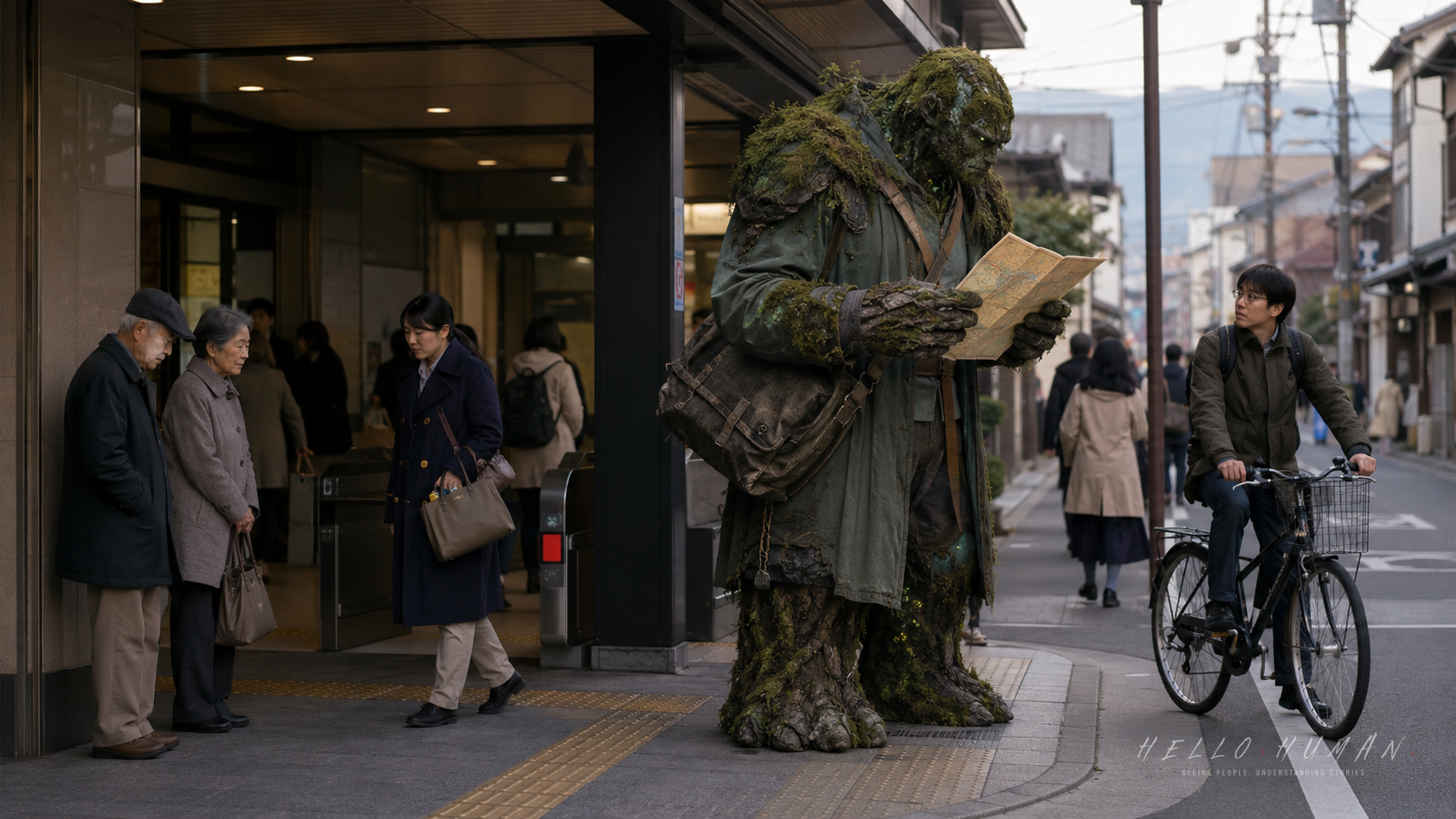
Goro stopped one step beyond the doorway, opened his folded map, and let his moss-covered shoulder fill the corner where the ticket-gate stream met the sidewalk.
Observation 01The Moment Something Changed

The exit was not crowded in a dramatic way. There were no raised voices, no pushing, no one rushing with a suitcase lifted too high. It was only steady: office workers from the ticket gates, an elderly couple from the stairs, a cyclist walking beside the curb.
Goro was a moss-coated giant, though he had learned to make himself smaller in human buildings. Moss grew naturally along his shoulder ridges, dark green near the neck and brown where the city air had dried it. His forearms were bark-dense and broad, with travel straps crossing them like vines tied around a tree.
He had waited until he was outside the station before opening his map. That seemed considerate. He had not blocked the ticket gate. He had not stopped on the stairs. He had even turned his back toward the wall.
But the wall curved inward beside the exit, and his body completed the curve. His shoulder and satchel narrowed the space where people leaving the station needed to turn onto the street.
A woman in a navy coat came out behind him, took one short step, and stopped before her bag touched the moss on his arm. She looked toward the open street, then down at the small patch of pavement between Goro and the curb.
The mistake was not checking the map; it was stopping at the exact corner where station flow became street flow.
Goro’s broad shoulder turned a narrow exit into a bottleneck.
The first reaction was a pedestrian shortening her step before choosing how to pass.
Observation 02The Reactions No One Explained
The woman in the navy coat passed sideways, turning her shoulders so her sleeve would not brush the moss. She did not look up at Goro’s face. Her eyes stayed on the pavement, reading the remaining space.
A man with a briefcase slowed behind her and pretended to check the strap of his bag. He gave the exit one more breath to clear, then slipped around Goro’s satchel with a smaller step than his walking rhythm wanted.
The elderly couple from the stairs did not enter the gap at all. They paused under the station roof, close enough to leave but not close enough to force a decision. The woman touched the man’s sleeve, and both of them waited as if watching for rain to ease.
A bicycle bell sounded once from the street, not sharp, only practical. The cyclist had stopped beside the curb because the pedestrians leaving the exit had spread outward around Goro.
Goro kept looking at the map. The paper was large enough to hide most of his chest. His moss compressed softly where passing air and cautious bodies narrowed around him. On his home path, a quiet crowd meant welcome shade. Here, the quiet had started to lean.
He noticed that no one stepped into the empty space in front of him. Instead, they used the less convenient spaces around him: the curb edge, the station wall, the pause under the roof.
The map showed streets, landmarks, and a temple gate three turns away. It did not show the living line he had interrupted by standing still.
The Japanese pedestrians reacted by making themselves thinner, slower, and less direct.
No one accused Goro of blocking the exit, but everyone treated the corner as blocked.
When people avoid the shortest path and curve around one body, that body may be standing in the flow.
Observation 03What the Traveler Finally Understood
Goro lowered the map just enough to see the elderly couple still under the roof. He saw the man with the briefcase already past him, adjusting his stride back to normal. He saw the woman in the navy coat glance once at the exit corner after passing it.
Then he looked at his own satchel. It hung over the exact gap where people needed to turn. His shoulder was not touching anyone, but it had taken the shape of the path.
His correction came before any apology. He folded the map in half, pressed his mossy shoulder closer to his body, and stepped away from the exit corner toward a vending machine alcove set back from the sidewalk.
The change was immediate. The elderly couple moved forward. The cyclist rolled past. Two students came out of the station and turned onto the street without breaking their conversation into silence.
Goro stood in the alcove and reopened the map with his elbows tucked. The moss along his shoulders loosened, no longer compressed by the invisible pressure of people passing around him.
He understood that in Japan, a quiet street can still be organized. The line may not be painted. The rule may not be spoken. But at station exits, store entrances, narrow sidewalks, and corners, movement itself shows where a visitor should not stop.
The correction was physical: fold the map, step into an alcove, and clear the turning path.
The flow returned as soon as pedestrians could leave the station without curving around him.
Goro learned to read not only signs and maps, but also the direction bodies were already moving.
Practical Takeaway
When you exit a station, store, restaurant, or narrow street in Japan, avoid stopping immediately at the doorway or corner. Step fully to the side, into an alcove, against a wide wall, or beyond the main stream before checking your phone, map, bag, or next route.
This matters because many Japanese pedestrian spaces rely on smooth, quiet flow rather than direct reminders. People may not ask you to move, especially if they can squeeze around you, but their silence does not mean the spot is easy for everyone.
Pay attention when people shorten their steps, turn their shoulders, wait behind you, or choose a curb-side route instead of walking straight. Those movements may be telling you that you have stopped where the path needs to turn.