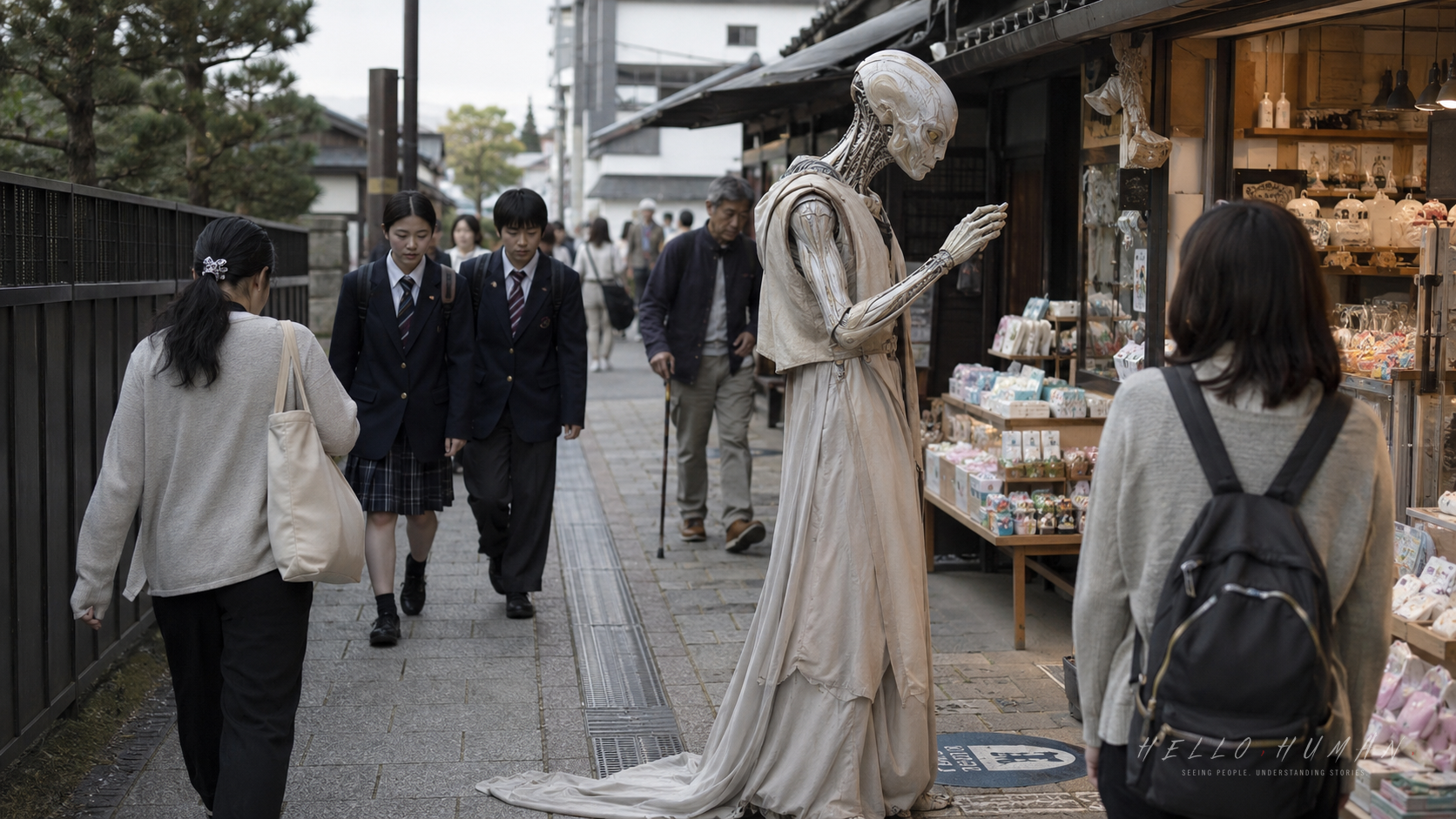
The sidewalk beside the small souvenir shops in Nara was only wide enough for two careful lines of people.
Ivo stopped in the middle of it.
Observation 01The Moment Something Changed

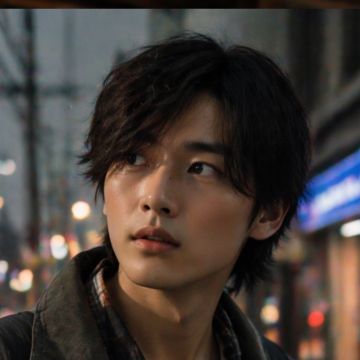
The street led away from a station exit toward a line of shops selling sweets, umbrellas, postcards, and small deer-shaped gifts. Bicycles passed slowly in the road. Pedestrians stayed close to the storefronts, moving in a narrow current between display stands and the curb.
Ivo walked with a quiet cataloging motion in his hands. Thin index-card bone plates layered his forearms, and tab-like ridges rose along the edges as if his body had been made to sort memory into sections.
He was not wearing labels or a costume. The pale plates grew under his skin, shifting when his wrists turned. His fingers moved in precise little counts, recording shape, color, price, distance, and direction.
When he saw a row of wrapped sweets in a glass case, he stopped at once. His body became still in the center of the sidewalk. One forearm lifted across his chest, and the raised tab ridges covered part of a ground direction marker near his feet.
The person behind him almost stopped against his back. She turned her shoulders just in time, stepped toward the curb, and passed without speaking. Her tote bag brushed the air near Ivo’s elbow, then swung back close to her body.
The mistake appeared as a sudden still point inside a moving path.
The first warning came from the person behind him changing direction quickly.
Ivo also hid a ground marker, making the walking lane less clear to others.
Observation 02The Reactions No One Explained
A man carrying a paper shopping bag slowed three steps behind Ivo. He looked at the shop window, then at the narrow strip of sidewalk left open, then chose the road edge for two careful steps before returning to the pedestrian side.
Two students approaching from the opposite direction shortened their conversation. One tucked her phone closer to her chest. The other tilted sideways, passing between Ivo and a display basket without touching either.
A shop clerk near the doorway paused with a tray of sample packages. She did not call out. She only drew the tray closer to her apron, leaving more room for people trying to squeeze past the display.
An older woman with a cane stopped before reaching the tightest point. She watched the movement around Ivo, waited for a small opening, and then crossed behind a younger couple who had already bent their path around him.
The line of people did not become loud. It thinned, curved, and repaired itself again and again. Each person made the same small calculation: do not bump, do not scold, do not stop the whole street if it can be avoided.
Ivo’s tab-like forearm ridges lifted slightly. His hand continued its counting motion, but slower now. The sweetness display still interested him, yet the motion around his body had become harder to ignore than the objects behind the glass.
Pedestrians reacted by bending their route instead of confronting the obstacle.
The blocked sidewalk created tiny delays that each person absorbed privately.
In a narrow street, stillness can become a shared problem even when the person standing still means no harm.
Observation 03What the Traveler Finally Understood
Ivo lowered his arm and looked down. The ground marker appeared from beneath his forearm ridge. It pointed along the sidewalk, not toward the window. The path had been telling people to continue while his body told them to stop.
He stepped toward the shopfront, then stepped again until his shoulder plates were nearly parallel with the wall. The correction was small, but the street felt different immediately. The center of the sidewalk opened.
The older woman with the cane passed first. She did not look at him directly. Her cane tapped once, then settled back into its steady rhythm.
Ivo folded his arms closer, flattening the lifted tabs along his forearms. The index-card plates made a dry, quiet sound as they settled. He kept looking at the sweets, but now from the edge, not from the flow.
The next group of pedestrians moved through without bending around him. A child pointed at the display, then stopped beside a parent only after both had stepped out of the walking line.
Ivo noticed that too. In Nara, the interesting thing could wait one step to the side. The street did not ask him to stop seeing. It asked him to stop where others could still pass.
Ivo’s correction was physical first: he uncovered the marker, moved to the wall side, and folded his body inward.
The people around him relaxed only after the walking path reopened.
The practical signal was not anger. It was the repeated curve of people trying to pass.
Practical Takeaway
On narrow streets in Japan, step fully to the side before stopping to check a map, take a photo, look at a shop display, answer a message, or decide where to go next. Avoid stopping in the center of a sidewalk, station exit path, shopping street, or crosswalk approach.
This keeps the walking flow easy for people behind you, especially older pedestrians, people carrying bags, parents with children, and cyclists passing nearby. A small sideways step can prevent several people from having to make silent detours.
Pay attention when people shorten their steps behind you, curve around your body, lower their shoulders to pass, or glance at the ground path near your feet. Those reactions often mean you have become the narrow point in the street.