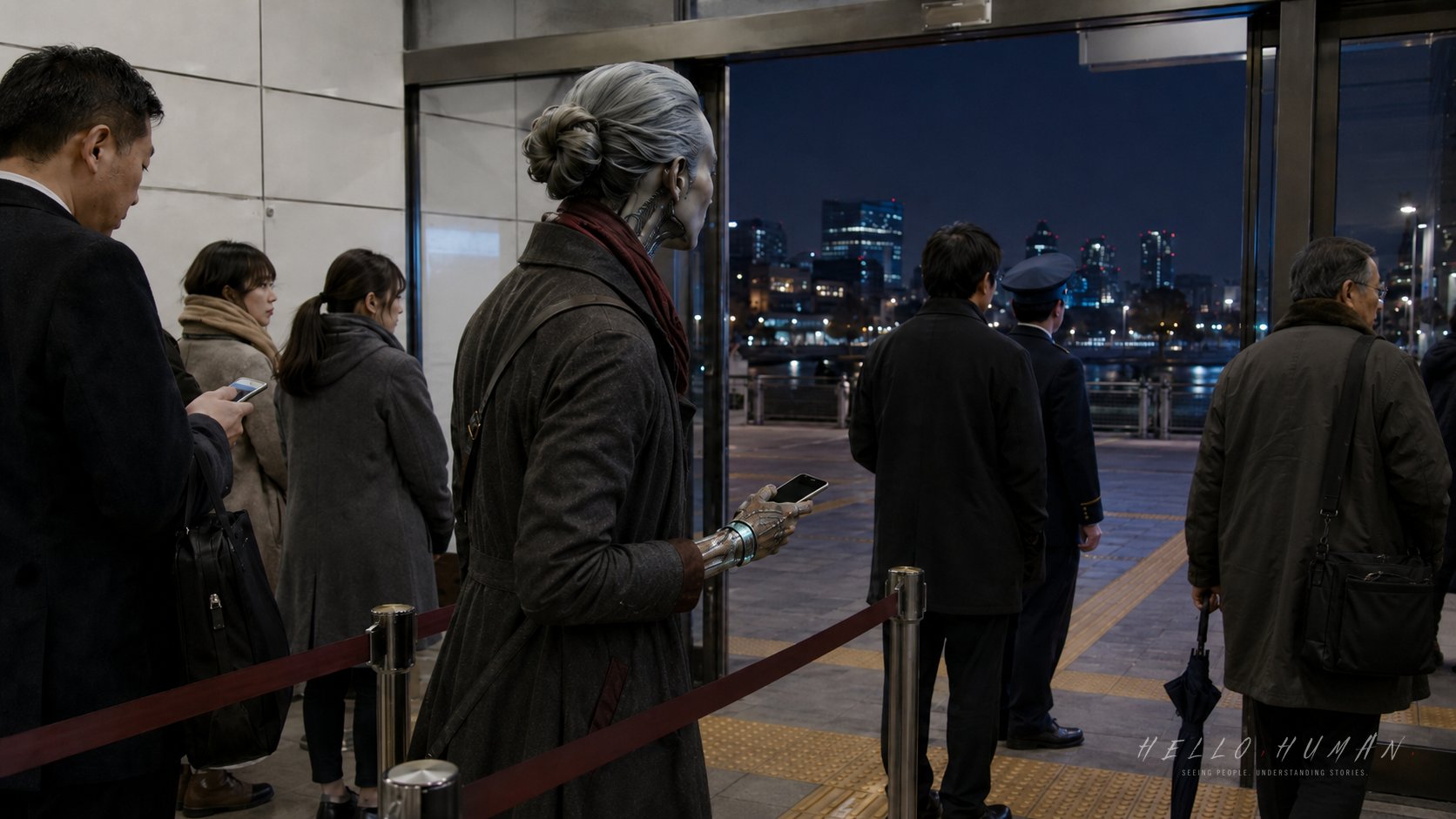
The station announcement area in Osaka was lightly busy, not crowded enough to push, but full enough for every hesitation to become visible.
Outside the glass doors, the year-end sky looked clean and dry above the station lights, while phones began to buzz one after another in coat pockets and gloved hands.
Observation 01The Moment Something Changed

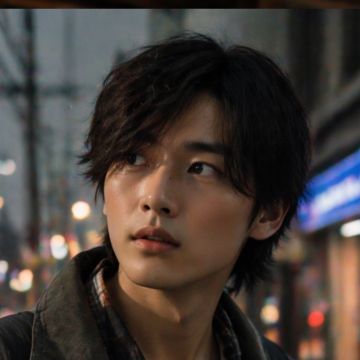
Orin’s phone trembled against the inside of his winter coat. The message opened with a sharp pattern of symbols and short lines of Japanese, followed by a map thumbnail that showed the river area beyond the station.
He looked up from the screen to the station exit. The air beyond the doors was clear. The pavement shone only with old cold, not rain. He could see the route he wanted: down the side street, past the vending machines, then onto the riverside path toward his lodging.
His wrists made a small internal adjustment. Beneath the cuff openings, tiny gear movement slowed and clicked once, quiet enough that only Orin felt it. Thin oxidized metal tendon lines along his fingers tightened around the phone.
The station announcement repeated overhead in a calm voice. A few people near the exit did not rush. That steadiness made Orin think the warning was informational, not immediate.
He put one foot toward the doors.
The mistake was not dramatic. He did not argue, run, or ignore a barricade. He simply trusted the clear sky above the station more than the warning on his phone, and began to move toward the riverside path as though visible weather were the final proof.
The visible cue was Orin turning his body toward the riverside exit after a phone warning, using the clear sky outside the station as his reason to continue.
The Japanese reaction began around him in small checks: phones lifted again, steps slowed, and attention moved from the open exit back to the announcement area.
Orin first understood only that people were hesitating, not yet that their hesitation was the practical response he had skipped.
Observation 02The Reactions No One Explained
A man in a dark overcoat near the ticket machines checked his phone, looked toward the exit, then checked the phone again. His mouth did not move. His briefcase shifted from his outer hand to the hand closer to the station interior.
Two women who had been standing by the doors angled their shoulders away from the glass. One pointed lightly at her own screen, not toward Orin, and both stepped back toward the brighter part of the concourse.
A station staff member near the announcement area paused with one hand near a small microphone, then looked toward the information display above the gates. He did not call out to Orin. His eyes moved once from Orin’s path to the line of people choosing not to leave that way.
An older commuter in a knit cap held his umbrella folded at his side, though there was no rain outside. He glanced toward the river direction, pressed his lips together, and turned toward a different exit corridor without speaking.
Orin noticed all of it as separate motions at first. A phone checked twice. A shoulder turning. A staff member’s eyes moving. A folded umbrella held ready under a dry sky.
Because no one sounded openly alarmed, he almost kept walking. In his own understanding, danger announced itself with visible force: smoke, water, shouting, a blocked path, a crowd running the other way. Here, the warning had produced something quieter and more coordinated. People were taking it seriously without performing fear.
The visible cue became a pattern: repeated phone checks, bodies turning back from the exit, and commuters choosing interior routes while the sky remained clear.
The Japanese reactions stayed indirect because the warning itself had already spoken; people did not need to dramatize it to make it real.
Orin began to see that calm behavior was not proof of low risk, but part of how the station kept risk from spreading into confusion.
Observation 03What the Traveler Finally Understood
Orin stopped with his foot still angled toward the glass doors. Then he brought it back beside the other one and turned his shoulders away from the riverside exit.
The movement was small, but it changed what he was asking of the space. He was no longer making other people silently decide whether to warn him. He was letting the warning, the announcement, and the local flow become enough.
He opened the phone again and reduced his plan to one immediate choice: stay under station cover and follow the people moving away from the river side. The soft copper glow inside his wrist seam dimmed as the internal gears resumed their calm, measured rhythm.
The staff member’s gaze passed over him once more, then moved on. The two women by the doors continued toward the concourse. The man with the briefcase fell into the same direction without hurry. Nothing congratulated Orin. The station simply stopped holding the extra tension of his wrong turn.
Only near the inner corridor did Orin understand the shape of the mistake. A disaster warning in Japan may point to a risk upstream, downhill, beyond the station district, or minutes ahead of what the eye can confirm. The sky above one exit is not the full situation.
At last-train timing, that matters even more. People are tired, routes are narrowing, and decisions become quick. The local signal may be a phone alert, a calm announcement, and a crowd that quietly stops treating the tempting shortcut as available.
The correction was physical first: Orin withdrew his step from the exit, turned away from the riverside path, and checked the warning again inside the station.
The Japanese reaction eased because the risky choice no longer required anyone nearby to intervene or carry concern for him silently.
Orin understood that safety signals in Japan can be calm, procedural, and indirect while still asking for immediate action.
Practical Takeaway
When your phone gives a disaster or weather warning in Japan, stop and check your route before continuing, especially near rivers, slopes, underground passages, coastal areas, or unfamiliar exits. Do not rely only on the sky above you or the absence of visible panic.
This matters socially because safety decisions are shared in public flow. When people quietly change direction, wait inside, check phones again, or follow announcements, they are helping the whole space reduce risk without creating confusion.
Pay attention at station exits, announcement areas, last-train timing, year-end travel, and moments when nearby Japanese commuters slow down without saying much. A calm crowd may still be responding to urgent information you have not fully understood yet.