The wind moved the glass doors of the Osaka mobile carrier shop every time someone entered from the underground passage.
At the counter, folders lay flat, number tickets blinked softly, and two visitors waited with documents held close to their laps.
Observation 01The Moment Something Changed


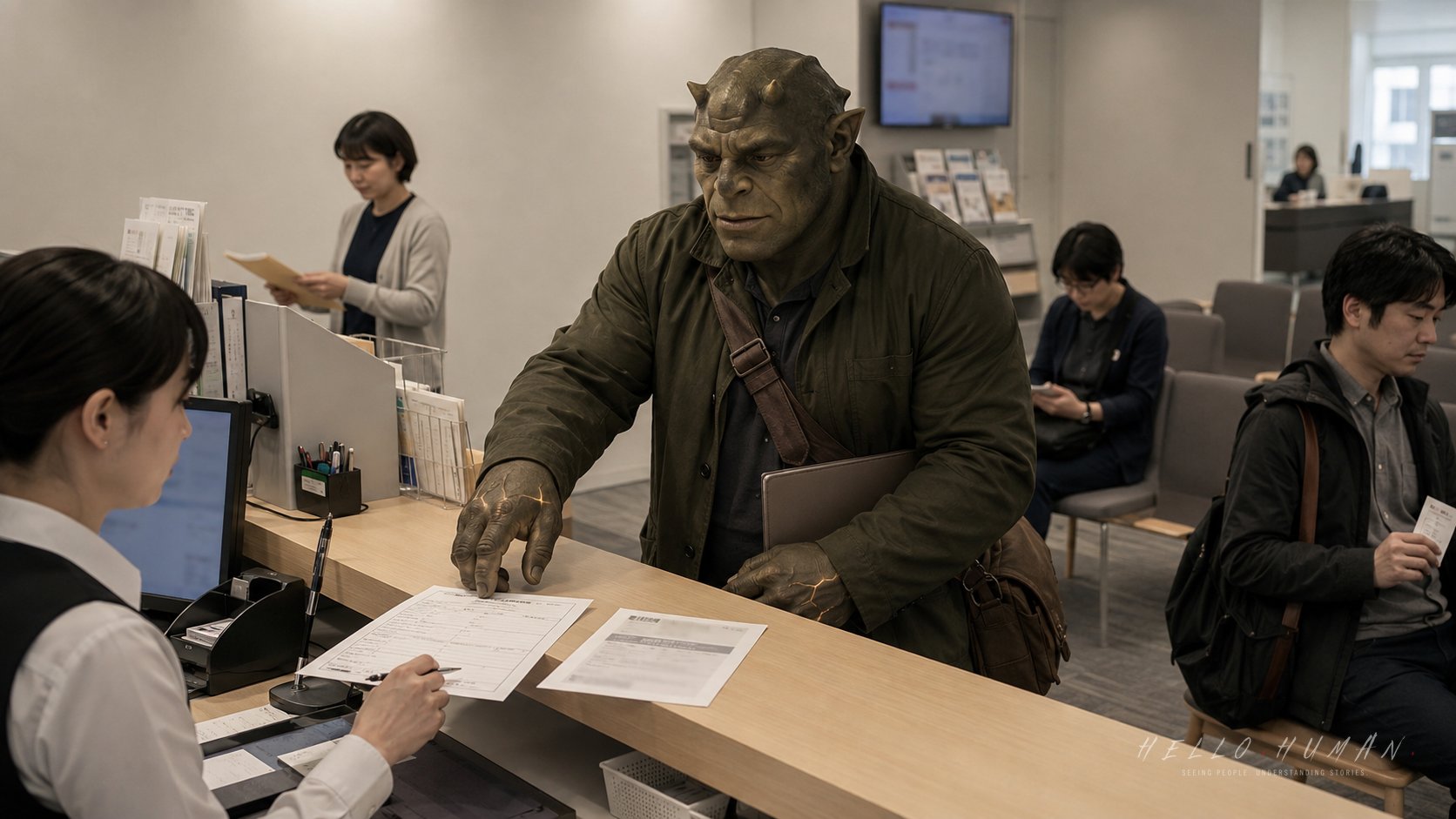
Doma sat low in the chair, careful not to let his compact shoulders crowd the small counter space. His muted clay skin deepened toward olive-gray at the neck, and small brow hornlets sat naturally in the broad calm structure of his face.
He had come with a folder of departure papers, a residence card copy, and the phone bill that would be charged automatically at the end of the month. Everything looked arranged, responsible, almost complete.
The clerk placed a cancellation form between them and explained the final steps in a gentle voice. Doma nodded, his wide palms resting low on the counter to keep his size from feeling too heavy in the quiet room.
Then he tapped the printed billing line with one careful finger. The last month would be paid by automatic withdrawal, he understood. So he slid the cancellation form back toward the clerk without signing the final section, as if the payment itself would carry the contract to its end.
The clerk’s pen stopped above the paper. It did not drop. It did not point sharply. It simply hovered, a small dark line suspended over the blank signature box.
The visible cue is the unfinished cancellation form being pushed back while the automatic payment line remains treated as the final step.
The Japanese reaction begins with the clerk’s pen pausing above the form instead of an immediate correction.
Doma notices the counter becoming still, but he has not yet understood that payment and cancellation are different actions.
Observation 02The Reactions No One Explained
The clerk looked once at the departure date, then at the unsigned box. Her smile stayed professional, but her hand did not move to take the form away.
The visitor seated nearest the pamphlet stand lowered his eyes to his own papers. He turned one page without reading it, then kept the stack still on his knees.
A woman waiting by the window shifted her number ticket from one hand to the other. She glanced toward the counter only briefly, then angled her shoulders away as if giving the conversation a little more privacy.
Behind the clerk, another staff member slowed while sorting SIM card envelopes. He did not interrupt. His gaze touched the form, the bill, and Doma’s folder, then returned to the envelopes with extra care.
Doma felt the change before he understood it. The ochre seams across his knuckles dulled, a quiet body-bound response when nearby people lowered their eyes. He had meant to leave no burden behind. The final charge would be paid. The account would not be unpaid, abandoned, or ignored.
But the clerk’s hand still waited above the same place on the paper. The bill showed money leaving. The blank box showed the contract staying.
The visible cue repeats through the paperwork: the final payment line is complete, but the cancellation section is not.
The Japanese reactions appear as lowered eyes, angled shoulders, slowed staff movement, and attention kept politely away from Doma’s face.
Doma begins to sense that the silence is not doubt about his honesty; it is concern about an unfinished procedure.
Observation 03What the Traveler Finally Understood
Doma stopped explaining the automatic payment. He drew the form back toward himself with both hands, slowly enough for the movement to read as a correction rather than impatience.
He placed the bill to the side and centered the cancellation form in front of him. His broad palms flattened near the lower edge of the paper, careful, low, and no longer pushing it away.
The clerk’s pen moved again. She pointed to the blank section with a small tilt, and Doma filled in the departure date, the cancellation request, and the signature line. The action came before the apology.
Only after he had completed the form did he look up and lower his head. The clerk’s shoulders softened. The staff member behind her resumed sorting envelopes at a normal pace. The visitor by the window checked her number ticket again, and the room returned to its quiet rhythm.
Doma understood then that automatic payment was not a farewell. It was only a way for money to move. The contract itself needed a visible ending, a recorded request that could be handled before he left Japan and became hard to reach.
The mistake had not been carelessness. It had been treating time as if it would close the matter by itself. At the counter, time needed a form, a date, and a clear instruction.
The visible correction is physical first: Doma pulls the unfinished form back, separates it from the bill, and completes the cancellation section.
The Japanese reaction changes from suspended waiting to resumed counter flow once the procedure has a clear ending.
Doma learns that paying the final month and canceling the contract are connected, but they are not the same step.
Practical Takeaway
Before leaving Japan, treat phone contract cancellation as its own procedure. Visit the carrier counter or confirmed cancellation channel, complete the required form, check the final service date, and keep any receipt or confirmation.
This matters because automatic payment only settles charges. It does not always tell the company that the contract should end, and leaving the account active can create later bills, notices, or contact problems after departure.
Pay attention when a clerk pauses over a form, looks again at a blank box, separates a bill from a contract document, or waits instead of closing the folder. Those quiet signals often mean the procedure is not finished yet.