The last train was close enough that the hotel bath had become careful instead of empty.
Steam moved low over the tiled floor in Kyoto, and the small washing stools made a neat row beside the handheld showers.
Observation 01The Moment Something Changed

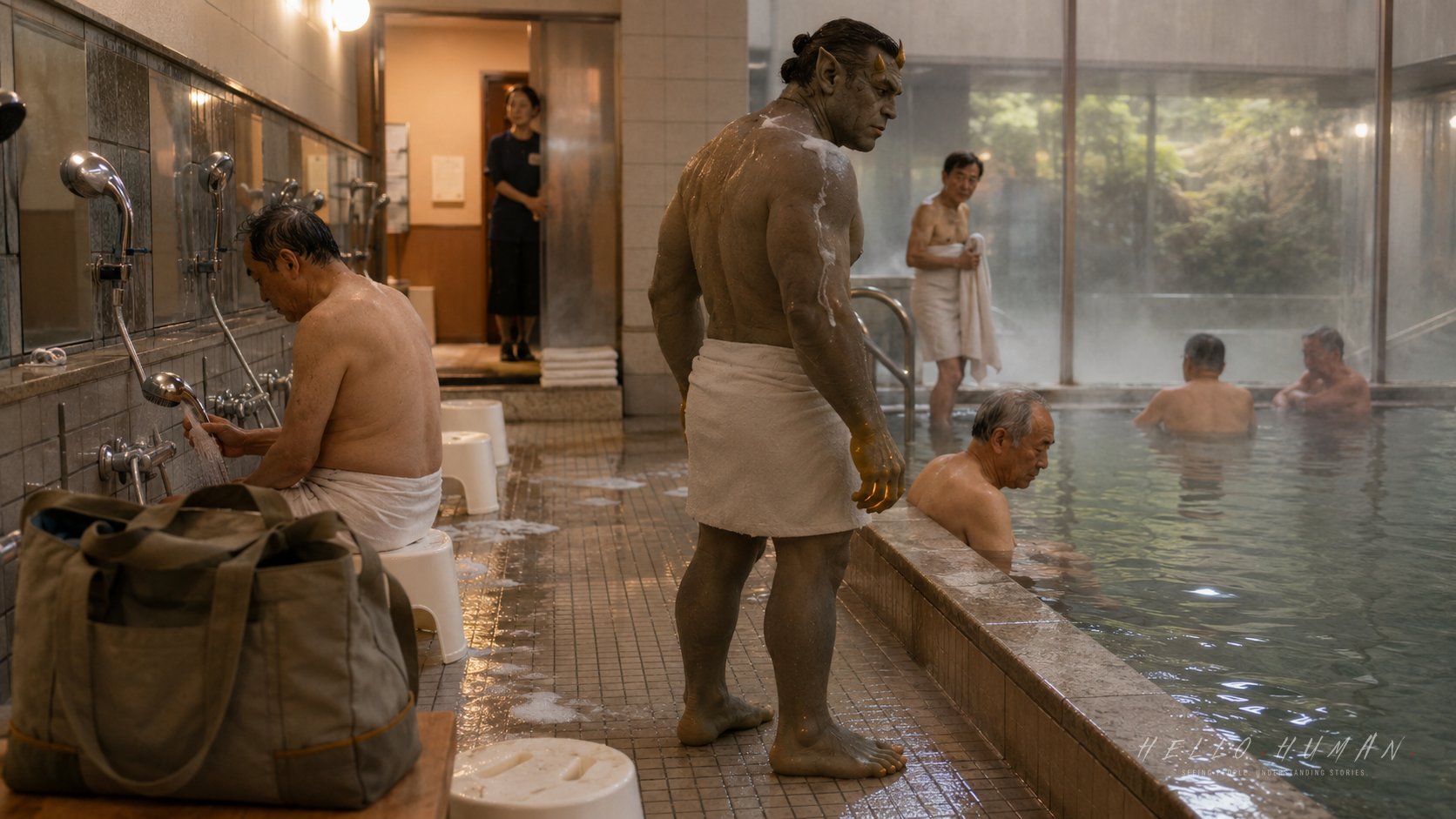
Mado sat low on the bath stool, trying to copy the quiet rhythm around him. His clay-olive shoulders were compact and grounded, his small brow hornlets softened by steam, his wide palms kept close so they would not seem too forceful in the narrow space.
At the changing shelf outside, his dense clay-toned tote hung by a wide strap designed to distribute weight without emphasizing his strength. A folded travel shirt with a broad collar cut below the hornlets waited beside it, the low shoulder seams reinforced and darkened slightly with ochre pressure marks.
Inside the washing area, he worked quickly. The hotel had been full of year-end guests, and the hour made him feel he was borrowing time. He rinsed his arms, his chest, and the warm shadowed brow line where a faint body-bound ochre glow sat along the knuckle seams of his hands.
Then he stood. A thin run of soap still clung near one shoulder and slid toward his elbow. Small foam marks remained beside the low stool, close to the shower bucket.
Mado stepped toward the bath. His movement was not dramatic. It was only one quiet step away from the washing area before the rinse was complete.
A seated Japanese bather beside him turned his shower head downward. The water hit the floor more softly. Another man near the bath edge paused with a folded towel in both hands, his eyes lowering toward Mado’s arm and then toward the shared water.
The visible cue was a body moving away from the stool while traces of soap still remained on the skin and tile.
The Japanese reaction was indirect: a shower head turned down, a towel stopped mid-fold, and attention shifted toward the bathwater instead of toward Mado’s face.
Mado first sensed that the room had not become angry, but it had become carefully still around his next step.
Observation 02The Reactions No One Explained
The first bather did not say anything. He simply angled his shoulders back toward his own mirror and rinsed the floor in front of his stool again, although that area was already clean.
The man with the towel took half a step away from the bath edge. He did not block Mado. He created a little space between his own body and the water, as if giving the moment room to correct itself.
An older guest at the far stool lowered his gaze and reached for his shower handle. He rinsed one forearm with slow, repeated passes, making the motion visible without turning it into instruction.
The attendant near the entrance glanced once toward the washing row, then toward the bath surface. Her hand rested on the stack of clean mats. She did not approach, but the small pause made the room feel even quieter.
Mado stood with one foot between the stool row and the bath. In his own public baths, water moved through multiple chambers, and the first pool often completed what the washing station began. Here, the still shared water seemed to be waiting for a cleaner boundary.
The ochre seams along his knuckles dulled when the nearby bathers lowered their eyes. His wide palms dropped closer to his sides. The strength in his shoulders, usually softened by posture, suddenly felt too large for the narrow tiled path.
The visible cue repeated through other bodies: people rinsed slowly, kept towels still, and stayed with the washing stools before turning toward the bath.
The Japanese reactions formed a quiet pattern: lowered eyes, angled shoulders, extra rinsing, and small spacing changes all pointed back to the unfinished wash.
Mado began to understand that the bath was not the place where cleaning began; it was the place everyone entered after cleaning had already been completed.
Observation 03What the Traveler Finally Understood
Mado did not speak across the room. He looked once at the bath surface, then back at his own arm. The foam line had thinned, but it was still there.
He turned around and returned to the low stool. The correction came through the body first: he sat again, took the shower head with both hands, and rinsed from brow to shoulder, shoulder to elbow, palm to fingertip.
He rinsed the stool next. Then the floor. The small foam marks broke apart and disappeared into the drain. His wide palms stayed low and careful, less like tools for strength and more like instruments for not disturbing anyone.
The first bather’s shower returned to its normal angle. The man near the bath edge unfolded his towel and stepped closer again. The attendant’s hand left the clean mats, and the room resumed its small late-night sounds.
Only then did Mado approach the bath. This time, his skin was clear of soap, the stool area was rinsed, and the path between washing and soaking had been made visible.
The meaning settled without a speech. In this Japanese shared bath, the hot water was not a private rinse. It was a common place already prepared by everyone’s washing. Entering it too soon did not look careless because of the body itself; it looked careless because the shared water had been asked to finish a private task.
The visible correction was simple: Mado went back to the stool, rinsed his body fully, and cleared the soap from the tile before approaching the bath again.
The Japanese response shifted through small releases: shower angles returned, towels moved again, and the quiet became ordinary rather than strained.
Mado understood that the washing area was not a preliminary gesture; it was the boundary that kept the shared bath comfortable for everyone.
Practical Takeaway
Before entering a shared bath in Japan, sit at the washing area, wash thoroughly, rinse all soap from your body, and rinse the stool and floor area you used. Step toward the bath only after your skin and the nearby tile are clear.
This matters socially because the bathwater is shared for soaking, not for finishing a wash. A clean entry protects the comfort of people already in the bath and lets everyone trust the same water without needing to speak up.
Pay attention when the room grows quiet around the washing stools, when someone lowers a shower head, pauses with a towel, or looks toward the bathwater instead of at you. In Japan, those small pauses often carry the correction before anyone says it aloud.